
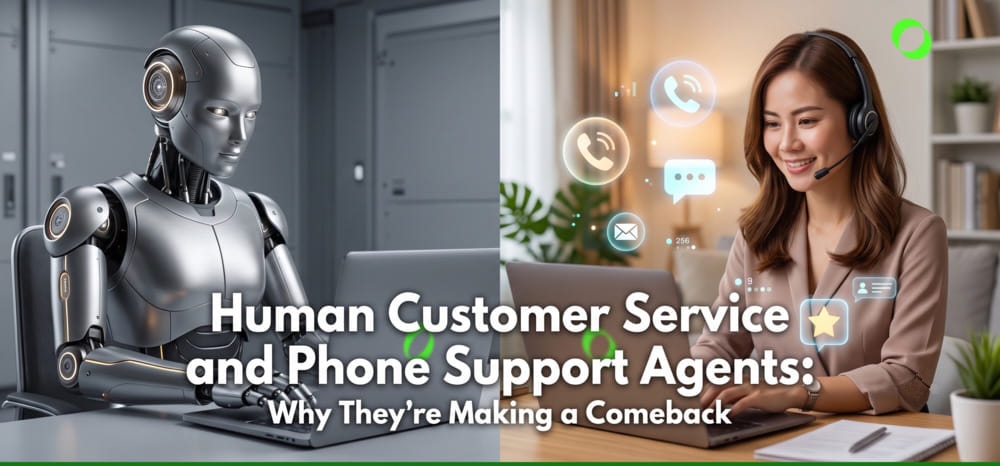
Will AI replace customer service jobs?
AI is unlikely to replace customer service jobs entirely. Instead, AI can take over routine questions, basic information gathering, and other repetitive support tasks, while human agents handle complex problems, frustrated customers, and conversations that require empathy and judgment. In fact, Gartner reported that 95% of surveyed customer service leaders planned to retain human agents while deciding where AI should be used. Human customer service jobs are changing, but the human voice still has a place in customer care.
A customer support call handled by phone support agents follows a spiel. Most of the time. But customer care specialists who truly understand empathetic, sincere communication also understand that these are at the very heart of customer experience.
Then, there was, and is… A.I.
We won’t introduce that sentence with an “In the age of Artificial Intelligence…” You already know how industries are responding to this once-unfamiliar technology that’s now permeated our day-to-day lives and businesses.
Should customer service be among those that are dominated by bots, when bots are being trained to answer the way humans do, more and more?
Do your customers mind, if at all?
Are they more concerned about products and services, with zero care or interest in who or what they’re talking to?
Should you replace your outsourced customer service team with customer support bot agents?
In This Blog:
- ➤Will AI replace customer service jobs?
- ➤Are People Tired of Chatbots?
- ➤What Are the Problems That Chatbots Can’t Solve?
- ➤Why Good Customer Service Requires Real Human Voices
- ➤How the Best Support Teams Split the Work Between AI and Humans
- ➤Getting a Remote Phone Support Agent Running Right
- ➤FAQs
- ➤When Someone Needs Someone (And in Any Business, That’s Always)
Why Do Customers Prefer Human Phone Support Over Chatbots?
Are people tired of chatbots?
The answer to human customer service vs automated customer service needs breaking apart: there’s a reason customers still pick up the phone, and the fatigue is real. Chatbot fatigue, that is.
Many customers will try the easier routes first: a chatbot, a scroll-through of an FAQ page. For most “first few” questions, anyway. After that, they’ll want to talk to a human.
Interestingly, customer surveys revealed that 55% of customers expect (and indeed, they’re met) their first queries to be answered by chatbots.
In fact, studies astound more, with data revealing that 80% of initial queries are answered by A.I.
When the answer still hasn’t come, then the phone call steps up to steer. And it’s not always as straightforward as the answer still not being presented by the bot. Something we’ll unknot below.
Why is human customer service important?
key takeaway//Quick Answer
Human customer service phone support remains the highest-converting customer retention channel for B2B and US e-commerce brands, resolving complex support tickets 3x faster than automated chatbots. While AI handles repetitive requests, live human voice support provides empathy and immediate problem resolution for important account inquiries. US businesses are growing human phone support sustainably by pairing automated IVR tools with dedicated offshore voice specialists, cutting operational payroll by 60–70% without degrading service quality.
When Do Customers Prefer Voice Agents?
It could be that the customer’s problem isn’t in any of the prompted options. It could be that the whole thing needs to be explained in one go, and not in a series of questions and answers.
Then comes the phone call, usually when the answer still hasn’t hit the spot, the problem doesn’t fit the options, or somebody needs to explain the whole thing to another human (even if the bot already did exactly that).
“
Gartner reported in 2025 that 36% of customers said phone was their primary channel for service interactions.
Customer Service & Support Report
…but it’s coming back, and growing.
Phone isn’t exactly the most popular channel in customer care, as past data shows. Live chat’s ahead of phone, even, based on average CSAT. 87% for the former, and 76% for the latter.
But look at what reaches human phone support for businesses – not the easy questions, and not the customers who’re still in a good mood.
Often, they’re the customers who are past frustrated. The ones worried about a charge and are trying to cancel something. The ones who are tired of explaining themselves to a machine.
Automation is built to handle volume, and yet a human is still needed when both the human on the other end and the relationship in between needs cultivating and supporting.
What Are the Problems That Chatbots Can’t Solve?
1. When Questions Aren’t So Predictable
Before we hop onto the “what can’t,” let’s skim through when automated tools are useful – usually when the questions are predictable:
“Where’s my order?” or the other version of it, “What happened to my order?”
“How do I reset my password?”
“What are your hours?”
“How do I get my refund?”
Not merely single questions either. Maybe second, third questions that trail behind what initiated the first bot-customer dialogue:
“When will my order be delivered?”
“Can I still change the delivery address?”
“Why hasn’t it shipped yet?”
Once the question opens to something that needs spontaneity and quick-thinking, flexible judgment, and when prompts answer only half of it, the conversation will have to be mediated by a human phone support agent.
2. No Empathy Under Pressure
A system can be trained to identify certain words or phrases and “tell” if a customer sounds angry. It can classify the sentiment as negative and generate a response that contains polite words and empathy or validation statements.
Calming someone down? It requires empathy. The more genuine, the more it goes through and reaches the customer’s raised shield. Repeating “I understand your frustration” and other similar prompts? Does anyone really think this helps calm customers down and appease their frustration?
A good customer churn phone support agent hears the pauses and the sighs. The change in someone’s voice, or the moment when they stop asking for an answer and just mumble their disappointment.
Zendesk’s customer service guidance makes the same point about empathy:
“
Technical knowledge alone doesn’t carry a difficult interaction when emotions are already running high.
Customer Service Guidance Report
3. When the Answer Isn’t So Simple
Bots work best when issues fit neatly into the box provided, but real customers can’t be put in a box. Nor are their frustrations always tidily confined in a single problem statement.
Billing issues can also be cancellation issues. Deliveries can, after further digging, have something to do with an account problem.
Then comes the repetition. The dreaded, hair-pulling repetition:
“Please explain your issue.”
“Please explain your issue.”
“Have I resolved your concern?”
“Please go back to the main menu.”
By the time a person finally answers, the customer’s wallowing through and reliving the whole frustrating journey in their head.
4. When Self-Service Is More-Work Service
Self-service is supposed to ease customer service mediation and make the experience more seamless. If it works. Because when it doesn’t, it moves the scenario elsewhere and multiplies.
A customer gets bounced between automated options. They start from the beginning each time, or they keep repeating the same information, then reach an agent who has to untangle the entire history anyway, and get to where the conversation erupted.
Not the ideal experience. Definitely a button that, with one more push or another, ruins your relationship with customers.
Related Read: Here’s what’s happening in the realm of AI Chatbot vs Human Live Chat Support.
Why Good Customer Service Requires Real Human Voices

Here are five things a human voice can do that can change the course of a difficult conversation (it goes beyond customer service phone etiquette):
1. Calming the Caller Down
Tone matters. So does pacing. So does knowing when to stop talking and let the customer finish.
A trained phone specialist can adjust in real time instead of waiting for a customer to select the right sentiment option.
2. Solving It in One Call Instead of Five Emails
Some problems, simple or complex, make more sense spoken aloud. A specialist can ask a question, hear the answer, ask another question, check the account, and work toward a resolution in the same conversation.
That can turn what might have become several rounds of emailing into one actual conversation.
3. Saving the Customer You Were About to Lose
Billing disputes, cancellations, and service problems are rarely only about the transaction itself.
Imagine a customer calls a subscription company because they were charged twice. They’re ready to cancel. The agent checks the account, finds the duplicate charge, explains what happened, and gets the correction moving before the call ends.
Sometimes the phone call is the last chance to keep the customer.
4. Reaching Customers Who Don’t Want a Chatbot
Not everyone wants to spell out a support problem over chat, line by line. There are customers who’d rather explain the situation in their own spoken words, especially when the issue’s intricate, or they’ve tried finding the answer themselves, to no avail.
Give them that option.
5. “Hearing” What Your Customers “Think”
A customer may never write in a survey that your checkout process is confusing. They might tell your live phone support virtual assistant, though.
Phone conversations can uncover hesitation, complaints, and little pieces of feedback that don’t find the right questions in a survey response. The right voice customer service agents know how to listen and unpack what customers are really saying and really thinking.
Related Read: Here’s a complete guide to Customer Service Outsourcing.
How the Best Support Teams Split the Work Between AI and Humans
This doesn’t mean throwing AI out the window. It’s “Augmention.”
There are plenty of support jobs that automation handles perfectly well:
- Order tracking and status updates
- Repeat questions with straightforward answers
- Initial sorting and routing
- Collecting basic information before a customer reaches an agent
Then there are the calls where a person should take over:
- A customer is angry, confused, or asking for a manager
- The issue has several moving parts
- The request doesn’t fit the usual process
- The customer is discussing cancellation or a high-value account
- A decision needs actual judgment
Gartner’s current research points toward a similar direction:
“
Despite the push toward AI-driven service, 95% of surveyed customer service leaders said they planned to retain human agents and define where AI should be used.
Customer Service Survey
Tip: If AI has already collected the order details and reason for the call, give that information to the specialist before the bot rolls out spiels for the customer. No need to let the human specialist start from scratch.
Related Read: Here are Five Ways a Virtual Assistant Can Improve Customer Service.
Getting The Right Remote Phone Support Agents
Hiring phone support agents? Not that difficult. Finding the right one – the one who can adapt to your brand voice, the one who has the skill and experience to genuinely build a connection with customers enough to keep them on the line and put their shields down? Finding that specialist?
Not so easy.
But with Remote Staff, we make it easy for you. We’ve been doing it for over 18 years, sourcing and screening dedicated outsourced call center phone support specialists for US businesses, including remote professionals with experience handling voice-based customer interactions.
We learn about your business story and pair you with the customer care agents who have the skill and ability to echo your brand and vision. In every conversation.
You won’t have to pool candidates yourself, and onboarding, payroll, HR, and ongoing support are on us.
FAQs
Can a remote phone agent really sound like part of my own team?
Yes, provided you actually train them like part of the team. Give them your product information, brand tone, customer scenarios, and escalation rules, then let them get familiar with the business rather than handing them a generic script.
Does phone support need to be US based to work well?
No. Geography alone doesn’t determine whether someone can handle a customer call well. English fluency, communication skills, product knowledge, and proper training matter far more to the conversation itself.
How much does a dedicated remote phone agent cost compared to a local hire?
In customer phone support ROI, a US customer service representative had a median wage of $21.53 per hour in May 2025, according to the BLS, before the other costs that come with employing someone locally. Dedicated phone support agents can cost less than that overall employment setup, but the actual figure depends on the role, hours, and staffing arrangement.
What happens when a call is too complex for the agent to resolve alone?
There should already be an escalation path. The specialist can bring in a senior team member, manager, or subject matter expert without leaving the customer wondering what happens next.
Is phone support still worth it if most of my customers prefer chat or email?
Yes, because the customer who calls may be calling for a very different reason. Chat and email can handle plenty of routine support, while phone remains important for customers dealing with something urgent, complicated, or frustrating. Gartner reported that 36% of customers identified phone as their primary service channel in 2025.
When Someone Needs Someone (And in Any Business, That’s Always)
AI can answer a lot of questions quickly, sort requests, pull information, and take some of the repetitive work off your support team’s list of tasks. But when a customer is upset, confused, ready to cancel, or just wants someone to listen properly, you need a person on the other end.
Automation can move the queue along, while a human meets the person on the other end.
Choose human-in-the-loop customer support: blended customer support agents.
Let us help you find your phone support agents. Request a Callback today.

Vaune Everis Cura has always been a writer in the truest sense, drawn to the art both as a personal creative pursuit and as a profession. Her experience penning content across digital marketing spaces and collaborating with business owners and market shapers has broadened her craft to include strategic direction and SEO insight. Having spent years with the InterContinental Hotels Group before stepping boldly into freelancing, she understands that at the centre of it all are genuine, meaningful brand–customer relationships built on purposeful, human content.