
Columbus Day’s parked around the corner, ready and waiting to drive by in all its October regalia and a three-day weekend. Trailing behind is this one question:
Is Columbus Day a paid holiday?
More than that, businesses are doing the weighing game again. Weighing losses and potential gains against another three-day weekend. But then they’re also genuinely concerned about giving their employees a well-deserved time off.
You, and many other owners like you, are.
Which one takes precedence, or is there a solution that balances it all out?
What does the law say about time off for this holiday?
PTOs?
And when 75% of retail SMBs rely heavily on holiday sales to meet annual revenue goals, while 50% of SMBs get at least a quarter of annual revenue from holiday shoppers, where should you tip the scales?
In This Blog:
- ➤Is Columbus Day a Paid Holiday for Private Employers?
- ➤What Is Columbus Day or Indigenous Peoples’ Day 2026?
- ➤What Businesses Are Closed on Columbus Day: Banks, Markets, and Federal Offices
- ➤Holiday Pay and PTO Laws By State: 2026 Update
- ➤Holiday Pay For Exempt vs Non-Exempt Employees (During Holiday Closures)
- ➤PTO Policy Best Practices: Let Employees Choose When to Take Time Off
- ➤What a Long Weekend Costs Your Business
- ➤The Offshore Advantage: Teams That Don’t Take the Day Off
- ➤Who Helps You Keep Business Afloat on Holidays?
- ➤FAQs
- ➤Holidays Shouldn’t Have to Mean Losing Customers
Is Columbus Day a Paid Holiday for Private Employers?
No, and that answer’s supported by the Fair Labor Standards Act (FLSA). Private employers aren’t required to give employees a paid day off for any holiday, federal or otherwise. That includes Columbus Day. The U.S. Department of Labor states this so: paid holidays are not a legal requirement.
Business owners and employers are caught unaware of this fact – that Columbus Day is a “federal” holiday, yet guarantees paid time off only for federal employees.
Private businesses can close or stay open as they see fit, and won’t break any law regardless.
Is Columbus Day a Federal Holiday in 2026?
Do Employees Have the Right to Federal Holidays Off?
The law says no. All 11 federal holidays are paid time off for federal employees. The law also says that it has no hold or influence over the private sector in this context. According to the U.S. Department of Labor, there‘s no federal law requiring private employers to provide paid holidays. Not even the 11 federal holidays.
Holiday pay is generally a matter of the employer’s policy or agreement with employees.
You’re now wondering, “How come this business I know gave their employees the weekend off – paid?”
Those businesses were making those decisions internally. In reality, less than 15% of private-sector employees get it as paid time off, well outside the six holidays (New Year’s Day, Memorial Day, Independence Day, Labor Day, Thanksgiving, Christmas) that close nearly every US business, per SHRM data.
To put a bow around it all, most businesses often don’t formally decide on how to go about Columbus Day. Time off or not, paid or not, they’re usually settled as the holiday approaches.
What Is Columbus Day or Indigenous Peoples’ Day?
It’s always been the same holiday; only now, Columbus Day’s got another name. “Indigenous Peoples’ Day.” Different states and cities use either one, or both, in some places.
Whatever your opinion or naming preference around this, payroll (nor your team’s work dynamic) doesn’t have to be affected by the holiday’s naming conventions.
Pew Research Center (October 2025) makes this even clearer:
30 states and three US territories recognize Columbus Day in some official form, but no more than 20 states and two territories make it a paid holiday for state government workers. In five of those states, the holiday shares its date with Indigenous Peoples’ Day under a second name.
The practical takeaway: There’s no national standard for holiday naming conventions. But for businesses, it’s always best never to assume that everyone else thinks the way you do – check what designation your clients and vendors use, so everyone’s on the same page.
What Businesses Are Closed on Columbus Day: Banks, Markets, and Federal Offices
What about the stock market? It stays open. The NYSE and Nasdaq trade normally, too, though the bond market closes anyway, following Securities Industry and Financial Markets Association (SIFMA) guidance.
The Federal Reserve and Treasury are both closed during the holiday, and bond auctions depend on both being open.
Their Closure / Time-Off Still Affects Your Operations
Whether or not your business decides to close shop, Columbus Day can affect your payroll schedule. Remember what we said about the Federal Reserve and Treasury going on holiday? Should Monday be business as usual for your team, payday may need to happen a little sooner.
Pin this inside your payroll system scheduling:
When Fedwire, the Federal Reserve’s payment system, shuts down, ACH and direct deposit files typically need to be submitted the business day before to post on schedule.
Confirm your submission cutoff with your payroll provider ahead of the date.
Columbus Day can impact your payroll schedule even if you’re a private employer, and even if you don’t give your employees the day off (or they decide not to take it).
Related Read: Understand Why Delegation Breaks Before Execution.
Holiday Pay and PTO Laws By State: 2026 Update
What Are Overtime and Holiday Pay Requirements of the FLSA?
The FLSA doesn’t require extra pay for working on a holiday; overtime rules apply as they would on any other regular workday.
Only if an employee’s total hours for a week exceed 40 is overtime brought into the picture, regardless of what day, whether on a weekday or weekend.
In the U.S., one state splinters from this norm: Rhode Island.
For The Ocean State, Columbus Day is among holidays belonging under “time-and-a-half pay” for non-exempt employees.
Holiday Pay For Exempt vs Non-Exempt Employees (During Holiday Closures)
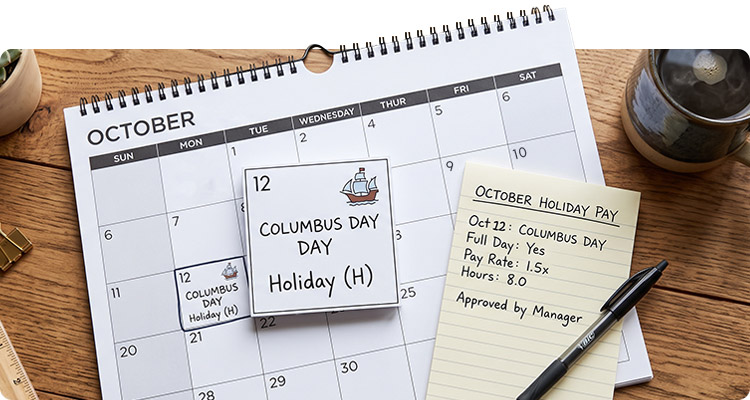
Non-exempt employees / Hourly employees
Business owners are not legally obligated to pay for a day they don’t work, unless company policy details otherwise.
Exempt employees / Salaried employees
If the business closes for the holiday, exempt salaried employees get their usual pay even though they stay out of the office that holiday. Should the business stay open and employees choose to go to work (for any reason), federal law doesn’t require employers to pay them extra.
Again, unless company policy details otherwise.
A note on full-week closures: If the business closes for an entire workweek, exempt employees don’t need to be paid for that week.
When is Columbus Day 2026?
key takeaway//Quick Answer
Columbus Day 2026 falls on Monday, October 12. It is observed on the second Monday of October each year and is a U.S. federal holiday.
PTO Policy Best Practices: Let Employees Choose When to Take Time Off
Not every employee wants Columbus Day off; some may want to save that day for another time.
With that, springs up: floating holidays. This option’s a win-win for both employer and employee. Less administrative undertakings, offering flexibility outside the office. What could be a bolted-down rule where Columbus Day time-offs are to be taken on the date itself, the latch and gate are open wider than assumed:
You, the employer, can offer a set of “floating days” your team can use whenever they need to. Both sides get something from it – business stays open on holidays, and your employees have the option to take their holidays when they actually want to.
Try applying this “floating” approach to Columbus Day and other holidays, as your operations see fit, and include said days in your policy.
Related Read: How to Hire the Right Virtual Assistant every time.
What a Long Weekend Costs Your Business
It might not seem like it at first, but when offices close for a number of simultaneous days, businesses are likely to lose a vast number of potential customers.
If you’re not (yet) a big business with offices mushrooming across different states, a long weekend may have greater aftershocks to you than for a company with enough people and locations to spread the disruption around.
MIT’s Lead Response Management Study tracked data over 100,000 call attempts throughout six US-based companies. Here’s what they found:
Contacting a lead within 5 minutes instead of 30 makes a business roughly 100 times more likely to reach them. The same window drops qualification odds by roughly 21 times.
Industry figures from Salesforce and Drift strike the same chord:
Did You Know?
78% of customers buy from whichever company responds first.
What a 3-day shop closure does is give your competitors – those who stay open, or, at a minimum, whose offices stay open half a day or less during the long weekend- available business.
The “Back After the Long Weekend” Backlog
Not to state the obvious, but those messages and tickets that formed a queue when your business was closed aren’t going anywhere. When your team returns, they’ll have to deal with those, along with the day’s regular tasks.
True, they come in fresh, rejuvenated from the break. That’s gone once they clock in.
Closed or Fully Staffed Isn’t the Sole Choice
We’re not telling you to pick between closing the office and telling one or more of your employees to give up their day off. There’s a third option:
Hand the day, the weekend, to a team that isn’t covered by such holidays.
How?!
We’ll explain it in the section below.
When is Columbus Day Weekend 2026?
key takeaway//Quick Answer
Columbus Day weekend 2026 is Saturday, October 10 through Monday, October 12. Columbus Day itself falls on Monday, October 12, making it a three-day weekend for federal employees and anyone whose employer observes the holiday.
The Offshore Advantage: Teams That Don’t Take the Day Off
Do Overseas Teams Actually Work on US Federal Holidays?
Yes. For teams based in the Philippines, Columbus Day is a regular working day. It isn’t a Philippine holiday. The country’s 2026 official calendar, under Proclamation No. 1006, places National Heroes Day on August 31 and Bonifacio Day on November 30, with no national holiday in mid-October.
Where US and Philippine Holiday Calendars Actually Overlap
Philippine teams have their own holidays to account for, particularly around Christmas and New Year. In 2026, Christmas Eve, Christmas Day, Rizal Day, and the Last Day of the Year are all non-working or regular holidays.
Setting Up Cross Coverage Without Confusing Clients
So, if you’re using an offshore team for coverage, know both calendars before making the schedule.
What you can do now for Columbus Day:
- Put your US paid holidays and offshore local holidays on one shared calendar.
- Add planned PTO and coverage assignments.
- Keep it alongside your PTO policy.
- Decide who handles calls, emails, and tickets when either team is out.
That way, Columbus Day doesn’t leave anyone guessing about who’s working.

Who Helps You Keep Business Afloat on Holidays?
This is where an offshore team can make a three-day weekend easier to manage. Remote Staff places US businesses with Filipino professionals who are already working the days your US based team is deciding whether to take off.
Columbus Day, for example, can be a regular workday for your Philippines-based staff.
You can engage professionals on a full time, part time, or project based arrangement, depending on what your business actually needs. Remote Staff also handles the onboarding, payroll, and HR support that comes with maintaining a Filipino remote team.
FAQs
Is Columbus Day a paid holiday?
No. The FLSA does not require private employers to pay employees for Columbus Day, even though it is a federal holiday. Paid holiday time is up to the employer’s policy or an agreement with employees.
Do banks and the stock market close on Columbus Day?
Banks generally close, along with the Federal Reserve and USPS. The stock market is a different story: the NYSE and Nasdaq remain open for regular trading on Columbus Day.
What states don’t observe Columbus Day?
Pew Research Center’s 2025 review found that 30 states and three US territories recognize Columbus Day in some official form. Only 20 states and two territories treat it as a paid holiday for state government workers. Several states and jurisdictions instead use Indigenous Peoples’ Day, including Maine, Vermont and New Mexico.
Does Columbus Day affect payroll processing?
It can. The Federal Reserve closes on Columbus Day, which can change Fedwire and ACH processing schedules and, in turn, the deadline for submitting direct deposit files. Check your payroll provider’s cutoff before the holiday rather than assuming your usual schedule applies.
Can I require employees to work on Columbus Day?
Yes. A private employer can keep its business open and require employees to work on Columbus Day. Nonexempt employees are paid their regular rate, with overtime due when applicable, unless a state requirement or your own policy provides something different.
Holidays Shouldn’t Have to Mean Losing Customers
Columbus Day is legally optional for private employers. You can close, stay open, give employees paid time off, or make it a regular workday, depending on your business and your policies.
But the businesses handling it best aren’t necessarily choosing between a completely closed office and a fully staffed one.
Look at your holiday calendar, your customers, and the work that cannot wait, then decide on extending your team so that coverage doesn’t become limp when certain members of your team are out of office.
Want to talk through your options? Request a Callback, and we’ll help you figure out what works for your team, Columbus Day holiday 2026 or not.

Vaune Everis Cura has always been a writer in the truest sense, drawn to the art both as a personal creative pursuit and as a profession. Her experience penning content across digital marketing spaces and collaborating with business owners and market shapers has broadened her craft to include strategic direction and SEO insight. Having spent years with the InterContinental Hotels Group before stepping boldly into freelancing, she understands that at the centre of it all are genuine, meaningful brand–customer relationships built on purposeful, human content.