
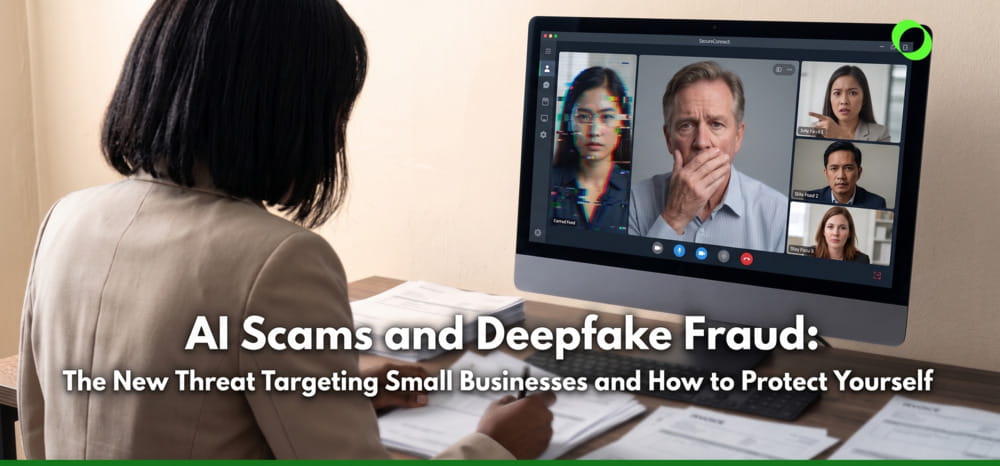
Your phone rings and it’s your accountant’s voice. She needs you to approve a wire transfer by EOD. You never for a second doubt it’s her. Her tone, phrasing, and urgency all sound about right.
Except it isn’t your accountant.
Nearly 60% of companies reported higher fraud losses from 2024 to 2025 (Experian). They’re targeting everyone. And SMBs are among the most vulnerable.
How to prevent AI scams?
US business owners tend to throw deepfakes and AI scams to the back of their minds, thinking they have nothing to do with them. 2026 is changing that.
Cyber attackers know that a majority of SMBs aren’t armed against AI scams and fraud attacks.
When deepfakes now account for 11% of all global fraudulent activity, what can you really do about it?
Start by understanding what you’re actually up against.
In This Blog:
- ➤AI Deepfake Scams: What Do Cybercriminals Use the Most Against You?
- ➤What Do AI Scams in 2026 Look Like? (What Are the New AI Scams? Today)
- ➤The 3 Small-to-Medium Business Profiles Most at Risk
- ➤5 Steps to Protect Your Business From AI Scams and Deepfake Fraud
- ➤One Business Function You Should Never Delegate to a Stranger on the Internet
- ➤FAQs
- ➤Small Business Doesn’t Mean Small Target
What is an AI scam in 2026?
An AI scam in 2026 is any fraud that uses artificial intelligence to automate deception. That can mean deepfake video calls, deepfake phishing, cloned voices, fake customer support chats, AI-powered phishing emails, synthetic identities, or even fake job offers and invoices that look completely legitimate. Unlike older scams full of obvious red flags, AI scams look and sound human, familiar, and believable, making them harder to spot and far more risky, especially for business owners who don’t have security protocols against such scams and fraud in place.
AI Deepfake Scams: What Do Cybercriminals Use the Most Against You?
It wasn’t that long ago when artificial intelligence, and more recent still, the human-AI hybrid workforce, were every industry’s conversation obsession. Smart businesses were moving past the AI replacement talk, incorporating it into their human teams instead.
AI to enhance efficiency like never before. The human to channel mental momentum towards more meaningful aspects of work.
Today, the buzz is taking yet another turn. It’s AI weaponization. Specifically, AI scams and deepfake fraud (a.k.a. impostor fraud).
What is AI as a Weapon (What is weaponized AI)?
Artificial intelligence is being weaponized. The same tools that help you generate images and write emails for your drip campaigns are being packaged and sold to criminal networks.
Fraud-as-a-Service. It’s a real thing.
The technical barrier has caved. Scams used to be visible a mile away (to most). They needed to be well-built and convincing. They required highly skilled hackers and advanced expertise. Not to mention, they were expensive to pull off.
Not so today. Low-skill bad actors can access deepfake generators. They can tap into phishing infrastructure and AI voice cloning through pre-packaged, mass-market subscriptions in platforms and suites.
“
Deepfake fraud incidents increased tenfold from 2022 to 2023. Other sophisticated attacks jumped from 10% to 28% between 2024 and 2025 alone. A 180% increase in a year.
Global Deepfake Threat Growth
Before getting into how to prevent AI scams, recognize that these new hackers or scammers are your camouflaged clients, team members, partners, and customers defrauding your business, and you don’t even know it.
What Do AI Scams in 2026 Look Like? (What Are the New AI Scams? Today)
#1. Voice Cloning
Voice cloning is the use of AI to replicate a person’s voice and speech patterns using audio samples. All it takes is 30 seconds of audio. Anything from a voicemail to a LinkedIn video. A Zoom recording. A TikTok or YouTube upload. A customer support call. It’s dropped into a voice cloning tool and turned into a convincing replica of your voice. Or your accountant’s. Or your bank contact’s. Or your CFO’s.
The clone then calls you or your team with a request: approve a transaction, transfer funds, confirm a password, or share sensitive information. Why would your team be suspicious? It’s a familiar voice. They do what’s asked.
Most SMBs don’t have callback verification or other AI scam prevention protocols against voice cloning scams and similar scenarios. No guideline about “if someone calls asking for money, hang up and dial the real number.”
This is the weak spot, the crack in the shield that attackers hope for.
#2. Deepfake Video Impersonation
It’s an ordinary Zoom call. Your manager is speaking. Your colleagues are present. Conversations sound like what the team would be talking about on any other Monday. Nothing out of the ordinary.
Or so you think. Because none of those faces are real. And you’ve no deepfake scam protection.
The request is casual and specific: send the payment and authorize the deal. Just one of those fake video scams so many SMBs fall for.
“
In 2024, a finance employee at Arup sat in on what looked like a normal video call with colleagues. Every face on that call had been generated by AI. He signed off on a $25 million transfer before anyone caught it.
The 2024 Arup Video Impersonation Incident
Your business uses the same, if not similar versions, of the same tools. Teams, Google Meet, Zoom, Slack. They have no mechanism for verifying that the face on screen is attached to the person you think you’re talking to. No way to combat AI impersonation scams, and tell you if the call is real, with the people you know in it.
#3. AI-Powered Business Email Compromise
Odd phrasing and generic greetings are a thing of the past. Those were signals in emails that used to tip you off. Today, and in AI fraud detection, generative AI writes pristine emails, with prose that sounds human. They know how to contextualize and mirror your vendors’ or business partners’ tones. They can pull up notes from a project you’re working on.
These aren’t always spammy either. Sometimes, they reach your inbox right on time when such emails are scheduled to reach you.
The emails often revolve around payment instructions or account updates.
#4. Deepfake Job Applicants
This next one’s a kind of attack that too few business owners are aware of, and Experian named this a top fraud threat for 2026.
Remote hiring is one of the wider doorways for such attacks. With no in-person cues to tip you off, relying on a video call and a good-looking resume is enough to hand a stranger the keys to your systems.
AI tools are able to generate polished resumes, complete with a candidate’s personal details and credible work histories. Many are able to do stand-ins for video interviews. Like a real person.
Nothing raises your eyebrows. The candidate greets you on the call while you conduct the interview. Which they ace. You onboard them. You give them access to logins and your financial tools.
Only after your systems go haywire and unauthorized wire transfers empty your accounts does your team realize something went wrong.
The DOJ didn’t just issue a warning about this.
In June 2025, they executed searches across 29 laptop farms in 16 states. This is all tied to fraudulent remote workers who used AI to pass interviews and get inside US companies. The FBI’s guidance since then is explicit: these operatives use deepfake tools to get through the hiring process.
Illustration: Priya is a Chicago-based agency owner who hired a remote developer after a smooth and impressive interview. Three months in, the “developer” had accessed client credentials. After discovering the breach, she and her team try to reach out to the new hire, only to hit dead end after dead end.
#5. Deepfake Investment Fraud & Crypto Deepfake Scams
This one targets business owners specifically. Not your team, Yot your systems. Business owners—you.
Fraudsters generate deepfake videos of real executives and financial managers and “leaders” in crypto to disseminate fake investment opportunities. The face on screen is someone you probably recognize. The voice matches. What the person’s talking about sounds credible. You even research about said person or company, and they have their own website.
Business owners who’ve recently raised capital or are actively looking to grow are the ones getting bombarded with this the most. Those who’ve recently exited receive these, too.
The targeting isn’t random. Your LinkedIn profile, your press mentions, your company posts, and your funding announcements tell attackers where you are in your business cycle.
What To Do: Any investment opportunity that arrives via video, email, or a cold call from someone you’ve never spoken to directly gets one response before anything else moves: a call to their verified office number. Don’t call the number in the email or video they sent. If you don’t have that number in your contacts list, delete the message.
The broader list goes deeper than the 5 mentioned above, with agentic AI attacks, synthetic identity fraud, model poisoning, and more. Most of it is aimed at enterprises with dedicated security teams.
For a business of your size, the four above are where your attention needs to be.
Related Read: Find out about the Cybersecurity Skills Shortage US 2026, and how this affects SMBs.
The 3 Small-to-Medium Business Profiles Most at Risk
No business is too small to “matter” to attackers. That’s just not their play. However, the businesses they’re targeting most aggressively, and frankly, prefer the most, are those with the thinnest defenses. Those with the least resistance.
That happens to be U.S. SMBs.
88% of ransomware breaches now revolve around SMBs (Verizon Data Breach Investigations Report). AI-augmented social engineering is increasingly the entry point, beating out Malware.
Here are the three most vulnerable SMBs most susceptible to AI scams and deepfake fraud, when understanding how to prevent AI scams:
SMBs That Run On Owner-led Approvals
You’re a priority target if you run a business with fewer than 15 people and you’re the one approving most financial decisions. There’s literally no IT gatekeeper between an attacker and your bank account. Approvals are done over the phone or via email with no hint of a firewall or a second set of screening eyes.
And that’s all they do: give you a call or send you an email, and they’re in.
Fast-growing SMB With 15 to 50 Employees
If you’re in a growth phase and you’re bringing in more people to your team, whether locally or remotely, there’s a good chance your internal systems and workflows are tailored to your company’s previous, smaller size.
New team members aren’t yet that familiar with each other. They have no basis for telling whether “someone” is talking exactly like somebody else. No basis to compare which conversations would immediately feel out of character to someone who’s been there longer. Or who’s normally looped into certain conversations and who isn’t.
High Vendor Count, High Payment Volume
Does your business run on frequent vendor payments and subcontractor relationships? How about frequent client fund handling? You’ll probably answer “yes,” especially if you’re in construction, real estate, accounting, or legal.
These are the very sectors where payment fraud is most able to slip through unnoticed. If any of these descriptions fit you, keep reading.
Related Read: Looking for more business opportunities? Here’s a take on the Battery Energy Storage Market Trends US 2026 and why this sector’s exploding right now. In a really good way.
5 Steps to Protect Your Business From AI Scams and Deepfake Fraud
For the best solutions in mitigating deepfakes in virtual calls, this list of 5 includes the main operational habits you and your team should familiarize yourselves with and implement this week.
What are Four to Five Ways Scamming Can Be Prevented?
#1. Set Up a Verbal Passphrase Protocol (What is a Verbal Passphrase?)
How to protect against AI-generated phone scams? A verbal passphrase is a pre-agreed word or phrase used to confirm someone’s identity during a phone call or voice conversation. Simply pick a word or short phrase and share it only among your team members in person or in a private virtual meeting. Never by text, never by email.
All requests involving money and system access should always require this passphrase. No one’s exempt. Yourself included.
If the caller doesn’t know the passphrase, they don’t get a pass. Never lead them on by asking “Do you know the passphrase?” Please don’t. If it’s a caller from within your company, they should bring it up themselves. Standard protocol for online identity protection.
What To Do: Set this up with your finance team and anyone who handles vendor payments this week. Change the phrase monthly or rotate it. No one should write it down. It shouldn’t be saved or shared via text or email.
#2. Build a Second-Channel Verification Wall Around Every Payment
One communication isn’t enough to move money. Any payment change, wire transfer, or vendor account update gets confirmed through a second, and then a third separate channel before it’s processed.
What To Do: When a vendor emails new banking details, call them back on the number already saved in your contacts. Immediately. Do not use the number in the email. If a client requests a payment change, follow the same process. The extra step may seem like a hassle.
Think of it as two minutes of verification against a fraudulent wire transfer takes considerably longer to deal with.

#3. Tighten Your Hiring Verification
A polished resume and a smooth video interview are no longer proof of anything. The threat of “hiring” a non-existent candidate who passes your entire process and gets system access without ever really existing is a widespread threat.
Basic identity-layer blocks the easiest path in.
What To Do: Paid identity verification services like Persona or Jumio verify IDs, faces, and live video checks before granting access or approving sensitive actions. Perfect for any remote hire who’s about to touch your systems.
Manual and old school also wins: during the interview process, ask candidates to hold a handwritten note with their name and the day’s date on a live, unscheduled video call.
#4. Run a “Skeptical Culture” Drill With Your Team
It’s not just business owners who are least aware of voice clones. Most SMB employees have never heard of it either. They have no reason to question a call that sounds exactly like you asking for something urgent.
A simple verification drill can unravel an otherwise convincing act, from detecting manipulated media to social engineering attacks.
“
Seventy-two percent of business leaders rank AI-enabled fraud as a top operational challenge.
AI Fraud Risk Assessment
What separates protected businesses from exposed ones is often a few extra seconds of verification. The one who knows how to pause and ask questions when a request tries to rush through or bypass a normal process.
What To Do: At your next team meeting, pull up ElevenLabs’ free voice cloning demo. Let your team hear what a cloned voice sounds like. Then put this rule in writing: no to wire transfers, password resets, and credentials handoffs without verification first. No matter how “urgent” they’re making the call sound.
#5. Know What Attackers Can Use to Clone You
Every podcast interview, LinkedIn video, YouTube clip, and conference recording you’ve put out is raw material. Thirty seconds of clean audio is enough to clone a voice. A few minutes of video footage is enough to build a visual model.
This doesn’t mean you stop showing up publicly or virtually. In cyber fraud detection, it means you know what’s out there and you watch it.
What To Do: Search your name and your key staff members across YouTube, LinkedIn, and podcast directories. Note what exists. Set up Google Alerts combining your name with words like “payment,” “wire,” and “urgent,” since these flag misuse early.
Go further with services like DeleteMe or Cloaked to handle executive data removal from data broker sites, where personal details get scraped and sold. The smaller your Clone Surface Area, the harder you are to impersonate convincingly.
Keep an eye out for our upcoming article on AI Fraud Risks in Remote Onboarding, and stay secure as you expand your offshore or hybrid workforce.
Related Read: As you continue strategize around how to combat AI generate scams, go over our guide on How to Calculate Outsourcing Cost US. Use the Calculator Tool below, put in your own numbers, and get the total for your planned hires (your numbers, not online averages):
One Business Function You Should Never Delegate to a Stranger on the Internet
SMBs often get stuck between speed and caution when hiring remotely. Add identity checks and verification steps on top of that, and screening only adds more steps to an already long process.
That’s where Remote Staff comes in. Our services are a practical solution to a specific vulnerability: the deepfake hiring problem. We vet candidates meticulously, choosing based on experience and skill. And we go out of our way to check that they’re real people.
Let us be your checkpoint so you won’t have to take the risk of letting a fraudulent actor into your systems by hiring through anonymous channels.
Beyond the secure process, you’re getting a person whose identity and background have been confirmed before they ever touch your systems.
Related Read: While you plan around reinforcing your workforce and ready your business for growth, here’s something about how to create a policy that supports Mental Health for Remote Workers.
FAQs on How to Prevent AI Scams
How do I know if my business has been targeted? (How to recognize and block AI scam attempts?)
Watch for signs such as unexplained login attempts. Vendors asking about payments you didn’t ask for. Employees reporting unusual calls from “you” when you didn’t make them. We recommend doing a weekly check on your financial accounts and setting up login notifications on all your business tools.
Do I need to hire a cybersecurity firm to deal with AI scams? (Does cybersecurity deal with AI scams?)
No, not for the base protections. You’ll need a cybersecurity firm when you grow your business. Large enterprises have them. But the five measures in this article require zero technical expertise. Start with verification protocols, team training, and a more careful hiring strategy before spending on software and expensive firms.
Is there software to detect deepfakes? (Do deepfake detectors work?)
Yes. Deepfake detection tools and anti-deepfake technology like Microsoft’s Video Authenticator, Sensity AI, and Pindrop for voice. But detection isn’t always a reliable defense for SMBs because the tools aren’t foolproof. Process-based verification (two channels, passphrases) is still more reliable and cheaper.
Is this only a risk if I have remote employees?
No. Voice cloning and BEC attacks are equally rampant in both in-person and remote teams. The attack isn’t specific to your office layout, but targets communication channels and your financial approval processes. Remote teams carry additional risk from the hiring angle, but the fraud types apply universally.
What do I do if my business has already been scammed by AI?
Report it immediately to the FBI’s Internet Crime Complaint Center (IC3) at ic3.gov. Contact your bank to attempt a wire recall. Document everything and notify your cyber insurance provider if you have one. Never attempt to contact the fraudsters directly.
Small Business Doesn’t Mean Small Target
Your best move is defense. AI scams and deepfake or impostor fraud are relentless against SMBs. This is a fact that’s become more alarmingly common this year. They target small-to-medium-sized businesses on purpose, knowing you don’t have the internal safeguards and verification systems to defend against their attacks.
When those scams and deepfakes do get through, they’ll cost you so much more than introducing verification protocols and skeptical cultures. The latter are a hassle at first. But a hassle worth ploughing through, rather than falling victim to a scam that only needed one careless, rushed decision.
In 2026, trust is the attack surface. Protection and security are now part of a business workflow.
Ready to talk through how Remote Staff can help you build a vetted, secure remote team? Request a Callback today.

Vaune Everis Cura has always been a writer in the truest sense, drawn to the art both as a personal creative pursuit and as a profession. Her experience penning content across digital marketing spaces and collaborating with business owners and market shapers has broadened her craft to include strategic direction and SEO insight. Having spent years with the InterContinental Hotels Group before stepping boldly into freelancing, she understands that at the centre of it all are genuine, meaningful brand–customer relationships built on purposeful, human content.