
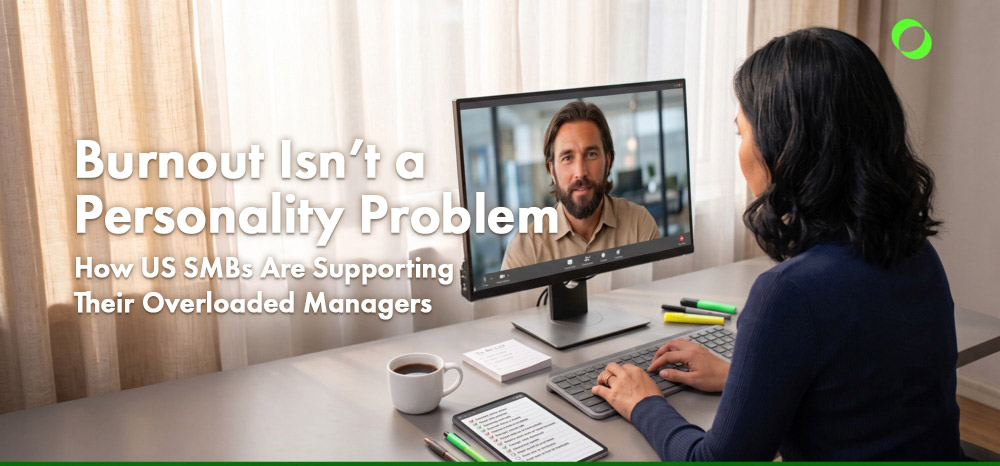
Meetings used to end this way:
One of your best managers signs off with three action items. Oh, and leaves behind a magnetic energy so infectious, it gives everyone else that extra boost they need for the rest of the workday.
Now?
That same manager’s got a new to-do list of updating the CRM, rescheduling a handful of calls, pulling last week’s numbers and translating them into a presentation, and queueing tasks that haven’t been updated.
Their energy? Fizzled out. Wiped off the face of most of your recent team meetings.
It’s the same scenario whether your employees work in-office or remotely. Manager burnout knows no geography or work setup.
Your manager isn’t suddenly lazy or failing at their job. They’re actually carrying all the additional load pretty well. For the time being.
But what this article aims to do is encourage US SMEs to give this some thought: How to prevent employee burnout?
More specifically, how to prevent manager burnout?
What’s eating the hours and mental capacity of your best people in leadership roles, and what can you do to support them better?
In This Blog:
- ➤Burnout Is Costing Businesses Millions: The Slow Burn
- ➤Managing Manager Burnout: Why Your Managers Are Doing Work That Isn’t In Their Job Description
- ➤Before the Burnout Signs: Three Patterns Behind a Burned-Out Manager
- ➤The 12-to-15-Hour Number: Tasks That Get Passed On to Managers By Default
- ➤What Are the Five Symptoms of Burnout? (Manager Focus)
- ➤How a VA Helps Your Manager: Why Pair a Manager With a Dedicated Virtual Assistant
- ➤The Right VA For Your Burnt-Out Manager
- ➤FAQs About How to Prevent Employee Burnout
- ➤Your Manager Doesn’t Have A Problem With Mindset or Efficiency
What is burnout at work? (What are signs of work burnout in managers?)
Work burnout is a state of physical, mental, and emotional exhaustion caused by prolonged, unmanaged workplace stress and unclear task boundaries. Common signs of work burnout include persistent fatigue, reduced motivation, irritability, difficulty concentrating, declining work quality, and feeling detached from work or colleagues. For managers, burnout often appears as constant overload from administrative work, less meaningful leadership, and an inability to switch off after work hours.
Burnout Is Costing Businesses Millions: The Slow, Slow Burn
It helps to first understand what job burnout is, and the Mayo Clinic summarizes it concisely:
Job burnout is a kind of stress related to work. Its symptoms – being or feeling bodily or emotionally worn out when you’ve not done any physically strenuous activity. Workplace burnout may, at times, include feelings of uselessness, powerlessness, or even emptiness.
It isn’t a medical diagnosis. However, burnout may elevate the risk of conditions such as depression. Certain personality traits and past work experience also contribute to it.
Whatever the cause, workplace burnout is more real than both employers and employees, whether in-office or remote, sometimes care to admit.
Here are some numbers to think about regarding manager burnout:
- 45% of middle managers report burnout; a higher rate than any other employee group
- Some surveys put the above percentage at 75% for extreme burnout
- The average manager now directly oversees about 12 employees; around 50% more than they did in 2013 (Gallup/Speakwise)
- Deloitte found 50% of middle managers report feeling “frequently overwhelmed” (the number was a sharp climb from 2023)
How Much Does Burnout Cost Companies?
“
Burnout costs US employers an estimated $3,999 per year for every non-managerial hourly employee. This goes up to $20,683 per year for executives.
2025 Study
That’s right, there’s a number for it, besides the cost of your employees being less motivated at work. Worse, losing them, if it isn’t addressed the right way.
Some employers have learned the hard way that not dealing with the root cause and simply replacing a burned-out manager doesn’t make the problem go away. Replacing a burned-out manager who quits typically costs $40,000-$60,000. The total after recruitment, onboarding, transitioning, and training. (Clover ERA).
Neither does it stop with that one employee. Protecting your managers protects everyone under them, and vice versa.
Gallup tells us that 58% of workers with strong manager support experience lower burnout.
If they’re run down and worn out, it affects those around them, too. It weakens individual and team morale and breaks down work culture.
Soon, more than one person will be exhibiting signs and symptoms of burnout. And all this can take place even if workflow momentum doesn’t show it.
Not initially, anyway.
What To Do: Had an exit interview recently? Or have you noticed that someone in your team isn’t their usual engaged, motivated self? Note the workflow or functional changes that transpired two or more weeks before you started seeing the signs of burnout.
Managing Manager Burnout: Why Your Managers Are Doing Work That Isn’t In Their Job Description
The administrative burden and debt. It’s a real, established term in business and HR context, which also has academic roots in public policy (Herd & Moynihan’s Administrative Burden: Policymaking by Other Means).
It refers to time, effort, attention, and mental energy people spend on the tasks that support work rather than the work itself. It talks about the accumulation of high-frequency, low-judgment tasks: Scheduling. CRM upkeep. Basic reporting. Documentation. Archiving.
These frequently get absorbed by a manager if there are no specific roles whose core responsibility is to handle them. Task flexibility and autonomy? Not like this. Not when it’s one small request at a time, until it becomes a permanent second function.
Before the Burnout Signs: Three Patterns Behind a Burned-Out Manager

Quiet Promotion
A “promotion,” in air quotes. This workplace term speaks of how a manager absorbs the responsibilities of a role that either got cut or is new and hasn’t been filled. Yet they don’t get the title change or formal acknowledgment of this “growth.” No pay adjustment.
In essence, the manager is now doing two jobs that are being treated as one.
Decision Slowdown or Bottleneck
Work, and ultimately, decisions, get backed up because capacity isn’t in line with demand. The manager is the lead decision-maker (depending on a business’s operational structure) or first contact in terms of work approvals, etc.
They have no choice but to fill the role, since there’s no plan to bring in new specialists or tools that should take care of the new tasks.
Player-Coach
Another established term for someone managing a team who’s also handling their own individual targets. They act as both “player” and “coach” at the same time. Capacity is divided into two full (not reduced because of the other) workloads.
Illustration: Adam owns a 9-person operations team for a regional logistics company in Nashville. Since his company flattened its management layer last year, his manager, Derek, has had to absorb a coordinator role nobody replaced; a textbook case of Quiet Promotion.
Derek now spends roughly 14 to 16 hours a week on tasks that aren’t at all related to his role as a team manager. What’s new to his task list? CRM updates after client calls, weekly performance report documentation, etc. Nobody’s proposed a new process improvement or a new hire. And it’s been four months.
The 12-to-15-Hour Number: Tasks That Get Passed On to Managers By Default
People often say, “Just delegate it.” It’ll “Free up hours.” But have you ever wondered how delegation actually does that?
Here’s a task-by-task breakdown.
- Calendar and scheduling coordination: 3 to 5 hours a week
- CRM data entry and cleanup: 2 to 4 hours a week
- Basic reporting and dashboard pulls: 2 to 3 hours a week
- Inbox management and routine follow-ups: 3 to 4 hours a week
The total lands at 12 to 15 hours a week. A second part-time job behind your manager’s full-time one. Larger businesses with more employees and teams mean more than 15 additional hours weekly.
Illustration: A manager earning $85,000 a year has an effective hourly rate of roughly $41. At 13 hours a week, that’s fallen to the administrative burden. Total that to a year’s worth: $27,000 in fully-loaded manager time annually spent on work that doesn’t require a manager’s leadership and judgment.
What To Do: Ask your core managers to track their calendars in 15-minute blocks for one week. Tell them to mark these blocks with “Required my judgment” or “someone else could’ve done this.” The second one’s where the administrative burden’s heavy, and a pointer that either a different specialist should be on top of them.
Extra Read: Here are 5 Signs Your Virtual Assistant is Working Multiple Jobs and what you can do about it.
What Are the Five Symptoms of Burnout? (Manager Focus)
Burnout research (Maslach Burnout Inventory, MBI) breaks the condition into three core dimensions: Exhaustion, Cynicism, and a Shrinking sense of accomplishment. Let’s apply this to a manager, and those three expand into five observable symptoms.
Here’s what to watch out for.
#1. Quieter One-on-Ones
This exhaustion’s often reflected in silence. A manager who suddenly only presents status updates, when they used to build their team up, double down on team wins, and deal with blockers, is an early signal.
Time and again, it’s misjudged as a dip in efficiency. When really, the root of it is burnout lying in wait for a tipping point.
What To Do: Compare your manager’s meeting notes from six months ago. What does the content look like? Are they looking more like task lists, with zero notes about recommendations? That’s your cue to work on “What is the best way to handle a burnt-out manager?”
#2. Full Calendar, But Output’s Getting Stalled
Busy doesn’t equate to productive. Your manager’s schedule is crammed to the brim with recurring admin tasks. It follows that they have less time for what their job description is.
Coordination work’s moving along just fine, but their team’s KPIs and overall cohesion are paying the price.
What To Do: Go over your manager’s team’s performance in the last 2 or 3 months. Have they flatlined? Declined? This should tell you it isn’t a problem about performance, but that their manager has been giving them less of the leadership they need.
#3. Advocacy For Their Teams Is Waning
“Cynicism,” in a word. The second core dimension in the MBI. But not to the deliberate detriment of their team. An engaged, highly motivated manager will always stand by their team.
They care enough to push back on unreasonable deadlines or requests. They recommend an increase in headcount or strategize task distribution when they see that their team members are overloaded. Or even possibly burnt out themselves.
But a manager who’s bogged down with support work won’t have the incentive and inspiration to look after anyone else. Including themselves.
What To Do: When was the last time your manager contributed their input on a decision? When was the last time they submitted a report on how their team is doing, and it’s all numbers and checklists? Nothing about what characterizes a strong team, team values, or individual growth among those under them?
Some time ago is proof of burnout.
#4. They’re the Only Ones Who Know Where Everything’s At
As a manager becomes the only point person for most or all support work, it culminates in cognitive overload. The one person who can do everything in the support work basket, constantly switching from one assignment to another.
Continuous context switching, even if the responsibilities involve just a stream of small decisions, will overload the brain’s capacity to process information efficiently.
Once they finally switch to their leadership position, they’ll have less mental capacity for it.
What To Do: Ask your manager to take a couple of days off. Not one. Three days to a week. You can assure them that it’s paid, or part of it is (or however your business deals with time off). If the answer’s something along the lines of “I’d like to,” maybe even followed by an “…but I can’t,” you already know how they’re doing.
#5. Unable to Disconnect From Tasks
Not an “inability” in terms of competence. It’s a combined physical and behavioral symptom wrought by work that spills over and beyond work hours. And it’s occurring more frequently and more regularly.
There’s too much to do, so, naturally, they do overtime. Day after day, on replay. But it reaches a point when, even on days when the workload doesn’t necessitate overtime, they stay inside “work mode” still. The necessity has become a habit, and eventually, behavior.
Soon, it’ll begin to diminish their ability to prioritize and make sound decisions. It’ll gnaw at their time management skills.
What To Do: Notice their after-work-hours activity for one week. Late-night emails and weekend Slack replies are clear proof of the inability to disconnect from tasks or work.
If a manager’s showing even two of these signs, it’s time to step in. You don’t need to count to five.
Burnout Signs Quick Reference:
How a VA Helps Your Manager Prevent Burnout in Remote Teams
Don’t make the mistake of spreading the additional support tasks your manager has been holding the fort for to anyone else. If you do, the same thing will happen to those assignees. Just at a slower pace towards overload, declining motivation, near constant fatigue, and, in the long run, burnout.
At the same time, delegation support isn’t confined to a CEO’s team, nor to entry-level staff. Something US SMEs skip unintentionally is the middle section. The area where managers are trying to keep everything, from people to tasks, together.
A dedicated Virtual Assistant absorbs every recurring, low-judgment support work that clogs a manager’s and a team’s week. They free up the manager’s work calendar from said types of work so the manager’s time goes back to what their role truly is about:
Coaching. Decision-making around their teams and the team’s outputs. Strategic work to support team members. Establish and maintain a balance of collaboration and work independence, where the context calls for whichever one.
Before the Handoff, After the Handoff: What Moves From Manager to VA
Illustration: Angela leads a 14-person marketing team for a mid-sized manufacturing company in Minneapolis. After her company paired her with a dedicated remote VA to handle campaign reporting, calendar management, and CRM hygiene, she recovered close to 14 hours a week.
Within two months, she’d relaunched a lead-nurture sequence that had been sitting in a shared drive for over a year. Her 1:1s with her team members became more insightful and purpose-driven, and it shows. The team’s not only been hitting targets, but has cultivated a strong support system and healthier team dynamics.
Extra Read: Learn How to Calculate Outsourcing Cost US and see the numbers yourself as you plan the hire using the outsourcing calculator tool below (toggle and click):
The Right VA For Your Burnt-Out Manager
How do you approach finding the right dedicated Virtual Assistant to work with your manager? American SMEs are hiring remotely, bypassing obstacles when it comes to vetting the best candidates.
Remote Staff has been placing Virtual Assistants with US businesses for over 18 years. We know where to look and what to look for, so that not only the best, but the right candidates are screened. “Right” because business needs and operations differ. So do industry requirements.
The engagement model adjusts to what you need, whether it’s part-time or full-time. Payroll, onboarding, and HR administration are handled on our end, so protecting your manager’s time doesn’t roll over to your list of to-dos.
Related Read: Learn how to create a policy that supports the well-being and Mental Health for Remote Workers.
FAQs About How to Avoid Employee Burnout in Remote Teams
What are the signs of burnout at work? (How do I know if my manager is busy or burned out?)
A busy week has an end. Burnout, on the other hand, is ongoing. A pattern. You’ll see this in flat outputs despite on-time submissions, less meaningful 1:1s, disengagement, and a general lack of motivation, work overflowing outside work hours, etc.
What tasks should you delegate to a Virtual Assistant first if you only have budget for a few hours a week?
Calendar and scheduling. They’re the fastest tasks to hand off, and are low-risk (errors are easier to rectify and consequences are limited). Relief from this handoff will immediately be felt, especially within the first two to four weeks after onboarding a VA.
What is the difference between a virtual assistant vs executive assistant?
Virtual assistants usually work from home and handle repetitive tasks like managing calendars, responding to emails, data entry, and record-keeping. Executive assistants organize executive calendars and serve as a strategic ally in daily activities. They work closely with senior executives.
What causes of work burnout?
Work burnout is commonly caused by chronic, unmanaged workplace stress that isn’t addressed over time. Contributing factors include excessive workloads, long hours, unrealistic expectations, unclear roles, and poor work-life balance.
Burnout can also develop when employees face constant interruptions or repetitive administrative tasks that reduce time spent on meaningful, high-value tasks.
Your Manager Doesn’t Have A Problem With Mindset or Efficiency
Managers face burnout when they’re constantly contending with an overload of unassigned support work on top of their actual duties. Tasks that don’t have a place in their skillset or job description. Being burdened by them, over a long period, causes them to be too exhausted, too unmotivated to give attention to their role as leaders.
Administrative burden or debt accumulates, and it usually ends up with the manager going through the motions, until it all comes crumbling down.
Leave the support work with a specialist whose expertise revolves around exactly that. Bring in a dedicated Virtual Assistant and let your manager do what they do best instead: leadership.
Ready to find the ideal VA for your operations’ admin work and support your employees in leadership roles? Call us or Request a Callback.

Vaune Everis Cura has always been a writer in the truest sense, drawn to the art both as a personal creative pursuit and as a profession. Her experience penning content across digital marketing spaces and collaborating with business owners and market shapers has broadened her craft to include strategic direction and SEO insight. Having spent years with the InterContinental Hotels Group before stepping boldly into freelancing, she understands that at the centre of it all are genuine, meaningful brand–customer relationships built on purposeful, human content.