
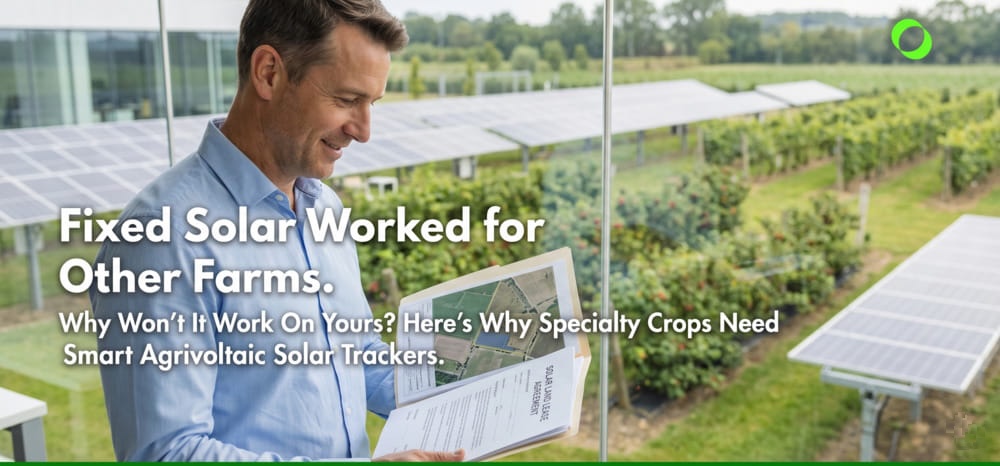
What are single-axis solar trackers?
Single-axis solar trackers are solar panel systems that rotate along one axis (typically east to west) to adjust panel position throughout the day. Unlike fixed solar panels that stay at one permanent angle, single-axis trackers move to optimize how sunlight reaches both the panels and, in agrivoltaic setups, the crops below. In specialty crop applications, smart single-axis trackers can also follow programmed crop schedules instead of simply following the sun, helping manage shade, field access, temperature, and water retention. The result is a dual-use solar system that balances energy generation with long-term agricultural productivity.
You’re already sold on solar.
As a farmland owner or manager, you’ve heard (or read) about the benefits of ground leasing for solar development. You don’t need more convincing.
The thing is, you also learned that fixed solar panels aren’t friendly to specialty crops like blueberries, grapes, and strawberries. The ones you’ve spent years understanding season after season, and learned to grow well through experience.
But what if the panels could work around your crops?
That’s where smart agrivoltaic single axis solar trackers plant a different idea. With this type of system, you still get better use for your land while lowering production energy costs. You still get a secondary income stream.
The “berry” on top?
The panels aren’t fixed. Not static. They adjust around speciality crop operations throughout the day, every day. Perfect for produce that depends on the right balance of light, temperature, irrigation, and timing.
Find out why smart agrivolataic tracking is better suited to specialty crops, and how you can earn solar revenue without sacrificing crop quality or land productivity.
In This Blog:
- ➤The Problem With Fixed Solar Panels
- ➤A Brighter Solution: What Does a Smart Single Axis Tracker Agrivoltaics Do?
- ➤Which Specialty Crops Benefit From Single-Axis Agrivoltaic Solar Tracker?
- ➤Harvesting More Than Energy: The Financial Side of Smart Single Axis Solar Trackers
- ➤The SMB Opportunity & What the US Market Looks Like Right Now
- ➤The Operation Capacity Concern Behind Going Dual-Use Solar
- ➤FAQs for Smart Agrivoltaic Solar Trackers in the US
- ➤The Land Isn’t Choosing Between Food and Energy Anymore
How Agrivoltaic Trackers Are Transforming Solar + Farming in the US
Agrivoltaic Solar Trackers US: The Problem With Fixed Solar Panels
To be fair, it’s a problem specifically for specialty or high-value produce farmland. Agrivoltaics, in a wider, more common application, has traditionally been structured around fixed-tile panels. This being “fixed” means:
Installed in a stationary and permanent position. One permanent angle for the life of the solar land lease agreement, or until they need replacing.
Such panels are among the most popularly used in dual-use farming agrivoltaics. They’re simple to operate. Lower upfront cost. Good for consistent land use. Proven and reliable across utility and agricultural projects in the United States and Australia. Nothing but good reviews.
But when you’re working with specialty produce like strawberries, wine grapes, basil, chili pepper, and blueberries, they’re not exactly a match for long-term crop performance.
Specialty crops require a more delicate, tailored kind of care. They’re more sensitive to sunlight. More demanding with water (small changes in moisture can instantly influence fruit health and quality).
If they’re less tolerant of a generalized kind of growing condition, the same is true when it comes to solar panels.
Illustration: Robert and Patricia run a 40-acre blueberry operation in western Oregon. They were approached by a solar developer offering $800/acre/year in lease income. They turned it down because part of the lease meant removing the irrigation infrastructure and farming the land.
Months later, a different developer came up with a dual-use proposal. Solar panels were to be installed, and farming operations could continue as usual. But the shade pattern was wrong for their blueberry variety. Another no.
They turned several more developers down until the couple figured out what was missing from the conversation: solar trackers.
A Brighter Solution: What Does a Smart Single Axis Tracker Do? (Single Axis Solar Tracker Specialty Crops)
To explain this, we need to get down to the technicals. A smart single-axis solar tracker is a solar panel system that moves throughout the day. It’s engineered with something called a horizontal single-axis tracker (HSAT). The HSAT rotates solar panels along a north-south axis according to a preset schedule. The said schedule can be customized based on crop requirements and field activities.
Standard trackers follow the sun to maximize energy output. Not smart agrivoltaic trackers. They do something different. They use programmed control strategies to move the panels based on what the crop needs, instead of what the sun’s doing.
Angles may vary depending on ground location, local climate conditions, and how the sun moves across the field throughout the day and over seasons.
How it generally works:
Morning: panels tilt east to catch early sunlight
Midday: panels move toward a flatter position as the sun rises overhead
Afternoon: panels tilt west to keep collecting sunlight
Special modes (agrivoltaics): instead of only following the sun, the panels can pause or change position for farming needs
More key behaviors that highlight this dual-priority mode:
- Crop-first mode: In critical growth periods or peak photosynthesis hours, the tracker tilts panels to open up more direct light for the crop; could mean slightly less energy output, but can be offset after said critical periods
- Energy-first mode: Once the crop’s daily light requirement is hit (measured in Daily Light Integral, or DLI), the tracker switches to maximum energy capture mode
- Stow/flat position: During harvest or when field equipment needs to pass underneath the installed panels, the tracker can be programmed to lie flat (panels horizontal); this opens the full row width for tractor access
HSAT systems with enhanced crop-specific control strategies create balance. They give crops the right amount of sunlight they need, when they need it, and generate more solar energy once the crops have received enough light for the day.
On terminology: “Single-axis tracker” describes the hardware. “Smart agrivoltaic tracker” describes what that same hardware does when it’s programmed for farming. One term with two ways of saying it. In this article, we use them interchangeably.
Clearance note: The minimum ground clearance for standard agrivoltaic structures with trackers is between 4 and 4.5 meters. That’s for standard farm equipment. It’s just how systems like Soltec’s AgriSun were designed: elevated clearance, 5-square-foot support bases/mounting footprints.
For the latter, tractors and other equipment can move freely under the solar array.
Related Read: Understand more about the Renewables Demand Surge US and how to make money from Virtual Power Plants, why these, too, are gaining traction.
Which Specialty Crops Benefit From Smart Solar Trackers For Farming?
How specialty crops perform under agrivoltaic systems varies widely, and understanding that difference needs more serious thought before you invest.
The crops that benefit most are either shade-tolerant at certain growth stages or highly sensitive to heat stress.
Crops That Perform Well Under Smart Agrivoltaic Trackers:
Crops Where Agrivoltaics is Less Straightforward
Universally (not limited to the US), agrivoltaics isn’t a good fit for commodity row crops. A 2026 University of Illinois study found that shading reduced maize yields by 24%; soybean yields by 16%, in high-humidity regions. Humid eastern Midwest conditions that grow these types of crops can do without solar tracking installation.
What To Do: As you narrow down tracker systems for your farm, ask the vendor: Does this tracker have programmable crop-mode controls? Or does it only follow fixed sun-position algorithms? That’s how you’ll know whether its main purpose is energy production or agricultural dual use.
Broadening Agrivoltaic Operations Without Expanding Local Costs
Managing smart agrivoltaic tracking systems requires significant administrative, technical, and regulatory upkeep. US solar developers and agricultural operators face heavy back-office friction – from monitoring real-time tracker telemetry and processing land-use permits to handling landowner communications and utility compliance.
Relying entirely on local US project managers? That’s $85,000–$120,000 USD per year. CAD/GIS technicians? $75,000–$100,000 USD per year. All to handle routine operational admin strains project margins.
Offshore specialists can handle remote telemetry auditing, compliance tracking, and administrative workflows at a fraction of the cost:
Harvesting More Than Energy: The Financial Side of Smart Single Axis Solar Trackers
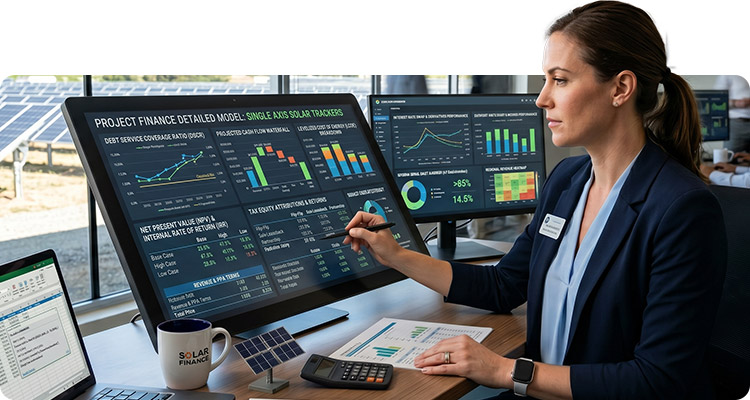
The standard explanation for agivoltaic systems goes something like: earn secondary income through solar, on top of your existing farm income.
But solar trackers aren’t standard. It’s earning solar income while protecting your crops and crop revenue. and in some cases, it may even improve it.
Here’s what the numbers look like:
Solar lease payments on dual-use agrivoltaic: typically between $300 and $2,000 per acre per year.
Location and your power purchase agreement terms (including system size) will affect the price. That’s before factoring in crop-side gains.
Research on Concord grape agrivoltaic systems, published in Applied Energy in 2025, found that a well-designed system reduced grower financial losses. The subsequent gain? A $408 improved income per acre per year.
Water and Solar Tracking Systems
Water? In the context of computing how much solar tracking systems really cost, it’s a number. Most solar proposals aren’t that detailed about it. But it’s as important as the projected solar income.
Compared to bare soil (soil without any solar installation), soil water evaporation under agrivoltaic panels drops by 21 to 33% (Solar Energy journal).
The numbers get even more impressive in regions where irrigation costs are staggering. Think California, the Pacific Northwest, or the Southwest. There, this kind of reduction immediately translates to lower pumping costs and fewer water purchases.
How Much Does a Solar Tracker Cost? (Agrivoltaic System Cost Per Watt)
Agrivoltaic tracker systems cost more than standard ground-mount solar. Expect to pay $0.90 to $1.50 per watt ($900,000 per MW to $1.5 million per MW). A basic system. Conventional ground-mount ones are at $0.80 to $1.20 per watt ($800 per MW to $1.2 million per MW).
Full machinery clearance in elevated structures has its own computation. Costs can reach $2.33 per watt, or 52% higher than traditional solar.
These aren’t the final numbers. There’s something called “offset mechanism,” and they’re your “financial levers.” Grants. Tax credits. Water savings. Solar income. Add them up, and they recover the upfront investment over time. And more.
Federal funding that applies:
- USDA REAP grants cover up to 25 percent of project costs under Farm Bill funding, and up to 50 percent under IRA-funded rounds (when available)
- The 30% federal Investment Tax Credit applies to commercial agrivoltaic systems through 2032
- 72% of all REAP grant projects go to solar, with approximately 3,378 grants already awarded to agricultural businesses
Stacked incentives and dual revenue streams make payback periods achievable in 5 to 7 years after final installation. The results have been documented. The Concord grape study showed a 14-year payback for the solar developer, and for the grower, financial improvements were already evident by year one.
A Note on Dual-Axis Trackers
Unlike their single-axis counterpart, dual-axis solar trackers are able to rotate both east-west and tilt up and down. This lets them track even the sun’s height through seasons. Precise energy capture, yes. But cost-effectiveness? Not for most US SMBs.
They’re mechanically complex, too, and are typically used in concentrated solar power plants or space/military applications.
For the sake of this article, and for practical reasons, going the single-axis route is recommended.
The SMB Opportunity & What the US Market Looks Like Right Now
As of early 2025, NREL (National Renewable Energy Laboratory) identified 596 agrivoltaic sites across 65,699 US acres, producing 10,473 MW of electricity. All that’s enough to power approximately 7.5 million homes. These figures come from the DOE’s own 2025 tracking data.
Dynamic panel systems (this article focuses on single-axis trackers, which belong under this broader umbrella) filled 87.9 percent of the agrivoltaic market in 2026. The industry is on the move, and it’s headed towards trackers, at full… tilt. Specialty crops are among the reasons behind this move.
You’ll find numbers that vary by source, but what remains consistent is direction.
“
By 2025 to 2026, the global agrivoltaics market had turned into a highly sought-after (and forecasted to keep growing) $6 billion industry. North America is projected to hold around 43%, the largest share, through 2035. It’s driven by federal funding and the scale of US agricultural land.
Market Projections & Growth Analysis
The DOE has set a target of 10 GW of US agrivoltaic systems. Solar already accounted for 93 percent of new US electricity capacity additions in 2025.
The practical takeaway for specialty crop growers: You’re neither late nor early to the burgeoning demand for single-axis solar tracker installations. This window’s perfect for you to evaluate your land and talk to developers about offers.
What To Do: Unsure if your state has active agrivoltaic research or extension programs? Massachusetts, Oregon, California, Arizona, Vermont, and New York all have documented specialty crop agrivoltaic activity.
If your state is on that list, there are likely local case studies and extension contacts you can access. Read through them before making the solar commitment.
Managing Smart Agrivoltaics: Agrivoltaic Remote Support Staff
The work to be done doesn’t stop at installation. It’s also not confined to the continuing crop production. It’s that post-install:
Data needs to be continuously monitored. And just as continuously, interpreted. There are REAP grant applications, permitting, and financial documentation to think about. Administration is a crucial backbone of power purchase agreements.
While this may sound like more continuous work, and it is, that’s where Remote Staff can help you out. Most specialty crop operations are already running lean, and staffing is scarce locally. But we have been placing agricultural operations support professionals with US businesses for 18 years.
From permitting coordination to rebate administration and energy production tracking, the operational load of a dual-use system can be entrusted to the professional hands of remote specialists.
Your local payroll overhead doesn’t need to get heavier. We take care of the candidate vetting, onboarding, payroll, HR, and admin. So, for roles your current team won’t be able to fulfill (because they’ve got their hands full), those are the specialists to hire offshore first.
Stay compliant with the Post Tax Season Planning Guide, so you’re covered in all corners, and learn about how to create a policy that supports Mental Health for Remote Workers.
FAQs About Agrivoltaic Solar Trackers
Can my existing farm equipment pass under agrivoltaic tracker systems?
If your tracker systems are within the minimum clearance of 4 to 4.5 meters. Below this, farm equipment may not be able to pass under them. Systems with elevated structures (like Soltec’s AgriSun, dual-use designed) provide 5+ meters of clearance and mounting bases as small as 5 square feet. Ideal for standard tractors, harvesters, and spray rigs.
Ask about clearance specs for your tallest piece of equipment before signing on to a system.
Do solar trackers improve crop quality? (What are the benefits of solar trackers?)
Yes, for speciality products (berries, leafy greens, herbs, and wine grapes). Solar trackers are programmed to help with moderating temperature and reducing heat stress. It also helps to naturally retain soil moisture, too.
Does the USDA REAP grant cover agrivoltaic tracker systems?
It does. REAP covers renewable energy systems, including solar PV on agricultural operations. Grant coverage is up to 25% under Farm Bill funding, or up to 50% under IRA-funded rounds (check that they’re available, to avoid funding pauses). Separately applied is the Investment Tax Credit.
Work with an installer who can document your system as a qualifying agricultural solar project, and confirm REAP application requirements with USDA Rural Development.
What is the difference between a smart agrivoltaic tracker vs a standard solar tracker?
A standard solar tracker simply follows the sun’s position to maximize energy output. That’s its only job. It rotates east to west throughout the day to keep panels pointed directly at the sun. That way, it generates as much energy as possible. A smart agrivoltaic tracker does that too, but it has an additional layer of programming built in specifically for farming; tilting to let more light through to the plants during critical growth periods, or lying flat so your tractor can pass underneath during harvest.
What is the payback period for agrivoltaics systems?
For specialty crop agrivoltaic systems, documented research puts that number at 5 to 7 years. Concord Grape placed that at 14 years for the developer. For the growers, they began seeing reduced grower losses within year one of installation.
With stacked incentives (REAP grant + federal ITC + water savings + energy revenue), your specific payback will depend on system size, crop type, and local utility rates.
The Land Isn’t Choosing Between Food and Energy Anymore
Preserving acreage or capturing solar income? Smart single-axis trackers just changed that “or” to an “and.” Fixed panel systems have their advantages. But for specialty produce cultivated on your farmland for generations. Going the smart agrivoltaics way is where you reap the most benefits.
Don’t stop at adopting solar. Adopt solar that’s crafted specifically for what you’re actually growing. For what your crops need. Not at a single time, but throughout the day. Throughout changing growing conditions. Throughout changing weather and seasons.
There’s no need to prove that the technology works. It does. The funding infrastructure is accessible to US SMB farmers, too. What’s left is your decision to match the right system with how much land you manage, along with your crop and cash flow.
Ready to map out what a dual-use solar operation via a single-axis tracking system would look like for your farm? Call us or Request a Callback today.

Vaune Everis Cura has always been a writer in the truest sense, drawn to the art both as a personal creative pursuit and as a profession. Her experience penning content across digital marketing spaces and collaborating with business owners and market shapers has broadened her craft to include strategic direction and SEO insight. Having spent years with the InterContinental Hotels Group before stepping boldly into freelancing, she understands that at the centre of it all are genuine, meaningful brand–customer relationships built on purposeful, human content.