
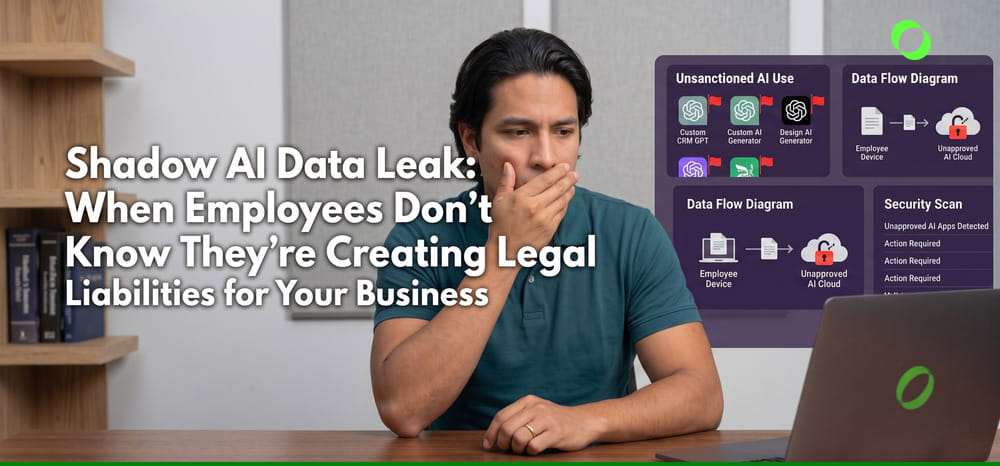
Customer financial data summarized through a chatbot. Confidential client emails submitted to an AI writing assistant for refining. Your team’s been using AI in everyday workflows. Tedious tasks got easier. And productivity? It’s through the roof.
But your employees are unaware of one thing:
Many public AI platforms may retain data, down to the most sensitive information. And from there, the lines begin to blur.
How to protect against shadow AI?
How about data leak prevention?
Unsanctioned or open-access AI tools can process, use, and forward company data for model training and other purposes permitted under their terms.
Sensitive info exits company systems, and your business no longer knows where it will move next. No way to know what the AI tool will do with it.
When sensitive information is exposed or processed improperly through unsanctioned AI, the employee isn’t the only one held accountable. The company is, too. It’s investigations and compliance work all on your shoulders. Then there’s loss of business and brand trust.
This is what shadow AI is. The consequences and costs are steep, but you don’t have to find that out firsthand. The better move is to put the right measures in place before your business ever has to pay it.
Here’s how.
In This Blog:
- ➤The AI Tool Problem and What Shadow AI Really Is
- ➤The Laws That Make Shadow AI Data Leaks A Liability
- ➤The Five Types of AI Data Classifications (Do NOT Use These On Unapproved Tools)
- ➤The Role That Makes this Governable
- ➤FAQs on Shadow AI and Data Leak Prevention
- ➤AI Use Policy is the Part Left in the Shadows
How to protect against Shadow AI?
Protecting against Shadow AI requires a combination of real-time endpoint visibility, clear acceptable-use policies, and sanctioned AI alternatives. Enterprises prevent unsanctioned AI risk by implementing continuous SaaS/API monitoring, establishing tiered data-access guardrails, providing regular AI risk literacy training, and deploying dedicated IT compliance assistants to manage access logs and approve safe tools.
The AI Tool Problem and What Shadow AI Really Is
Shadow AI takes place when employees use freely accessible AI tools, from Generative AI tools to public-facing LLMs, outside company-approved systems to complete everyday work tasks. Most of the time, employees are simply trying to work faster or avoid tedious manual work. The problem is that these unapproved AI platforms are outside your systems.
They’re outside the guardrails your business may have in place. If you don’t have any such safeguards, it gets worse. You’re left with limited visibility into what information was shared and less control over where it goes afterward.
It doesn’t start and end with just ChatGPT and similar platforms. But it is mostly open-access AI tools that employees use independently.
Browser-based AI writing assistants. AI note-takers joining Zoom calls. AI summarizers built into email clients. Free Grammarly-style tools with generative AI features. The AI browser extensions your team installed without internal review.
How to protect against shadow AI? The workings of the AI tools are happening outside your company’s software audit and monitoring. They’re nearly invisible to you. Like a “shadow.”
Numbers worth taking a closer look at:
- 78% of employees who use AI at work bring their own tools
- 50% of what employees paste into unsanctioned tools is classified as confidential business information; includes financial records, client data, contracts, internal strategy documents ( SaaS Data Security Report)
- 63% of businesses don’t have an AI or Shadow IT governance policy (IBM 2025)
How to avoid shadow AI in enterprise? First, know this – the average enterprise experiences 223 data policy violations per month related to AI usage.
Illustration: Marcus’ senior bookkeeper in his 22-person accounting firm in Columbus, Ohio, currently uses AI in daily tasks. She pastes a client’s quarterly financial summary into ChatGPT to help draft an explanatory memo. She’s done it dozens of times. It takes her fifteen minutes instead of the hour it used to, manually.
Both have no idea about what’s going on: the client’s revenue figures and cash flow data are now in a system they’ve never contracted with. There’s no way to review what data was leaked. No way to retrieve them either. When that client later asks for a data processing agreement, Marcus’ team doesn’t know how to answer.
Related Read: There’s a 700,000 Cybersecurity Skills Shortage 2026 happening in the US. But that’s not what’s shocking. It’s that because of it, SMBs are at risk. Learn more about how to protect your business with the Cybersecurity Data Breach Legal Guide.
The Laws That Make Shadow AI Data Leaks A Liability
Besides legal obligations, you’re dealing with extra work and investigation that comes with the interruption. You’ll also be investing in the effort required to earn trust back. Here’s a legal slice about the consequences of Shadow AI, and why it isn’t only for your legal team to think about.
HIPAA (Health Insurance Portability and Accountability Act)
As long as you handle protected health information, this Act requires your attention. When an employee copies and pastes PHI (Protected Health Information) to an unapproved AI tool, that’s automatically counted as an “unathorized disclosure.” It should prompt inspection and risk assessment.
What are unsanctioned AI tools? (What does unsanctioned AI tool mean?)
Any AI tool or platform a business or company hasn’t approved, reviewed, contracted with, or allowed for handling sensitive business information is considered unauthorized or unauthorized.
Non-healthcare companies aren’t outside the reach of HIPAA. And company size has no bearing.
Penalties range from $100 to $50,000 per violation. Violation categories have an annual cap of around $1.5 million per violation category.
GLBA (Gramm-Leach-Bliley Act)
This applies to businesses that provide financial products or services to consumers. Accountants, mortgage brokers, financial advisors, tax preparers, insurance agencies, and more are within this Act’s scope.
According to GLBA’s Safeguards Rule, covered businesses are to work within certain safeguards regarding customer financial data. When an employee uses an unsanctioned AI tool to process that data, the business is in violation of the Safeguards Rule, regardless of the employee’s intention.
CCPA (California Consumer Privacy Act) and state equivalents
Businesses serving California customers may be subject to this Act, even if the business’s main office isn’t headquartered in the same state. At present, over 20 states in the US have their own consumer privacy laws: Virginia, Texas, Colorado, Connecticut, and others.
What To Do: Review your most recent client service agreements. Pick three, and go over data handling, confidentiality, and information security clauses. If those agreements mean you’re expected to observe safeguards, but your employees are unconsciously submitting sensitive client data to public AI platforms, that’s a breach.
If you don’t find any such clauses, check if you can dig up those responsibilities elsewhere in your contracts. They may also be in policies or legal requirements. Still not there, or maybe policy enforcement or statements are unclear? Get legal guidance before moving forward.
Why Banning the Use of Unauthorized AI Usage is NOT the Answer
Putting blanket bans on all AI tools will only cause employees to try to access them using other means. Maybe not through company systems, but through their personal devices. It’ll inadvertently create this unhealthy behavior of handling data “on their own.” Something that exacerbates the problem of visibility even more.
Key data about this reality:
- 44% of employees have used AI in ways that unintentionally breach policies
- Close 50% of employees upload sensitive company data to unauthorized platforms (KPMG, Klynveld Peat Marwick Goerdeler 2025)
- 47% of generative AI users access tools through personal accounts, working beyond the company’s line of sight (Netskope 2026)
Banning AI use altogether also puts blinders on decision-makers, who’ll remain oblivious to the fact that an AI usage policy is the solution. And that, better, company-safe alternatives are a defining factor.
Related Read: AI Scams and Deepfakes are running rampant in the U.S., and they’re targeting SMBs. Here’s what you need to know.
The Five Types of AI Data Classifications (Do NOT Use These On Unapproved Tools)
#1. Customer and Client Personal Information
Any kind of personal detail. Names, contact details, financial information, and government-issued ID numbers. They belong under the protections of CCPA since they’re personally identifiable information (PII). But it doesn’t stop at this level of personal info.
Customer lists, CRM exports, intake forms, onboarding documents, and support tickets. When these data are placed in an unsanctioned AI tool, the business has become an accessory to transferring them to a third party, sans the disclosures its privacy policy promises customers.
By default, most open access AI tools retain user inputs. That is, unless the platform has an enterprise agreement with explicit data retention restrictions. Submitted data may be stored, used to train future models, or accessed by the vendor or platform provider.
What To Do: Make “no customer or client data in unapproved AI tools” the first rule in your AI use policy. Legal language not needed here. It’s going to be enforced internally, so plain and specific is the way to go.
#2. Protected Health Information (PHI)
Medical records, health insurance details, prescription data, and diagnosis information. These are counted as Protected Health Information. Health-related data that ties back to an individual belongs here.
HIPAA covers healthcare providers, health plans, and their business associates. It applies to non-healthcare businesses, too. The ones that handle employee health records or process health insurance data as part of benefits administration.
A single unauthorized disclosure is enough to call it a compliance issue, whether it’s a patient summary or an insurance claim pasted into a public AI tool.
What To Do: If your business handles health data, classify it before writing your AI use policy. The policy has to account for what the data is before it can govern where it goes.
Sample Data Classification Table:
#3. Financial Records and Account Data
Financial records such as client financials, tax documents, bank account details, credit card numbers, investment data, and loan files sit within the type of information GLBA is designed to safeguard. For SMBs outside the GLBA domain, state data breach notification laws may apply if the information is exposed.
GLBA reaches well outside the usual finance sector through the Safeguards Rule: accountants, mortgage brokers, financial advisors, tax preparers, insurance agencies, and any business providing financial products or services to consumers.
What To Do: What roles in your business regularly brush against client financial documents? Those team members are to belong to the first group named in your AI use policy. Name them not merely by data type, but by job function.
#4. Proprietary Business Information and Trade Secrets
Unlike regulated personal data, proprietary business information doesn’t always have specific laws covering it. Source code, product roadmaps, pricing models, unpublished research, strategic plans, client lists, acquisition targets, and internal contracts are within a company’s internal operations.
Business confidentiality is the main safeguard. How a company uses and protects information is hinged on how seriously they preserve it.
Most B2B service agreements and client contracts include confidentiality and data handling provisions. A contract language or a pricing model and deliverable, once submitted to a public access AI tool, could result in the breach of the contract’s confidentiality obligations.
“
The Samsung case is one of the more prominently documented examples.
Samsung Electronics
Samsung engineers pasted proprietary semiconductor source code into ChatGPT on three separate occasions within weeks. There was no evidence of a data leak or misuse by the unauthorized AI tools. However, the issue was that Samsung deemed the information no longer contained within their own systems.
Before anything escalated further, they restricted employee use of generative AI tools and introduced tighter controls afterward.
#5. Employee Data
Here’s data outside the borders of customer data. Anything from performance records to compensation information, all the way to what seems insignificant, like time-offs and training requests, is a part of this category.
The California Consumer Privacy Act extends not just to “consumers” per se, but to employee data for California-based employees as well. It’s the same problem that asks the same questions: what was shared? Where did it go? Who can access it now?
What To Do: Name HR workflows that involve employee records in your AI use policy. Performance reviews, compensation discussions, disciplinary processes, and leave documentation should stay off unapproved tools until a compliant alternative is in place.
Enforcing AI Governance Without Inflating Onshore Payroll
Continuous monitoring of Shadow AI generates thousands of security alerts, API logs, and tool request tickets weekly. For US companies, forcing local IT Managers ($110,000–$145,000 USD/yr) or Cybersecurity Analysts ($120,000–$160,000 USD/yr) to manually audit logs and process AI approvals pulls them away from strategic engineering.
Enterprise governance software paired with dedicated remote offshore IT specialists is among the most practical solutions. Keeps your network secure while lowering operational friction:
The Role That Makes this Governable
AI governance shouldn’t be someone’s responsibility only when a breach begins breaking your systems and relationships with customers. Tools change weekly. Employee habits change constantly. You need a dedicated person who understands this role and knows more than intellectual property protection, but is well-versed in Shadow AI data leak prevention, tools, and secure alternatives. Someone who’ll look at it not as a side task, but as a primary duty.
For most SMBs, a compliance support specialist or a data privacy operations role that handles AI tool vetting is the ideal candidate. This professional maintains the approved list, monitors for policy drift, coordinates with legal when something needs escalation, and keeps the policy current as new tools appear.
Remote Staff has been placing compliance support and data governance professionals with US businesses for 18 years. We vet specialists with hands-on experience in data handling tasks. The person you need is one who builds the documentation and keeps your policy defensible when regulators decide to step in.
Leave not only the vetting, but also the onboarding, payroll, HR, and admin work to us.
FAQs About How to Protect Against Shadow AI
What are the legal risks of Shadow AI in small businesses?
Shadow AI itself is not illegal. But it causes your business to violate laws that are. These laws include HIPAA, GLBA, CCPA, and state data breach notification statutes. The violation comes not from using the tool, but from what the tool does with the data (process, store, etc.).
What are the consequences of a data breach for an employee? (What happens if you put confidential information into AI?)
Accidental exposure doesn’t reduce legal liability. Under most US privacy laws, the business is responsible for how personal data is handled. However, the responsibility still includes employees using unapproved tools. More than these, regulators evaluate whether your business has an AI use policy. If not, then the business may face investigations, breach notifications, contractual disputes, compliance remediation work, and financial penalties. Employees may also face internal disciplinary action.
Do I need a lawyer to write an AI use policy?
Not for a working first version. A practical minimum viable policy covers approved tools, prohibited data categories, a disclosure requirement, and a named owner. Legal review comes after to refine the document, and to ensure proper legal language is used throughout.
What data categories carry the most legal exposure for SMBs?
Summary: Customer personal information (PII), protected health information (PHI), client financial records, and proprietary business data have the highest regulatory and contractual exposure. Another is Employee data, which is garnering more coverage under state privacy laws (includes CCPA). Any combination of name plus sensitive category data entered into an unsanctioned AI tool is a potential violation.
Can I just ban AI tools entirely and avoid the problem?
You may, but don’t. Note that it’s now the AI tool itself that’s the culprit. It’s when you put sensitive business, employee, and customer data into it, even if unintentionally, that leads to legal issues. Instead of banning the use of artificial intelligence in your operations, create an AI use policy. Then, provide your team with approved AI tools instead of free, and often easily compromised, platforms.
Related Read: Learn how to Calculate Outsourcing Cost US and see your own numbers (not online averages) as you strategize around hiring the right specialists for AI security.
Shadow AI Governance Policy is the Part Left in the Shadows
…and the absence of approved AI tools in place of free, ungoverned platforms. Rogue employees? Bad intentions within your team? Not likely. More often, it’s ordinary work happening outside policy and visibility.
You need an AI use policy. You need sanctioned AI tools, so your team can work without constantly worrying about unintentional data leaks.
The businesses fighting against shadow AI are bringing in remote IT compliance specialists. They’re actively documenting a policy, and treating it as seriously as they should.
Thinking of what a compliance support hire looks like for your business? Prevent or uncover hidden shadow AI security risks of data exposure in AI tools, and call us today or Request or Callback.

Vaune Everis Cura has always been a writer in the truest sense, drawn to the art both as a personal creative pursuit and as a profession. Her experience penning content across digital marketing spaces and collaborating with business owners and market shapers has broadened her craft to include strategic direction and SEO insight. Having spent years with the InterContinental Hotels Group before stepping boldly into freelancing, she understands that at the centre of it all are genuine, meaningful brand–customer relationships built on purposeful, human content.