

For U.S. companies, the pattern is frustratingly familiar with their offshore hires: the résumé looks flawless, the interviews go smoothly, and the candidate checks every box.
Yet within 30 to 90 days, performance stalls. According to Harvard Business Review, traditional hiring methods consistently overvalue credentials while undervaluing real-world execution, especially in cross-border and remote contexts where managers lack daily visibility early on.
This gap is amplified in offshore hiring, where distance, cultural norms, and communication styles distort appearances of capability.
The result is not a talent problem—it’s in a broken hiring process. When companies rely too heavily on résumés to evaluate offshore talent, they mistake polish for performance and fluency for effectiveness.
So, if you’re struggling with perfect-resume offshore hires who underdeliver, keep reading.
The Resume Trap in Offshore Hiring
Offshore hiring failures rarely happen because candidates are dishonest or incapable. They happen because résumés are designed to showcase credentials, not capability.
In offshore markets, especially those serving U.S. employers, candidates are trained to optimize for Western expectations—format, phrasing, certifications, and keywords—often at the expense of practical fit.
Hiring managers, under pressure to scale quickly or reduce costs, fall into a common trap: equating résumé quality with job readiness.
English fluency becomes a proxy for competence. Brand-name tools replace proof of problem-solving.
Over time, this leads to offshore recruitment problems that surface only after onboarding, once the real work begins.
Why Offshore Résumés Look So Impressive
Offshore résumés aren’t impressive by accident. They are the result of market incentives, coaching, and volume-based recruiting systems optimized for speed, not long-term success.
CVs Are Optimized for Western Employers
In many offshore markets, candidates are explicitly trained to mirror U.S. job descriptions.
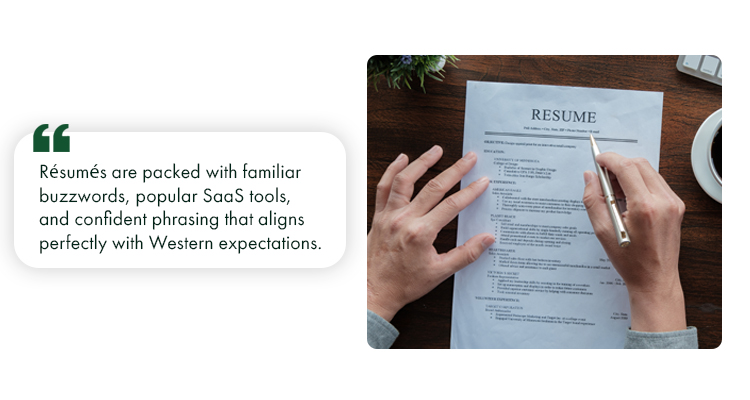
Résumés are packed with familiar buzzwords, popular SaaS tools, and confident phrasing that aligns perfectly with Western expectations.
Certifications and short-term courses are emphasized because they scan well, even when hands-on experience is limited.
The result is a résumé that reads like a perfect match, but reveals little about real execution under pressure.
This is how resume vs real performance gaps begin.
Coaching and Resume Factories
Entire industries now exist to “polish” offshore CVs. Candidates pay services to rewrite experience, optimize LinkedIn profiles, and rehearse interview answers.
While not inherently unethical, this means many employers end up hiring the résumé, not the person behind it.
When combined with volume-based recruiting, this creates an illusion of abundance: dozens of “perfect” candidates, but few who can actually perform.
Without deeper analysis, this leads directly to poor candidate vetting and costly churn.
What Résumés Don’t Reveal
Résumés are static documents, while offshore work is dynamic. The most critical predictors of success rarely appear on paper.
Yet they determine whether a hire thrives or fails.
Real Communication Skills
English proficiency on a résumé does not equal effective communication in real workflows.
Offshore hires often struggle not with language, but with clarity, confidence, and initiative in distributed environments.
Key gaps that résumés don’t show:
- Ability to communicate clearly in Slack or async tools
- Comfort asking clarifying questions instead of waiting
- Tone management in written communication
- Speaking up in Zoom calls without prompting
- Translating vague instructions into action
These gaps are a major contributor to offshore hiring failure, especially in fast-moving U.S. teams.
Decision‑Making and Ownership
Many offshore professionals are trained in execution-first environments: follow instructions, avoid mistakes, and escalate cautiously.
U.S. companies, however, expect problem-solvers who make judgment calls, flag risks early, and take ownership.
This mismatch creates an offshore talent mismatch. The employee waits for direction. The manager expects initiative. Neither side realizes that the expectations were never aligned.
Résumés don’t reveal how a candidate handles ambiguity, but it defines most offshore roles.
Cultural and Work‑Style Fit
Cultural alignment issues are subtle but powerful. They rarely show up in interviews—and never on CVs.
Common friction points include:
- Hierarchy vs autonomy in decision-making
- Comfort giving or receiving direct feedback
- Interpretation of deadlines and urgency
- Willingness to challenge assumptions
- Expectations around availability and responsiveness
Without addressing these during hiring and offshore onboarding, even skilled employees can underperform.
The 7 Reasons “Perfect” Offshore Hires Fail
By the time offshore hires fail, most leaders already feel something went wrong, but can’t pinpoint why.
The résumés were strong. The interviews were smooth. The references checked out. Yet performance never matched expectations.
This isn’t bad luck. It’s a pattern tied to resume vs real performance gaps that appear when companies rely on surface-level signals instead of execution-proof hiring.
Below are the seven most common reasons perfect-resume offshore hires underperform, and how each one quietly undermines results.
1. They Were Hired for Credentials, Not Capability
Offshore hiring often prioritizes degrees, certifications, and brand-name tools. These credentials look reassuring, especially to U.S. hiring managers unfamiliar with offshore markets.
But credentials don’t guarantee applied skill. In many offshore regions, professionals are encouraged to stack certificates quickly to remain competitive.
This creates an offshore talent mismatch where knowledge exists in theory but not in execution.
When capability isn’t tested, companies end up paying for potential instead of performance, fueling offshore hiring failure down the line.

2. They Interview Well but Can’t Execute
Interview performance is a weak predictor of job success, especially in remote roles.
Offshore candidates are often well-trained to answer behavioral questions and mirror U.S. communication styles. They sound confident, agreeable, and articulate.
Execution, however, requires prioritization, independent thinking, and follow-through—skills that don’t surface in conversational interviews.
When hiring decisions rely on interviews alone, companies confuse likability with reliability, deepening offshore recruitment problems.
3. No Real‑World Skill Testing
Many offshore hiring processes skip practical testing altogether, especially when hiring at scale. Résumés and interviews replace live work samples because they’re faster.
This shortcut is costly. Without task-based trials, companies never see how candidates handle ambiguity, feedback, or time pressure.
The result is poor candidate vetting, where red flags appear only after onboarding—when replacement costs are highest.
4. Communication Breakdowns
Communication issues are one of the most underestimated causes of offshore underperformance.
The challenge isn’t English proficiency—it’s clarity, initiative, and context. Common breakdowns include:
- Waiting for instructions instead of asking questions
- Misinterpreting tone in async tools
- Over-indexing on politeness instead of urgency
- Hesitating to flag risks or blockers
These issues compound quickly in remote environments and strain offshore team management, especially when expectations were never made explicit.
5. Lack of Accountability Culture
In many offshore markets, workers are trained in hierarchical environments where accountability flows top-down.
U.S. companies, by contrast, expect ownership, self-management, and proactive problem-solving.
When these norms collide, performance stalls. Tasks get completed, but outcomes don’t improve.
Without addressing cultural alignment issues, managers mistake passivity for competence, and accountability gaps widen.
6. Poor Onboarding and Expectations
Offshore onboarding is often treated as an afterthought: a few documents, a Slack invite, and a kickoff call. That’s not onboarding—that’s access.
Without structured offshore onboarding, new hires lack clarity on success metrics, communication norms, and decision rights.
This confusion fuels early mistakes, slows ramp-up, and increases attrition, hurting offshore employee retention within the first 90 days.

7. No One Is Managing Performance
Many offshore hires fail not because they’re incapable, but because no one is actively managing them.
Founders assume autonomy, managers assume alignment, and offshore employees assume silence means doing fine.
This vacuum leads to drift. Without regular feedback, performance tracking, and coaching, even strong hires underperform.
A lack of intentional offshore team management turns small gaps into chronic failure.
The Hidden Cost of Bad Offshore Hires
The real damage of offshore hiring failure is operational and cultural. These costs rarely appear on balance sheets, but leaders feel them every day.
Bad offshore hires result in:
- Lost salary paid to underperforming roles
- Lost time spent rehiring and retraining
- Missed deadlines that delay product or revenue
- Demoralized teams forced to compensate
- Leadership burnout from constant course correction
Ironically, companies chasing cheap offshore labor often end up paying more—proving that quality vs cost hiring isn’t optional, it’s strategic.
How to Hire Offshore Talent That Actually Works
High-performing offshore teams are built through managed offshore hiring, where systems replace assumptions and structure replaces guesswork.
Below is a proven framework used by teams that avoid resume-driven mistakes and build durable offshore capability.
Replace Résumés With Work Samples
Résumés should open doors rather than serve as the primary basis for hiring. Ultimately, a candidate’s real suitability comes from the quality of their work, and effective offshore hiring should integrate:
- Live skills tests relevant to the role
- Task-based trials simulating real workloads
- Time-boxed assignments with feedback loops
These tests reveal execution speed, judgment, and learning ability—qualities no résumé can show.
Interview for Behavior, Not History
Instead of asking what candidates have done, ask how they think. Scenario-based interviews surface decision-making, ownership, and problem-solving under constraints.
Examples include:
- “What would you do if requirements were unclear?”
- “How do you prioritize when everything feels urgent?”
- “Describe a time you pushed back on instructions.”
This approach uncovers mindset fit and prevents offshore talent mismatch before it starts.
Onboard Like They’re Onshore
Offshore success depends on intentional onboarding. Strong onboarding includes:
- Clear SOPs and role-specific playbooks
- Defined KPIs for the first 30, 60, and 90 days
- Daily or weekly check-ins early on
- Explicit communication and escalation norms
When offshore onboarding mirrors onshore rigor, performance stabilizes, and retention improves.
What Great Offshore Teams Do Differently
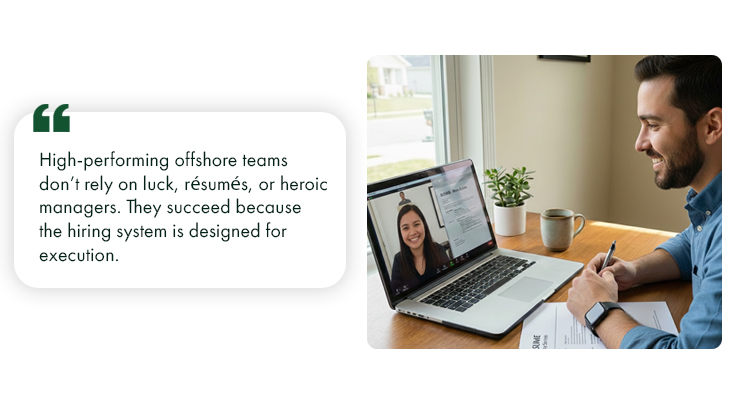
High-performing offshore teams don’t rely on luck, résumés, or heroic managers. They succeed because the hiring system is designed for execution.
Where struggling teams chase perfect-resume offshore hires, successful ones engineer outcomes from day one.
The difference isn’t geography. It’s discipline. Great offshore teams consistently invest in:
- Structured onboarding. They don’t assume new hires will “figure it out.” Clear SOPs, role-specific playbooks, and defined success metrics eliminate ambiguity early. This prevents confusion that often leads to offshore hiring failure in the first 60 days.
- Cultural training. Top teams address cultural alignment issues directly, how feedback works, how decisions are made, when to escalate, and what ownership really means in a U.S.-led environment. Cultural clarity reduces friction and accelerates trust.
- Manager ownership. Offshore success isn’t delegated to HR or left to chance. Managers actively own performance, cadence, and coaching. Strong offshore team management replaces silence with feedback and direction.
- Clear output expectations. Instead of vague job descriptions, great teams define outputs, timelines, and quality bars. This closes the resume vs real performance gap and aligns everyone around results, not activity.
This is the core of managed offshore hiring: fewer assumptions, more structure—and dramatically better outcomes.
The AI Factors: Why More Resumes Are Getting Cannibalized
Offshore hiring didn’t get harder because there’s less talent out there. It’s mostly because résumés stopped being reliable signals.
Two modern tools are accelerating this problem: AI résumé writers and ATS screening systems. Together, they don’t just polish CVs, they actively strip out differentiation, making it harder to tell who can actually perform – and who is simply good at posturing.
AI Résumé Writers Are Standardizing “Excellence”
AI résumé tools allow candidates to generate perfectly worded, Western-style CVs in minutes. They mirror job descriptions, insert the right buzzwords, and confidently describe impact, regardless of depth of experience.
The result is a wave of résumés that sound senior, proactive, and outcome-driven, even when their real-world execution is inconsistent.
This doesn’t mean candidates are dishonest—it means hiring managers are increasingly evaluating language models, instead of the people using them.
ATS Tools Underparse Real Ability
Applicant Tracking Systems were built to manage volume, not assess capability. In offshore hiring, they often worsen the problem by prioritizing keyword density, formatting, and role alignment over context and execution.
Strong candidates who don’t optimize for ATS logic get filtered out, while “perfect-looking” résumés move forward, even when practical skill hasn’t been validated.
It creates pipelines optimized for appearance, not performance.
Why This Accelerates Offshore Hiring Failure
When AI-generated résumés pass through ATS filters, hiring teams inherit a distorted shortlist.
Interviews then validate presentation rather than capability, and real skill gaps surface only after onboarding, when replacing a hire is costly.
This is how résumé-driven hiring quietly breaks at scale.
FAQs
Offshore hiring raises hard questions, especially for teams burned by past experience.
These answers cut through the noise and address the real issues behind offshore recruitment problems.
Why do offshore hires look good but perform poorly?
Because résumés are marketing tools, not performance indicators. Many failures stem from poor candidate vetting, overreliance on interviews, and lack of real-world skill testing, creating an offshore talent mismatch.
How do I test real skills before hiring?
Use task-based trials, live simulations, or short paid test projects that mirror the actual job. This exposes execution ability, communication style, and learning speed, far more reliable than credentials alone.
Should I trust offshore résumés at all?
Yes, but only as a starting point. Résumés should open conversations, not decide outcomes. Without validation, they contribute to a broken hiring process driven by assumptions instead of evidence.
What is the best interview style for offshore candidates?
Scenario-based interviews. Ask how candidates would handle ambiguity, push back on instructions, or prioritize competing tasks. This surfaces behavior and judgment, not rehearsed history.
How long before I know if an offshore hire will succeed?
With proper onboarding and management, you should know within 30 to 60 days. Without structure, teams often waste 90 days before acknowledging an offshore hiring failure, magnifying cost and frustration.

Stop Hiring Résumés, Start Hiring Outcomes
Offshore hiring doesn’t fail because talent is lacking. It fails because too many companies optimize for speed, volume, and cheap offshore labor instead of durability and performance.
The résumé isn’t the problem; the process is. When teams prioritize quality vs cost hiring, invest in structured vetting, and treat offshore onboarding with the same rigor as onshore roles, retention improves and performance compounds.
That’s how offshore employee retention becomes predictable, not accidental. If you’re ready to stop guessing and start building an offshore team that actually delivers, it’s time to rethink how you hire.
Book a vetting strategy call and replace résumé-driven decisions with a hiring system built for outcomes!
- Also looking for ways to upsell or cross-sell your products and services? Click here.
- Looking for ways to work around tariffs? Learn more here.
- If you’re ready to experience the full advantages of working with a top global team, check out our 1,000 fully vetted and highly talented staff here.

Darren Aragon is a multifaceted writer with a background in Information Technology, beginning his career in research at Pen Qatar and transitioning through customer service to a significant role at Absolute Service, Inc. His journey into freelance writing in 2021 has seen him excel across various niches, showcasing his adaptability and deep understanding of audience engagement.