
IN THIS BLOG:
- ➤ What Is an AI Specialist and What Isn’t?
- ➤ What Does An AI Specialist Do? (Problems They Solve)
- ➤ The 7 Types of AI Specialists and Which One Fits Your Business Best
- ➤ How to Know Which AI Specialist Your Business Actually Needs
- ➤ How Much Does an AI Specialist Make?
- ➤ Four Signs Your Business Should Have an Artificial Intelligence Specialist
- ➤ How Remote Staff Sources AI Specialists for US Businesses
- ➤ FAQs About Hiring an AI Expert
Your team has access to more AI tools than ever before. Productivity should be up. Customer response times should be faster.
Why are the results still falling short of what the technology promised?
You’re missing the person whose job is to make all those tools function as a cohesive system that supports your company’s goals: an AI specialist.
The role is newer than most business owners realize. A few years ago, job postings for this position described a single generalist. Today, the field has split into distinct specializations, each solving a different business problem.
Understanding that distinction is what puts you ahead of businesses still hiring for the old version of the role.
In this complete guide, learn about what artificial intelligence specialists do, what problems they fix, and which type of AI expert matches your business needs today.
What is an AI specialist?
An AI Specialist is a dedicated operator who transforms individual AI tools into a cohesive system aligned with your business goals. They move beyond simple prompting to handle workflow integration, predictive modeling, and data logic. They link the technology you pay for and the actual ROI your business sees.
What An AI Specialist Is and What Isn’t?
Part of what’s changed is how the role is understood, and the confusion usually starts there. When most business owners hear “AI specialist,” they imagine a coder deep into building neural networks, working for a company with a nine-figure R&D budget.
This exists. But it’s the type of specialist that isn’t for you.
The professional relevant to your business operates in “Applied AI.” Someone who’s experience says it all, and isn’t currently in AI training for beginners. They take existing tools, frameworks, and platforms and deploy them to solve real, specific business problems.
Illustration: Think of the difference between an engineer who designs a highway and the one who builds the sidewalk right around the corner in your neighborhood. Both are skilled. Only one of them gets cars moving where you want them to.
What Does An AI Specialist Do? (Problems They Solve)
Surface Insights From Your Existing Data: The Data Archive Problem
Businesses that have been operating for three or more years are sitting on a substantial archive of customer data. More often than not, that data stays untouched and unused. A specialist builds the models that turn purchase history, customer behavior, and content engagement into something your team can act on.
Orchestrates Next-Gen AI & Marketing Platforms: The Disconnected Stack Problem
Companies with under 200 employees use an average of 42 SaaS apps. Very few share data automatically, which is one of the main reasons your team still does things manually.
A specialist builds the logic that determines what happens when data moves between them: which actions trigger automatically, what gets flagged for human review, and how discrepancies get resolved.
Instigates Autonomous Campaign Optimization: The Response Lag Problem
Response delays between your customer and your team are conversion windows closing. A lead submission at 9 AM and sales seeing it hours later almost always translates to a lead lost.
A specialist builds the trigger logic that responds, qualifies, and routes without waiting for someone to open their inbox.
Instills Predictive Reporting: The Instinct-Driven Decisions Problem
Gut feel is how many SMBs make marketing, pricing, and staffing decisions. Sometimes it works. When it doesn’t, course-correcting costs more than anticipated.
With a specialist building the reporting and modeling infrastructure through patterns your data has already established, you’re giving your judgment better raw material to work with.
The 7 Types of AI Specialists and Which One Fits Your Business Best
The term covers a broad range of expertise. They may have gone through AI certification programs, but more importantly, they’ve done the work. Read through each category in the context of a small-to-medium business to understand what differentiates one from the next.
#1. Machine Learning Specialist
Builds and trains predictive models using historical data. Best for businesses that want to forecast customer behavior, anticipate churn, predict demand, or surface high-probability leads before a sales rep makes contact.
#2. Natural Language Processing (NLP) Specialist
Natural Language Processing skills are what power this specialist’s work. In the SMB context, that means customer sentiment analysis across reviews and transcripts, automated support ticket classification, intelligent document processing, and chatbot logic.
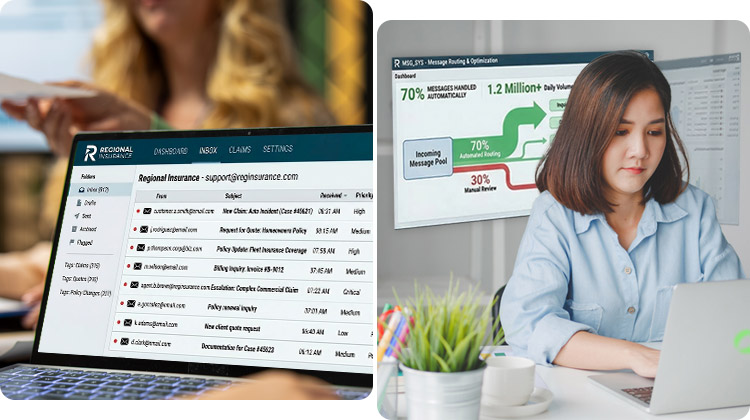
Illustration: A regional insurance firm in Dallas receives roughly 800 support emails every week. Most of them follow predictable patterns. Their NLP specialist built a classification and routing system that handles 70% of incoming messages.
Human review not required. Response times dropped from hours to minutes. That recovered capacity is directed towards actions that require human judgment.
#3. Generative AI Specialist
Works with large language models to build internal knowledge bases and content pipelines, document automation tools, and AI-assisted workflows. This isn’t simply someone who knows how to write a prompt in ChatGPT.
This type is increasingly relevant for businesses that produce high volumes of repetitive written output.
#4. AI Automation Specialist
Integrates AI into existing business workflows rather than building models from scratch. Where a standard operations hire connects your tools, AI automation specialists layer intelligence on top: routing decisions based on model outputs, classifying customer requests dynamically, and parsing unstructured data before it enters a workflow.
The output, at scale, is hyper-personalization: every contact receives communication that reflects their specific behavior.
#5. Machine Learning Operations (MLOps) Specialist
Keeps AI systems from malfunctioning quietly and before anyone notices. They handle deployment pipelines, model monitoring, performance tracking, and updates as conditions change.
#6. AI Product Specialist
Sits between the business and the technical work. They specify what your business should get from AI, translate that into project scope, and communicate results so your team can act on them.
#7. AI Compliance Specialist
Ensures your AI systems meet HIPAA, FINRA, GDPR, or CCPA requirements now, and as your business continues to grow and face changes.
How to Know Which Specialist Your Business Actually Needs
Start with your problem. Every business problem AI can solve falls into a recognizable pattern: predicting something, automating a decision, processing language at scale, keeping a system running reliably, or staying compliant.
Use the grid below to match your situation. If the same specialist type appears against your two or three highest-priority problems, that’s your starting point. A few rules of thumb:
- If your data is the problem, start with a Machine Learning Specialist. Unused transaction or behavioral data is forward-looking insight waiting to be extracted.
- If your people are the bottleneck, look at AI Automation or NLP. Any process where a human reads something and decides what to do with it is a candidate for automation.
- If you’re in a regulated industry, Compliance isn’t optional. Involve this specialist before any system goes live, not after.
- If you don’t have an internal technical team, hire the translator first. An AI Product Specialist prevents expensive misalignments between vendor promises and actual delivery.
- If something is already built and running unsupervised, you need MLOps. A model nobody is monitoring is a liability.
When problems span multiple categories, prioritize by impact. Fix the highest-cost problem first.
How Much Does It Cost to Hire an AI Specialist?
Salaries for this role in the US range from around $70,000 for entry-level hires to $200,000 or more for senior specialists, before benefits, tools, and overhead raise that number.
For many SMBs, that math doesn’t have to be the barrier.
The same hands-on expertise is available remotely, at a cost structure that reflects a different labor market rather than a different standard of work. For businesses where AI isn’t yet a full-time need, part-time and project-based engagements bring that cost down further while still delivering measurable results.
Why Hire a Remote AI Specialist
Not every business is at the same stage with AI. But the situations that call for this role tend to show up in recognizable ways. Consider this a quick “Readiness Check.”
#1. You Have Data With No System to Read It
Your CRM has records. Analytics platform has numbers. The email tool has open rates. But nobody on your team has the time or the technical background to extract anything strategic from any of it.
#2. Your AI Tools Are Running Unsupervised
You set up a chatbot, a recommendation engine, or an automated scoring system at some point. It runs. Nobody checks it. You don’t know if it’s still working correctly because there’s no reporting infrastructure to tell you.
#3. You’re Adding Headcount to Handle Volume
Every time your business grows, you hire another coordinator to manage the increase. That’s a maintenance model, not a growth model. If your operational costs grow in direct proportion to your revenue, the system isn’t scaling.
#4. A Competitor’s Operation Is Getting Faster
You can see it: your competitors’ customer experience is more responsive. Their outreach is more personalized. Their team seems to produce more with the same apparent headcount.
Remote talent is how businesses at your stage are making this hire without breaking the budget.
How Remote Staff Sources Specialists for US Businesses

With AI industry demand outpacing local supply in the US, remote hiring has become the practical answer and a deliberate choice. The work is platform-based, the output is measurable, and geography has no bearing on either.
The specialist salary difference compared to a US-based hire is significant, and it comes down entirely to location, not caliber.
Remote Staff gives US businesses access to experienced AI professionals across all the AI job qualifications covered in this article. Every candidate is screened for demonstrated project experience.
When you hire AI specialist, you choose the structure that fits where your business is, whether full-time, part-time, or project-based. Payroll, onboarding administration, and HR support are handled on your behalf, so the time you’d otherwise spend on administrative setup goes back into your business.
FAQs About Hiring an AI Expert
Is an AI specialist the same as a data scientist?
Not exactly. Data scientists focus on extracting insights through statistical analysis and modeling. AI specialists apply those capabilities operationally by building and managing the systems that act on those insights in real-time.
What’s the difference between an AI engineer vs AI specialist?
An AI engineer builds the models and the technical pipelines from scratch. A specialist works within that infrastructure, applying existing AI tools and platforms (like LLMs or automation frameworks) to solve specific business problems.
Do I need a specialist if I already use tools like HubSpot or Salesforce?
Quite possibly. Most modern platforms include native AI features that go completely unused. A specialist activates these hidden capabilities and connects them to your other tools to build a truly intelligent stack.
How long does it take to see results from AI automation?
Businesses with clean data typically see measurable output within 2 to 3 months. If your data is fragmented or your tools aren’t connected yet, expect a full quarter to build the foundation before the ROI becomes visible.
Businesses Growing Fastest Already Have an AI Specialist on Their Team
The AI tools your business is paying for right now are not running at their potential. Not because the tools are bad, but because the expertise to connect them, configure them, and extract what they’re actually capable of is a specific skill set no one on your team currently has.
That skill set is what an artificial intelligence specialist brings. They understand the technology deeply enough to make it work around your business.
The gap between what AI can do for your business and what it’s currently doing is exactly the size of this role. The businesses pulling ahead this year aren’t using better tools than their competitors. They have an expert who knows how to use them properly.
Your team doesn’t have one. Yet.
Check out our offshore readiness checklist and request a callback. It’s time to plan for this hire today.

Vaune Everis Cura has always been a writer in the truest sense, drawn to the art both as a personal creative pursuit and as a profession. Her experience penning content across digital marketing spaces and collaborating with business owners and market shapers has broadened her craft to include strategic direction and SEO insight. Having spent years with the InterContinental Hotels Group before stepping boldly into freelancing, she understands that at the centre of it all are genuine, meaningful brand–customer relationships built on purposeful, human content.