
When hiring remote staff, most founders aim for a productive, independent team member who “just gets it.” But when things don’t go as planned in virtual staffing, it’s common to assume the issue lies with the person.
They’re too slow, too quiet, not proactive enough. And before long, the label sticks: bad hire. In many cases, though, that conclusion can be premature—and misdirected. The issue isn’t always who you hired. More often, it’s how the role was defined, how the systems were (or weren’t) set up, and what the hiring process emphasized in the first place.
Let’s take a closer look at the symptoms that often get misread as hiring failures—and the structural issues that are typically behind them.
What Founders Often Misinterpret as Hiring Mistakes
Certain patterns come up again and again when managers feel that a remote hire “isn’t working out.”
These observations may be valid—but the conclusion isn’t always:
“They Can’t Do the Job”
This concern usually surfaces when a new hire struggles with foundational tasks, overlooks important details, or delivers work that feels uneven or below expectations. From the founder’s perspective, it can quickly look like a skills gap—or worse, a misrepresentation of experience.
But a perceived lack of technical ability doesn’t always originate with the hire. In many cases, it traces back to how the person was evaluated in the first place. If the hiring process relied primarily on resumes, interviews, or conversational assessments, there may never have been a meaningful opportunity for the candidate to demonstrate real, job-relevant skills.
And without technical assessments, practical exercises, or scenario-based questions, it’s difficult to validate whether someone can actually perform the work required day to day.
Equally important is whether candidates were asked to solve realistic problems during hiring.
Were they given hands-on tasks, sample workflows, or case studies that mirror actual responsibilities?
Were technical interviews structured to test applied knowledge rather than theoretical understanding?
When these steps are skipped, gaps in ability often show up only after the hire has already started.
Even when baseline skills are present, performance can still suffer if expectations aren’t clearly defined. If examples are vague, standards are implied rather than stated, or success criteria are left open to interpretation, new hires are forced to guess.
That guesswork often shows up as mistakes, slow execution, or work that doesn’t align with what the founder had in mind—not because the person lacks competence, but because they were never given a clear reference point for what “good” looks like in this specific role and environment.
“They’re Unreliable”
One of the more common complaints founders raise is about inconsistency—missed deadlines, late log-ins, or lapses in responsiveness during working hours.
In a physical office, these behaviors would stand out immediately. In a remote setup, where visibility depends on structure rather than proximity, the same concerns often surface more gradually but feel just as frustrating.
However, what often looks like unreliability can actually be a breakdown in expectations—and in how those expectations were communicated (or not) from the beginning.
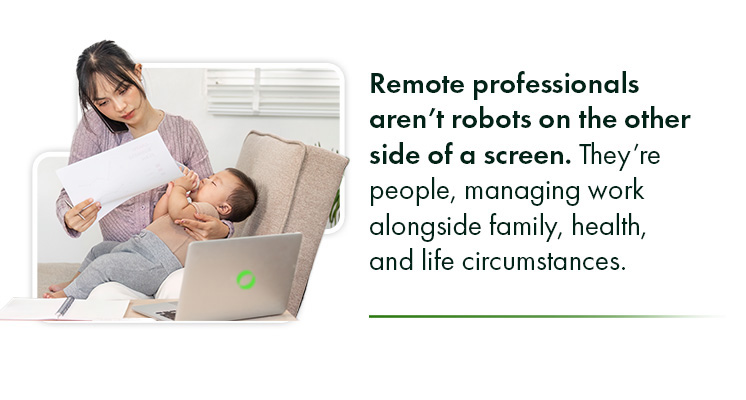
Remote professionals aren’t robots on the other side of a screen. They’re people, managing work alongside family, health, and life circumstances.
If working hours, availability expectations, or urgency protocols aren’t made clear up front, both sides are left making assumptions. And when those assumptions clash, the result gets misread as carelessness or lack of commitment.
Founders sometimes assume that a remote worker will match their own rhythm, stay constantly online, or prioritize unspoken urgencies. But unless those norms are explicitly stated and mutually agreed upon, there’s a high risk of misalignment.
Does the team have shared working hours? Is responsiveness expected within minutes, hours, or by end of day? What’s the protocol for when life interferes with work? These questions are rarely addressed early—but they should be.
In addition to setting clear communication and availability guidelines, there also needs to be infrastructure to support visibility.
Without a reliable way to log tasks, share status updates, or report blockers, even the most diligent contributor can appear disengaged. Accountability in remote teams is not just about output—it’s about designing systems that make progress visible and expectations fair.
Unreliability may sometimes be a real issue. But more often, it’s a reflection of mismatched assumptions, unspoken norms, or avoidable gaps in communication—especially in the early stages of the working relationship.
Set the right expectations early, and you avoid turning manageable misunderstandings into misplaced judgment.
“They Don’t Communicate”
This complaint often arises when a remote hire gives sparse updates, rarely asks questions, or seems absent from team channels. Language barriers may also contribute to the perception of disengagement.
But communication isn’t universal—it’s contextual. If expectations around what to share, how often, and through which channels aren’t clearly defined, people default to their own habits. What one team sees as “radio silence,” another may view as focused execution.
Silence often reflects ambiguity, not apathy. If someone isn’t updating you, it’s worth asking: were check-in rhythms set? Were they told what’s expected daily vs. weekly? Are questions welcomed or discouraged—explicitly or implicitly?
Most people communicate better when norms are clear, safe, and reinforced. When they’re not, mismatched styles are easy to misread as a lack of effort.
“They’re Not a Culture Fit”
When a new team member resists feedback, prefers to work independently, or communicates differently than the rest of the group, it’s easy to write them off as a poor culture fit.
But more often than not, that label reflects a mismatch of working styles—not a failure of attitude or intent.
The term “culture fit” is frequently used as shorthand for discomfort: they don’t work the way we work, or they don’t mesh with the existing team dynamic. But without a clearly defined cultural framework—how decisions are made, how collaboration happens, how feedback is handled—it’s hard for anyone new to align. What may feel like resistance could simply be unfamiliarity with team norms that were never made explicit.
This is where a more structured approach can help.
Rather than relying on gut feel or post-hire impressions, founders can use psychometric tools—like the Predictive Index—to understand behavioral drives and predict how someone is likely to communicate, collaborate, and respond to pressure. These insights allow hiring teams to define culture fit not as a vibe, but as a set of measurable traits aligned with role demands and team dynamics.
Approaching culture fit scientifically—rather than intuitively—helps reduce bias, improve alignment, and set up both the new hire and the team for success. It shifts the question from “Do they seem like one of us?” to “Do they bring the traits this role and team actually require?”
“They Lied on Their Resume”
When a new hire talks a strong game during the interview but underdelivers once the work starts, it’s natural to suspect they overstated their experience.
And in some cases, that’s true—résumé inflation does happen.
But more often, the real issue isn’t dishonesty—it’s a hiring process that failed to validate what mattered most.
Many interviews still reward confidence, charisma, and general familiarity with industry language, while overlooking the specific capabilities the role actually requires—especially in remote environments where written communication, self-direction, and follow-through are critical.
Without structured assessments or real-world tasks built into the process, it’s easy to mistake a polished interviewee for a fully qualified hire.
The fix isn’t to become overly skeptical of every candidate—it’s to tighten the front end of the hiring process.
That starts with a properly scoped job description that’s tied to actual outcomes, not just a wishlist of skills. From there, build structured interview questions that probe how candidates have handled similar challenges in the past. And most importantly, include job-relevant assessments—case studies, writing tasks, or test projects—that reflect what success looks like in the role.
When you design the hiring process to test for substance, not just style, you greatly diminish the need to second-guess someone’s credibility.
“They Lack Initiative”
“They wait to be told what to do. They don’t take ownership.” These are some of the most common complaints when dealing with virtual staff.
On the surface, it can feel like the person isn’t motivated, isn’t thinking ahead, or simply doesn’t care enough to go the extra mile.
But initiative doesn’t exist in isolation—it’s shaped by the environment and the clarity of the role.
If a new hire hasn’t been given enough context, decision-making authority, or access to key tools and information, hesitation is often a rational response. Without clear signals on what’s in their control, people will default to caution.
What gets labeled as “passive” may in fact be someone trying not to overstep in a vague or undefined setup.
Still, some individuals are naturally more proactive and comfortable operating without close guidance. The key is to identify this before hiring.
One effective way to do that is by designing structured behavioral interview questions that uncover past patterns.
For example: “Tell me about a time when you took initiative on a project without being asked. What was the situation, what did you do, and what was the result?”
Answers to this kind of prompt give you a clearer picture of how the candidate behaves when faced with ambiguity—and whether they naturally lean toward taking action or waiting for direction.
In addition to interviews, psychometric tools like the Predictive Index can provide a deeper, more data-driven understanding of a candidate’s behavioral wiring.
Some roles call for people who are comfortable operating independently and making quick decisions. Others require more structure and support. The PI helps match personality traits to the actual demands of the role, so you’re not just hoping someone has “initiative”—you’re intentionally screening for it.
What’s Actually Going Wrong: The Structural Issues Behind “Bad Hires”
In many of these cases, the behaviors that frustrate founders are symptoms of something else: missing structure, rushed onboarding, and unclear expectations.
Undefined or Shifting Role Scope
When responsibilities aren’t clearly outlined—or change from week to week—it’s easy for new hires to miss the mark.
Without knowing the exact outcomes they’re responsible for, or what decisions they can make independently, they either act too cautiously or overstep. Neither looks great, but both are understandable.
Clear scope isn’t just a job description. It’s a working agreement: here’s what you own, here’s where you can make calls, and here’s what success looks like.
Overhiring for Breadth, Not Fit
It’s common to hire one person to solve too many problems: a VA who can manage operations, create content, handle customer support, and maybe even “help with strategy.”
But no one thrives in a role this fragmented unless they’re given time and guidance to narrow focus.
When expectations are too broad, failure is almost guaranteed. And it’s not because the person can’t perform—it’s because no one could in that setup.
No Task or Workflow Infrastructure
A lack of process creates confusion. When there’s no task management system, unclear priorities, or multiple channels of communication, even the most capable hire will struggle to stay on track.
Blaming the person for disorganization when a proper system doesn’t exist is like blaming someone for taking the wrong road when no map was provided.
Weak Screening for Remote-Critical Skills
Many hiring processes still prioritize performative signals—how well someone comes across in a video call—over the day-to-day competencies that actually matter in remote work.
Time management, documentation, async communication, and follow-through are harder to assess, but far more predictive of long-term success. If you don’t screen for these, don’t get surprised if the hire seems to flounder once the video call ends and the actual work begins.
Missing Onboarding and Role Context
Effective onboarding goes beyond introductions and logins. It involves giving someone the tools, knowledge, and real-world context they need to get started.
If a hire has to dig through Slack history to figure out your processes or guess which file is the latest version, that’s not a performance issue. That’s a design flaw.
Gaps in Communication Rhythm
When there’s no regular cadence for updates, check-ins, or feedback, misalignment festers. Some founders unintentionally ghost their team for days, then resurface with new instructions—and are surprised when the hire isn’t “proactive.”
But without a structured loop of input and course correction, there’s no safe path forward. The result is paralysis, not ownership.
Misunderstood Expectations Around Autonomy
Founders often want hires who can “own” things.
But ownership without access, decision-making authority, or clear goals is meaningless. If a team member constantly has to ask for approval or wait for feedback, they’ll naturally fall back into dependency.
The problem isn’t that they lack initiative. It’s that the system isn’t built to support it.
How to Separate True Performance Issues from Structural Gaps
Not all hires will work out. But before making that call, it’s critical to distinguish between a performance or skill gap or and structural issues within your organization.
Legitimate Red Flags
There are times when parting ways is necessary. These include:
- Repeated dishonesty, such as falsifying time logs or misrepresenting qualifications.
- A pattern of ignoring feedback after it’s been made clear and actionable.
- Consistently low-quality output even when SOPs, context, and support are provided.
When these occur despite a strong foundation, it’s time to take decisive action.
Misinterpreted Signals
More often, the following issues are falsely read as incompetence:
- Uncertainty around priorities—especially when no clear task system exists.
- A slow start in the absence of proper onboarding or documentation.
- Over-reliance on the manager for direction when decision boundaries aren’t defined
In these cases, what looks like failure may actually be a natural response to the environment.
How to Build a Setup Where Virtual Staffing Succeeds
So how can you prevent these misunderstandings and create a hiring process that sets both you and your team up for success?
1. Define the Role in Operational Terms
Start by writing down the outcomes this role is responsible for, the decisions they can make independently, and what “excellent work” looks like in that domain.
Avoid generic lists. Instead, describe real-world scenarios they’ll be handling.
2. Design the Hiring Process Around the Work
Instead of focusing solely on resumes and interviews, include tests, writing samples, or trial tasks.
Evaluate candidates on how they communicate, follow instructions, and solve problems independently—not just how they talk about it.
3. Build Onboarding Like a Runway, Not a Launchpad
Structure the first 30–90 days as a progression: introduce tools and context gradually, define checkpoints for feedback, and provide clear guidance on what to focus on each week.
Don’t assume someone will “figure it out” unless that’s part of what you hired them to do.
4. Clarify Autonomy with Guardrails
If you expect someone to take initiative, give them the clarity and authority to do so.
Define where they can make decisions, what they should escalate, and how to track progress. Autonomy thrives when supported—not when left to guesswork.
Final Thought
Most virtual hires who don’t meet expectations weren’t the wrong person.
They were placed into roles without the structure or clarity to succeed. If your remote team keeps running into similar issues, it might not be a hiring problem—it might be a systems problem.
Fix the system, and you may find the hire was right all along.
- Also looking for ways to upsell or cross-sell your products and services? Click here.
- Looking for ways to work around tariffs? Learn more here.
- If you’re ready to experience the full advantages of working with a top global team, check out our 1,000 fully vetted and highly talented staff here.

Darren Aragon is a multifaceted writer with a background in Information Technology, beginning his career in research at Pen Qatar and transitioning through customer service to a significant role at Absolute Service, Inc. His journey into freelance writing in 2021 has seen him excel across various niches, showcasing his adaptability and deep understanding of audience engagement.