

The new year brings many opportunities. For individuals, it’s a time to set new goals or build better habits. For businesses, it’s another chance to make bold marketing moves to sustain growth – or even surpass what they achieved in the past year.
It’s important, then, to set new targets and identify key milestones. For business owners, this means strengthening their presence in the marketplace through consistently bold, yet carefully planned marketing strategies.
Why Bold Moves Win in 2026
Social media, Gen Z consumers, and artificial intelligence are changing the way we do business. In 2026, particularly, “playing it safe” won’t cut it anymore.
Here’s why.
Consumers Expect Personalization and Purpose
Personalization now goes beyond addressing customers by their first name in emails. Since this has become the default, effective marketing strategies require a deeper level of personalization.
Businesses must also invest in predictive algorithms. These tools help anticipate customer needs based on past purchases and browsing behavior. It’s also important to invest in values-first branding.
Modern buyers, particularly those from Gen Z and Gen Alpha, support brands with a “soul.” This means they actively seek out brands that don’t just deliver quality products, but also prioritize sustainability, ethics, and social responsibility.
So, how do you go about it?
Standing Out in a Crowded Market Requires Risk
Most, if not all, business owners are risk-takers – and this is even more true in the 2026 market.
The “middle of the road” is already crowded, with many startups and established businesses playing it safe by relying on marketing strategies that worked in the past.
However, today’s consumers are already bombarded with AI-generated content. As AI becomes the norm, it becomes even more important to create and develop a distinct brand voice.
To break through, take creative risks, such as:
- Unconventional aesthetics;
- Provocative messaging; or
- Experimental platforms.
Trends Move Fast – So Should You
Consistent social media posting is no longer enough. You need to track top marketing trends, identify which ones are relevant, and act on them before everyone else – or better yet, create your own.
This requires a lot of time, experience, and trial and error. Your marketing strategy must also be adaptable, as plans made for Q1 may no longer be relevant in the following quarters.
To make things easier, we’ve put together a list of five bold marketing moves to kick off 2026, based on current and emerging marketing trends.
Let’s take a look.
Move #1. Own a Micro-Niche with Specialized Content
Marketing in 2026 is no longer about reaching the most people; what matters now is reaching the right ones.
- Use Niche SEO and Topic Clustering – With generative AI in the mix, generalist brands are getting lost in the noise. This is driving a shift toward micro-niches, which calls for a focus on long-tail SEO and topic clustering rather than broad keywords.
- Build Authority in a Vertical – Move beyond one-off posts and focus on recurring deep-dive series, “masterclasses,” or gated guides that deliver high-value, actionable content.
For example, if you run a repair service, instead of posting a random tip about fixing home leaks, provide additional advice on how to prevent leaks or related maintenance tips.
Narrowing your focus doesn’t mean limiting your growth. In fact, it can accelerate your conversion rates by positioning your brand as a custom-fit solution rather than a generic alternative.
Real-Life Example
US brand YETI is a strong example of a micro-niche strategy. It began by deeply focusing on serious outdoor enthusiasts and professional hunters and anglers who need gear that can withstand extreme conditions.
Instead of traditional commercials, YETI produces high-quality, long-form documentaries that capture the “soul” of the niche—featuring wild horse trainers, remote deep-sea fishermen, and high-altitude ranchers.
Simply put, YETI avoids the “sea of sameness” by refusing to market to casual weekend picnickers. By creating content that feels “too intense” for the average consumer, it became a status symbol within an elite niche—eventually drawing the mass market toward the brand.
Move #2. Be First on New Channels (Before Your Competitors)
Social media channels are no longer limited to TikTok, Facebook, Instagram, and Twitter/X. Assuming otherwise would be a mistake.

In 2026, the costliest mistake a brand can make is waiting for a channel to trend before joining it. By the time you do, organic reach may have already plummeted, and the cost per acquisition for paid ads could have skyrocketed.
- 2026 Channels to Watch – For 2026, brands must familiarize themselves with:
- AI-Generated Video Platforms – Tools like Sora and its successors now allow brands to create hyper-personalized, high fidelity video ads in minutes.
-
- Short-Form B2B Podcasting – The era of the 60-minute “filler” interview is over. Today, executives are shifting to “atomic podcasts” – 3- to 5-minute daily insights – to engage more effectively with their followers.
-
- Shoppable Livestreams – Tech firms are now offering live, interactive demos, allowing procurement teams to ask questions in real time and click a “Request Custom Quote” button directly within the video feed.
- Dominate While Attention is Cheap – In 2026, the “Early Adopter Premium” is even more pronounced, as AI algorithms favor content volume and historical engagement.
By establishing your brand on emerging channels now, you train the platform’s AI to recognize you as a “Top Entity,” keeping you at the top of feeds long before competitors arrive and drive up costs.
Real-Life Example
While most beverage companies are still trying to master traditional social media, Liquid Death already positions itself as an “entertainment agency that happens to sell water.”
As a result, it prioritises being early in weird or unproven spaces where attention is cheap but culture is dense.
For example, as AI agents began influencing household purchasing decisions in late 2025, Liquid Death was among the first brands to optimize its product data for Generative Answer Engines (GAEs).
This ensured that when users asked an AI, “What’s the most eco-friendly water with a punk-rock vibe?” Liquid Death appeared as the cited authority.
Move #3. Use Data-Driven Storytelling for Deeper Engagement
Storytelling is more important than ever. While facts inform, stories help you sell. Grounding your stories in data adds authority and makes them even more relevant to your audience.
The most successful brands are shifting from generic brand storytelling to a customer-focused approach. Rather than highlighting your brand’s features, concentrate on sharing your customers’ stories.
Share user-generated content or create next-generation marketing materials based on real stories, performance analytics, and data from your organic followers and loyal customers. You can also use branded infographics to reinforce your stories with real-world data.
Real-Life Example
A good example is Ryan Reynolds’ Mint Mobile. The company began as a low-cost burner phone service and grew into a billion-dollar brand through effective storytelling and genius marketing.
Rather than competing with Verizon or AT&T for the mass market, Mint targeted a “challenger-mindset” niche – people who dislike the big wireless machine. As a result, its content focuses on one specific problem: the absurdity of wireless overpricing.
Mint uses customer behavior data to poke fun at the industry.
In a world of “unlimited” data claims, it famously showed customers they were paying for data they never used. This anti-upsell approach, grounded in real usage metrics, built an emotional bond through radical transparency – one of the strongest trust builders in 2026.
Move #4. Transform Customers Into Evangelists
In 2026, the most credible voice for your brand isn’t a paid influencer or a high-budget ad campaign – it’s your actual customer.
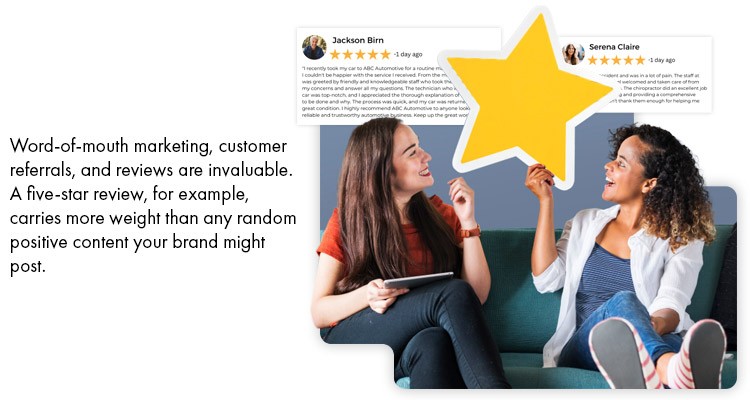
Word-of-mouth marketing, customer referrals, and reviews are invaluable. A five-star review, for example, carries more weight than any random positive content your brand might post.
So, how do you achieve this?
- Launch a Loyalty or Referral Program – Reward customers not just for buying, but for sharing. For example, create a tiered system where “evangelists” receive early access to new products or services in exchange for their authentic reviews.
Automate the collection of testimonials at moments of peak satisfaction. Then use these snippets to fuel your retargeting ads, replacing polished brand content with raw, relatable human experiences. - Feature Customers as Content Creators – The line between customer and creator has blurred. Today, customers are becoming organic supporters, generating content for the brands and products they love.
Create a Spotlight Reel that highlights the customer’s personal or professional journey and how your brand plays a role. By making the customer the hero rather than your brand, they’re much more likely to share the content with their own network.
Real-Life Example
Reynolds’ Aviation American Gin exemplifies this approach.
While many celebrity-owned spirits rely on billboards and traditional ads, Aviation Gin turns its audience into a self-multiplying sales force by treating every customer touchpoint as a moment of shared amusement.
For example, the brand publicly shared a real Aviation Gin email address – ryan@aviationgin.com. The twist? Anyone who emailed it received a series of hilarious, deadpan “out-of-office” replies.
The brand also actively encourages user-generated content (UGC) that mirrors Reynolds’ dry, self-deprecating humor.
When fans post photos of Aviation Gin cocktails with witty captions, the brand often engages directly, reinforcing a community where customers become co-writers of the brand’s story.
Move #5. Automate Creatively, Not Lazily
AI is a tool – and it should be treated as one.
Don’t fall into the trap of using AI to churn out content for the sake of it. Today, the competitive advantage belongs not to those who simply use AI, but to those who know how to orchestrate it effectively.
- Human + AI Copy = Best of Both Worlds – To maintain authority, treat AI as a high-level collaborator rather than a ghostwriter. Instead of relying on generic prompts, train your AI tools using your best-performing past work, a “never-use” word list, and your unique philosophical perspectives.You can use AI for 80% of the heavy lifting such as research, outlines, and initial drafts. However, the final 20% should be handled by a human editor to add nuance, humor, and the subtle insights that algorithms simply can’t replicate.
- Use Automation for Speed, Not for Voice – The true power of automation lies in eliminating the latency of thought.
Instead of setting up tasks one by one, automate distribution, formatting, and data tagging. You can also automate social media posting. For example, a single signature content video can be automatically sliced into 16 platform-specific clips.
AI and automation should be used to reduce workload, not replace the human touch.
So, make sure every automated touchpoint – from LinkedIn DM sequences to email nurturing – still feels personal and offers an option to connect with a real person, ensuring your brand voice remains authentic, not mechanical.
FAQs – 2026 Marketing Trends & Tactics
Here are some frequently asked questions about the future of marketing in 2026.
1. What Makes a Marketing Move “Bold”?
In 2026, boldness isn’t about a high budget, it’s about the willingness to deviate from the algorithmic path.

Rather than trying to be “everything to someone,” aim to be “something to everyone.”
It also means moving beyond safe, corporate approaches and prioritizing social values. In other words, it’s less about brand safety and more about brand bravery.
2. Is Content Still King in 2026?
With AI capable of generating endless “good” content at the click of a button, content is no longer king – authority is.
It’s no longer about churning out five blog posts a week; it’s about creating a single, deeply authoritative asset and using AI to atomize it into 50 platform-native versions.
Simply put, content is the territory while your brand authority is the king that rules over it.
3. How Do I Compete in a Saturated Niche?
Stop competing based on features and start competing on perspective instead.
Don’t aim to be the best “project management software.” Instead, position yourself as the “project management software for remote biotech research teams” or your chosen marketing niche.
By adding layers of specificity, you narrow your competitor set from thousands to dozens, making it easier to stand out.
4. What New Platforms Should I Invest In This Year?
Success this year isn’t about being on every platform. It’s about being on the platforms where your audience is already doing their research, such as:
- Generative Answer Engines (GAEs)
-
-
- Perplexity
- ChatGPT (with Search)
- Google’s Gemini
-
- “Dark Social” and Private Micro-Communities
-
-
- Invite-only Slack channels
- Discord servers
- WhatsApp Communities
-
- Interactive Vertical Video (B2B & B2C)
-
- TikTok Shop
- YouTube Shorts
5. Are Micro-Influencers Still Effective in 2026?
Gone are the days when influencers had to be celebrities or social media personalities with millions of followers. Today, even micro-influencers with fewer than 100k followers can be a powerful force in conversion-driven marketing.
With their smaller followings, micro-influencers are seen more as knowledgeable friends than as walking billboards selling anything and everything.
In 2026, success belongs to “informers,” not entertainers. Micro-influencers with professional expertise – such as engineers, sustainability experts, or specialized hobbyists – are now considered more effective, as their endorsements feel earned rather than bought.
Ready to Own 2026? Start Planning Bold Moves Now
Whether 2025 went as planned or didn’t end the way you hoped, 2026 offers your business a fresh opportunity to make its mark.

Invest in niche marketing, be bold in exploring new platforms, and leverage AI and automation to simplify your work – without ever losing the human touch.
With the support of your dedicated marketing team, 2026 can be a year of growth, expansion, and deeper connections with your loyal followers and customers.
For more information on how to get started, call us today or request a call back now.

Syrine studies law while working as a content writer. Outside of writing and studying, she tutors, plans events, and browses social media. In 2021, she published Stellar Thoughts.