
In This Blog:
92 million jobs are expected to be displaced by AI come 2030, according to the World Economic Forum’s Future of Jobs Reports.
There seems to be an impending doom of job insecurity made manifest by artificial intelligence. The internet has only fanned the flames with posts, reels, videos, and blogs about AI taking over, the slow burn of panic and anxiety spreading since 2022.
The same questions are being asked on repeat:
Is AI replacing humans?
What jobs will AI replace by 2030?
What jobs are safe from AI?
But what does the data say, really? The same WEF study that mentions those millions of jobs lost also says this:
170 million more jobs will be created by 2023, with a net +78 million, as a result of AI in the job market.
It’s another side to the story that doom-scroll algorithms fail to shed just as much light on. New jobs built. Certain human skills and experiences becoming more valuable.
The full picture starts with the misconception around “AI job replacement.”
The Misconception: What Jobs Will AI Replace? (Is AI Replacing Jobs?)
Yes and no. The numbers being shared about AI and job displacement are real and are backed by research. This much is certain. It’s that the conclusions being drawn from them are one-sided and overstated. Reports are stripped of context and repackaged in doomsday headlines of mass unemployment.
There’s a detail not being talked about as frequently, of the risk of being replaced:
It’s the difference between jobs being eliminated and jobs being affected, along with AI job automation within roles that remain in the hands of humans.
Either replacement or enhancement. Careers running obsolete versus tasks being automated.
Here are some statistics worth noting:
- McKinsey: 30% of US work hours could be automated by 2030; these aren’t vanishing jobs, but are tasks inside jobs
- Goldman Sachs: 300 million jobs are “affected” globally; “affected” isn’t the same as “eliminated,” and in this statement, it means “changed”
Task Erosion vs. Human Replacement
In understanding “What jobs will AI replace,” ask erosion occurs when many parts of a task are automated to the point that the role itself turns hollow. Sometimes, the role itself disappears. This is the single thread running through many “AI took my job” stories. That said, the whole of jobs being undone by AI, though happening, is less on a large scale than the media portrays.
“
Only 10–15% of US jobs could be eliminated by AI in the next five years. 50–55% will be reshaped, not eliminated.
Labor Market Research, April 2026
There’s been no systematic increase in unemployment for highly exposed workers since ChatGPT’s release in late 2022. The effect is not elimination but a slower hiring for entry-level roles. (Anthropic labor market research, March 2026)
Of course, that’s not to say there are certain sectors within industries that rely on AI more than others. But the non-dystopian fact remains: parts of jobs that are repetitive and rule-based are being replaced, so that the jobs themselves are reshaped.
Illustration: Tom is a loan officer at a mid-sized bank in Ohio. Monday mornings usually started with two hours of pulling credit reports and cross-referencing income documents. His least favorite parts of every workday and week.
His bank adopted an AI tool that now handles all of it before he arrives. Tom is still very much a valuable member of the bank. He wasn’t replaced by AI. He still approves or declines every loan and catches the things the system flags incorrectly.
What changed is that he does the actual job of a loan officer. His role remains. His job description, more tailored to his skill set. Only the repetitive, formula-driven parts of his daily responsibilities were made more efficient via AI.
Jobs Most Likely to Be Replaced by AI
Which Jobs Will Be Gone By 2030? (There’s a Catch)
The more a role can be described as a fixed input producing a fixed output, the greater its exposure is to AI adaptation. On the topic of common jobs affected by AI, two types of data exist on this:
- Observed exposure: what AI is actually doing in professional settings right now
- Projected exposure: what researchers estimate AI will automate based on task analysis.
They’re not the same thing, and it’s important to understand the distinction.
In March 2026, Anthropic published a labor market report that looked at what Claude is being used for in professional settings, then mapped it against 800 occupations. Naming it “observed exposure,” it’s a metric with a grounded read on where AI is in today’s workforce.
What Jobs Will AI Replace By Observed Exposure:
The Observed Coverage column is what’s taking place presently, while the Theoretical Capability Column is about what the AI can do in the near future.
A note on theoretical capability: You may have noticed the staggering numbers under Theoretical Capability. When Anthropic’s research lists everything above Healthcare Support in high percentages, it’s measuring what AI can do with the tasks inside that field. It doesn’t represent what audiences want.
For instance, it tells you that AI can generate scripts, conduct diagnoses, and analyze financial reports. But “theoretical capability” has nothing to do with the person receiving what AI will produce.
Related Read: Automation’s on a high, but there’s also such a thing as too much of it. Don’t go the Kroger way and lose billions in the process. Learn about the Risks of Over Automation.
What Will AI Automate Next?
Data here is drawn from task analysis. This project-based research is sector-specific, showing where the trajectory points (McKinsey, Oxford, Careery).
What Occupations Have the Highest Risk of AI Automation? (The Next Phase)
A note on these numbers: Automation risk percentages refer to the proportion of tasks within a role that are automatable. It isn’t reflective of the probability of the entire job disappearing.
A bookkeeper at 94% task exposure doesn’t mean 94% of bookkeepers lose their jobs. It means most of what they do daily can be handled by a system. What remains is the judgment layer and other key skills a system can’t replicate.
The Pattern Across The Numbers
Every role with high exposure has one thing in common: the work includes parts that follow a formula. Getting to that formula doesn’t require human judgment or empathy. That’s exactly what AI is good at, regardless of the job type or whether the role has “junior” or “senior” preceding it.
The Dallas Fed put it simply in February 2026:
AI takes over work that runs on textbook knowledge, and makes experienced workers more valuable. The people most at risk are those whose daily, repetitive, formulaic work could be written out with code.
Even the most exposed roles won’t be completely gone because what’s disappearing are checklists, the repetitive tasks inside them.
Related Read: On the topic of “exposure,” here’s something about the Cybersecurity Skills Shortage US, AI Scams and Deepfakes, and why SMBs are being targeted.
What Jobs are Safest From Being Replaced By AI? (AI-Proof Careers)
This list of jobs AI cannot replace (careers safe from AI) has more to do with the value inside roles rather than what AI can’t structurally reach. Here are some categories of job roles that will remain in human hands, and away from AI’s full grasp. Where augmentation, human skills plus judgment plus creativity, enhanced by AI productivity, is most promising.
AI Job Replacement Statistics: Jobs AI Will NOT Fully Replace (Which Jobs Won’t Get Taken Over By AI)
55% of consumers are more likely to trust brands that publish human-generated content, and consumer preference for AI-generated content dropped from 60% to 26% in three years. Brand trust, loyalty, and audience relationships are built on the belief that a real person is behind what’s being said. The premise of human-centered careers.
Related Read: AI isn’t the only one creating opportunities. Here are Wealth Building Trends for Remote Business Owners.
Now the Other Side: What Jobs Will AI Create?
It’s not one-sided. Artificial intelligence in job markets is creating job titles that weren’t considered mainstream professions a few years back. In the United States, AI Engineer is now the #1 fastest-growing job title, up 143% year-over-year (LinkedIn, 2026).
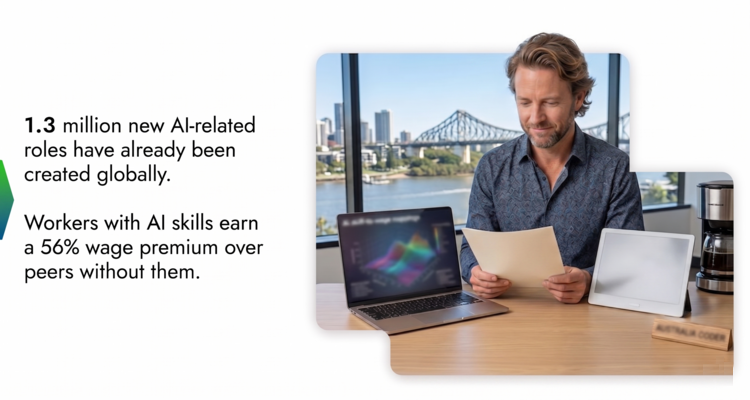
Reskilling for AI economy? 1.3 million new AI-related roles have already been created globally. Workers with AI skills earn a 56% wage premium over peers without them.
AI removes the execution layer in formulaic tasks, then creates demand for the people who govern the systems within.
These are the roles, with skills needed for AI future.
What Does An AI Engineer Do?
An AI engineer builds and sets up AI systems. Software engineers, data scientists, and full-stack developers are transitioning into it right now. PhD certificates not required.
Salary range: $110,000–$206,000+
What Does an AI Prompt Engineer Do?
The person who figures out how to retrieve reliable output from AI tools. They design workflows so that AI can build at scale. Companies that have both the tool and the AI prompt engineer report 40% fewer AI errors.
Salary: $96,000–$166,000
Projected growth: 33% annually through 2030
What Do AI Specialists Do?
This specialist activates AI tools to handle operational problems. They turn the existing AI into a workable, profitable system. Very few SMEs have an AI specialist on their team who knows how to use them properly.
Salary: $70,000–$200,000
Illustration: Rachel runs a marketing agency in Austin. She’d been paying for HubSpot for two years. Her team of 22 used it for email and basic contact management.
An AI specialist she hired six months ago switched on predictive lead scoring and connected it to her sales pipeline. Tasks that two coordinators would spend way too much time on now run independently. Those coordinators are able to focus on strategy and relationship-building.
Rachel kept her team and merely upgraded what her team does.
What Does An AI Data Annotator Do? (AI Trainer)
AI learns from labeled data. That data labeling is done by a specialist who’s able to teach the model to recognize good output from bad. This requires real domain expertise.
Salary: $113,000–$170,000
Projected growth: 32.8% through 2030
AI Governance and Ethics Specialist
When AI makes decisions such as hiring, lending, and medical triage, those decisions need to be under the supervision of an expert. That expert should have the skill of deciding what’s legal and fair, being objective while taking the human problem into consideration, when appropriate.
Salary: $120,000–$180,000+
This is currently the fastest-growing governance category in enterprise hiring.
Hire the roles you need as you businesses expands in the world of AI augmentation (humans + AI working together) and know how to Calculate Outsourcing Cost US.
FAQs
What jobs will AI replace first?
Data entry, basic customer service duties, entry-level, replicate-heavy content production, and routine administrative tasks are the first. Since their output is based on highly structured inputs and doesn’t require human judgment, AI can easily take over this territory. Entry-level workers in high-exposure roles have already seen a 13% employment decline (Harvard/HBS, 2025).
Will AI replace more jobs than it creates?
No. It will reshape more jobs than it creates or eliminates. The harder truth is that the jobs being lost and the jobs being created may not be in the same industries or skill types.
What new jobs is AI going to create? (Which 5 jobs will survive AI?)
These are the jobs AI has already created: AI Engineer, Prompt Engineer, AI Specialist, AI Trainer or Data Annotator, and AI Governance. They are also undergoing the most active hiring for AI-created roles.
What do you do as an AI specialist?
AI specialists set up and implement existing AI tools inside a business. They don’t build AI or systems. Instead, they make your business’s existing AI solve problems. By configuration and integration, they help improve your tools over time.
Don’t Fall For The AI Doomsday Takeover Narrative
Not when it comes to a job market takeover, anyway. Better yet, equip yourself with skills that are about to become, if not already, highly in demand, due to the emergence of artificial intelligence.
This is the age of the future of work that AI is expanding. It’s also the age of human capacity evolving. AI isn’t displacing people, nor is it obliterating every role out of existence.
It’s not that all careers are resistant to AI or that everything will become automation risk jobs. Learn about human skills that are turning into treasure troves of true value. Skills that can stand the test of time, and the evolution of tech and AI. If you have them, double down. If you don’t, it isn’t too late to master them.
The data has always upheld both sides of the story. It’s just that the other noteworthy detail didn’t get as much coverage overall.
What matters is that you’re paying attention to which side of the job market change you’re looking at, and what you’re doing about it. Request a Call back.
Looking to future-proof your workflows and teams? Discover how to hire specialized, AI-fluent remote professionals. View our Remote Staff Roles and Rates today.

Vaune Everis Cura has always been a writer in the truest sense, drawn to the art both as a personal creative pursuit and as a profession. Her experience penning content across digital marketing spaces and collaborating with business owners and market shapers has broadened her craft to include strategic direction and SEO insight. Having spent years with the InterContinental Hotels Group before stepping boldly into freelancing, she understands that at the centre of it all are genuine, meaningful brand–customer relationships built on purposeful, human content.