

Hiring is one of the few business decisions where companies are expected to make long-term commitments based on limited, imperfect information. Despite this, many organizations still rely heavily—sometimes almost exclusively—on a single decision tool: the job interview.
While interviews are familiar and intuitive, decades of research and real-world hiring failures have shown that interviews alone are insufficient predictors of job success. The true cost of a mis-hire extends far beyond the obvious expense of recruitment fees or replacement costs.
Poor hiring decisions disrupt team productivity, erode morale, consume management time, and delay strategic execution. In roles that influence customers, revenue, or leadership pipelines, a single mis-hire can create ripple effects that last for years.
To address this challenge, leading organizations are moving away from intuition-based hiring and toward evidence-based selection systems.
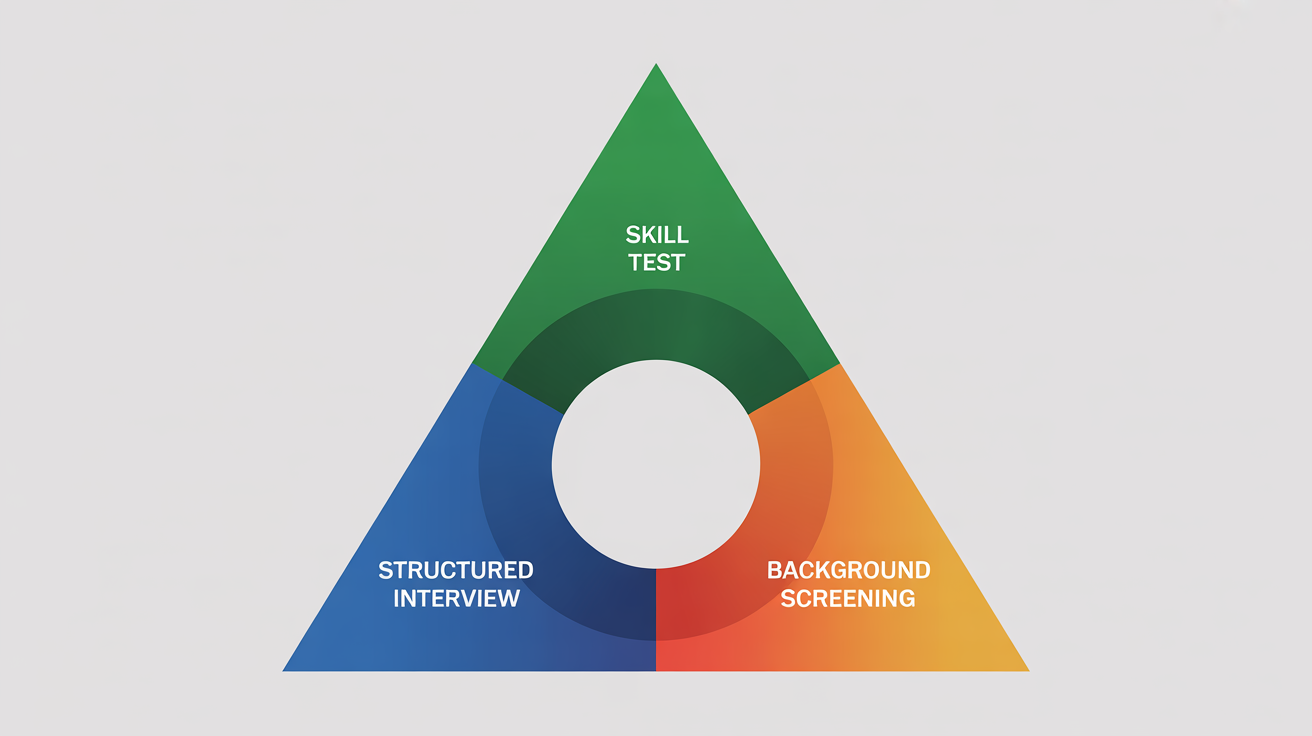
One of the most effective of these systems is what can be described as the 3-Way Hiring Method—a structured, repeatable approach that combines three complementary evaluation tools: structured interviews, short skills tests or live cases, and triangulated reference and background checks.
When designed and executed correctly, this method materially improves decision quality and can drive meaningful gains in performance, retention, and cultural alignment—often approaching a 60% improvement in overall quality of hire compared to interview-only approaches.
Redefining “Hiring Fit”
At its core, hiring is not about selecting the most impressive candidate. It is about selecting the candidate with the highest probability of long-term success in a specific role, within a specific organization, at a specific moment in time.
True hiring fit has three dimensions.
The first is performance: the individual’s ability to consistently deliver outcomes at the level required by the role. The second is retention: whether the individual can sustain that performance over time without disengagement, burnout, or misalignment. The third is culture alignment: how well the individual’s values, behaviors, and working style integrate with the team and organizational environment.
Most hiring failures occur not because candidates lack intelligence or motivation, but because one or more of these dimensions were never properly evaluated. The 3-Way Hiring Method exists to address this gap by systematically assessing each dimension using distinct, evidence-based signals.

Why a Multi-Method Approach Works
Hiring is fundamentally a prediction problem. Organizations are attempting to forecast future behavior, often under pressure, ambiguity, and changing conditions, using limited information gathered over a short period of time.
This makes predictive validity, or the extent to which a selection method accurately forecasts future job performance, critically important. Different hiring methods capture different aspects of candidate behavior.
Structured interviews provide insight into how candidates reason, reflect, and describe past behavior. Skills tests and work samples demonstrate whether candidates can actually perform the tasks required by the role.
Reference and background checks reveal how consistently candidates have shown up across contexts and over time. Each method has limitations when used in isolation. Interviews can be influenced by charisma or bias.
Skills tests may miss interpersonal dynamics. References can be superficial if poorly structured. However, when these methods are combined into a coherent system, their strengths reinforce one another and their weaknesses are mitigated.
This is the central logic of the 3-Way Hiring Method: no single data point decides the hire. Instead, decisions are made by triangulating multiple, independent sources of evidence.
A High-Level Hiring Workflow
Organizations that apply the 3-Way Hiring Method typically follow a standardized funnel. Candidates progress from an initial resume or profile screen into a structured interview.
Those who meet a defined threshold then complete a short skills test or participate in a live case exercise. Finalists undergo reference and background triangulation before an offer decision is made.
What differentiates this process from traditional hiring is not the steps themselves, but the discipline of standardization. Each stage uses consistent questions, scoring criteria, and pass-fail thresholds. This reduces subjectivity, improves fairness, and allows hiring decisions to scale without degrading quality.
Method One: The Structured Job Interview
Interviews remain a critical component of hiring, but their effectiveness depends entirely on how they are designed and conducted. Unstructured interviews—informal conversations guided by intuition—are poor predictors of job success.
In contrast, structured and semi-structured interviews consistently rank among the most predictive selection tools when aligned with job requirements. The foundation of a structured interview is job analysis.
Before any questions are written, the organization must clearly define the competencies that differentiate high performers from average or struggling ones. These competencies typically include a mix of technical capability, problem-solving ability, communication, collaboration, and role-specific behavioral traits.
Once competencies are defined, interview questions are designed to elicit concrete evidence. Behavioral questions ask candidates to describe specific past experiences, while situational questions explore how candidates would respond to realistic future scenarios.
Both approaches move the conversation away from hypotheticals and toward observable patterns of behavior. Equally important is scoring. Structured interviews rely on simple rating scales—often from one to five—anchored with clear behavioral examples.
This makes sure that different interviewers interpret responses consistently and evaluate evidence rather than impressions. Notes are taken systematically, and scoring is completed independently before discussion, minimizing groupthink and bias.

Method Two: Short Skills Tests and Live Case Exercises
While interviews assess how candidates explain their thinking, skills tests reveal how candidates actually work.
Work samples and job-relevant assessments are among the strongest predictors of real-world performance because they simulate the tasks candidates will perform after hiring.
Effective skills tests are designed with three principles in mind. First, they are job-relevant, reflecting real tasks rather than abstract puzzles.
Second, they are time-bounded, typically lasting between 30 and 60 minutes to balance rigor with candidate experience.
Third, they are evaluated using clear rubrics that define what good performance looks like.
Skills assessments can take many forms. Some roles benefit from written exercises, such as drafting an email, proposal, or analysis.
Others may require technical tasks, such as building a spreadsheet model or debugging a process. Leadership and strategy roles often benefit from live case discussions, where candidates walk through their thinking with a hiring manager.
The goal is not perfection, but evidence of capability, structure, and judgment.
Importantly, skills test scores should be integrated into a weighted scorecard alongside interview results. This prevents any single method from disproportionately influencing the final decision.
Method Three: Reference and Background Triangulation
Reference checks are often treated as a formality, conducted late in the process and limited to candidate-supplied contacts. When handled this way, they add little value. However, when structured and triangulated, references become a powerful form of verification.
The purpose of reference checking is not to confirm whether a candidate is likable, but to test the consistency of their claims against observed behavior. High-value reference checks focus on job-relevant behaviors such as reliability, collaboration, ownership, and integrity.
A triangulated approach intentionally seeks multiple perspectives. Former managers can speak to results and accountability. Peers provide insight into collaboration and dependability. Direct reports, where applicable, reveal leadership style, fairness, and coaching ability. Patterns across these perspectives are far more informative than any single opinion.
To remain ethical and compliant, reference conversations must verify the identity and relationship of the source, avoid inappropriate questions, and remain tightly anchored to job-related competencies.
When conducted properly, reference checks often surface early warning signs—or strong confirmations—that do not appear elsewhere in the process.
Integrating the 3-Way Method into the Organization
The effectiveness of the 3-Way Hiring Method depends on integration and follow-through. Organizations should consolidate interview scores, skills test results, and reference insights into a single decision framework.
Weights can be adjusted based on role priorities, but the principle remains the same: decisions are evidence-based, not personality-driven.
Equally important is measurement over time. Hiring quality should be tracked through post-hire indicators such as performance reviews, ramp-up speed, and early attrition. This feedback loop allows organizations to refine their selection criteria and continuously improve outcomes.
Over time, organizations that systematize this approach consistently report fewer mis-hires, faster onboarding, and stronger team performance. Achieving a 60% improvement in quality of hire is not a matter of chance—it is the result of disciplined design, execution, and learning.

Applying the Method: Turning Hiring into a Strategic Capability
Hiring excellence is not the product of instinct, charisma, or confidence in one’s ability to “read people.” Those qualities may feel decisive in the moment, but they are unreliable predictors of sustained performance.
What consistently produces better hiring outcomes is structure, evidence, and disciplined execution. The 3-Way Hiring Method is designed precisely for this purpose: to replace guesswork with a repeatable system that improves decision quality over time.
Importantly, this method does not eliminate human judgment. Instead, it elevates judgment by giving decision-makers better inputs. Leaders are no longer forced to choose between two candidates based on subjective impressions or interview chemistry alone.
They are equipped with multiple, independent data points—how a candidate thinks, how they perform under realistic conditions, and how they have shown up across past environments. Judgment remains central, but it is informed by evidence rather than dominated by intuition.

Darren Aragon is a multifaceted writer with a background in Information Technology, beginning his career in research at Pen Qatar and transitioning through customer service to a significant role at Absolute Service, Inc. His journey into freelance writing in 2021 has seen him excel across various niches, showcasing his adaptability and deep understanding of audience engagement.