

Relying only on recruitment can sustain a small team, but it begins to fall apart the moment your organization needs to grow rapidly.
Adding people without strengthening your systems creates more complexity, not more productivity.
As hiring volume increases, every weak point becomes clearer.
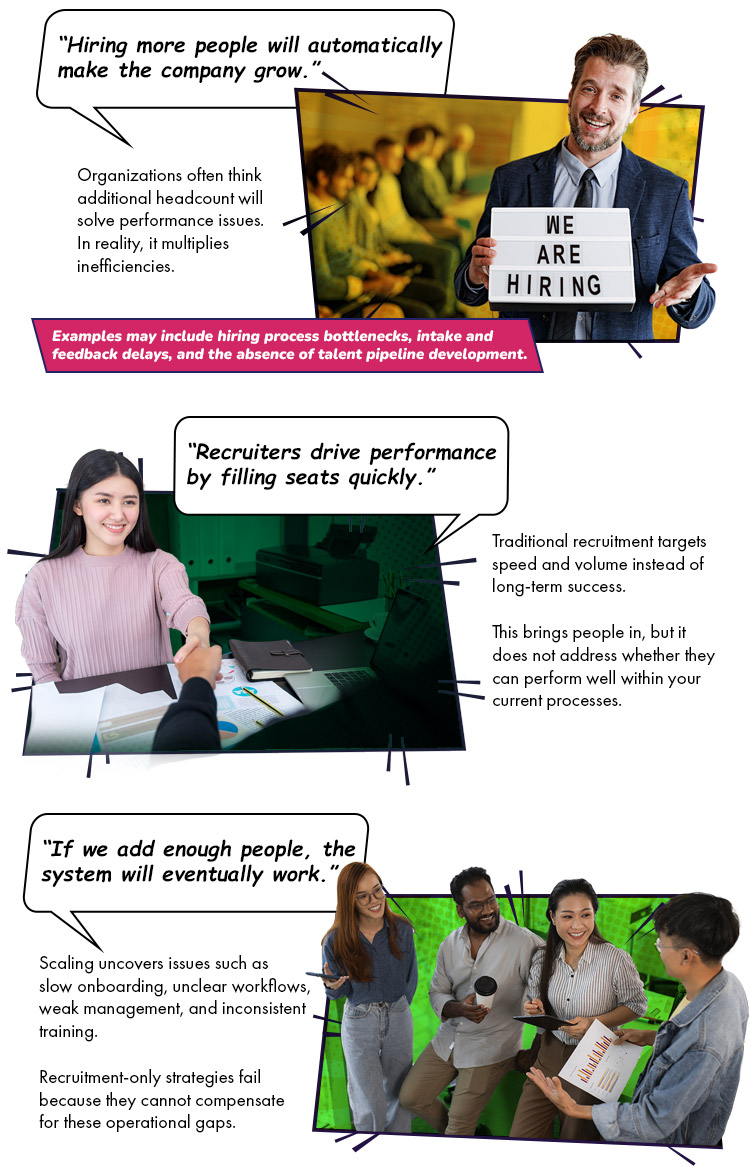
The Hiring Myth That Breaks Growing Companies
Many companies assume that hiring more people will automatically drive growth, but this belief overlooks the real scaling recruitment challenges behind managing a larger workforce.
“Hiring more people will automatically make the company grow.”
Organizations often think additional headcount will solve performance issues. In reality, it multiplies inefficiencies.
Examples may include hiring process bottlenecks, intake and feedback delays, and the absence of talent pipeline development.
“Recruiters drive performance by filling seats quickly.”
Traditional recruitment targets speed and volume instead of long-term success.
This brings people in, but it does not address whether they can perform well within your current processes.
“If we add enough people, the system will eventually work.”
Scaling uncovers issues such as slow onboarding, unclear workflows, weak management, and inconsistent training.
Recruitment-only strategies fail because they cannot compensate for these operational gaps.
What Recruitment-Only Actually Delivers
Many companies expect recruitment to do more than it actually can.
Recruitment is useful, but its role is limited.
It helps you find candidates and move them through the hiring process, but it cannot guarantee that these people will perform well once they join.
Recruiting Finds People, Not Performance
Recruiters handle CV screening, interviews, and job offers. Their role ends at identifying someone who fits the requirements on paper.
They do not own output, retention, performance, or how fast new hires ramp up.
Once a candidate is hired, whether they succeed or not depends entirely on the systems and leadership inside the company.
Recruiting Ends at Day One
Once a candidate accepts the offer, the recruitment function steps back.
Managers inherit the new hire without support for onboarding, training, or workload structure.
If the organization lacks clear processes, the risk shifts to the team, often resulting in slow ramp times, confusion, or early turnover.

Where Recruitment‑Only Breaks at Scale
As teams grow, the limits of a recruitment-only approach become impossible to ignore.
Hiring more people without strengthening internal systems creates gaps that show up scaling recruitment challenges immediately in onboarding, culture, and performance.
Onboarding Chaos
Without strong systems, new hires walk into confusion instead of clarity. Most problems include:
No training systems
New hires arrive without proper guidance, leaving them to figure out processes on their own.
No ramp plans
There is no clear timeline for when a new hire should reach productivity, which slows down output.
No accountability
No one is responsible for ensuring onboarding success, so mistakes and gaps go unnoticed.
Culture Dilution
Every new hire affects the company’s identity.
Recruitment can bring people in, but it cannot protect or reinforce culture.
Without intentional effort, values become inconsistent and the original culture weakens as the team expands.
No Performance Ownership
Once someone is hired, ownership of productivity becomes unclear.
Recruiters step out of the picture, and, most of the time, managers inherit the responsibility without support or structure, creating a reactive vs proactive hiring environment.
As headcount grows, this overwhelms teams and makes performance harder to manage.
The 7 Ways Recruitment‑Only Fails Growing Companies
At this stage, the limits of a recruitment-only approach start to shape how the organization actually performs.
The team may grow in numbers, but the results do not grow with it.
These seven scaling recruitment challenges breakdowns show what happens when hiring continues but the rest of the business cannot keep pace.
1. Hires Look Good on Paper but Cannot Execute
Resumes and interviews cannot fully predict real-world performance. Without proper onboarding and structure, even strong candidates struggle to deliver.
2. No One Owns Time-to-Productivity
Recruiters stop at the offer stage, and managers rarely have formal ramp-up plans. This leads to slow start times and inconsistent performance.
3. Managers Become Default Onboarding
In the absence of a training system, managers are forced to onboard every new hire themselves. This takes time away from their real work and creates uneven results.
4. High Turnover Becomes Normalized
Without support, new hires feel lost, frustrated, or overwhelmed. This leads to early exits, repeat hiring cycles, and rising labor costs.
5. Hiring Velocity Outpaces Training
When teams grow faster than training capacity, skill gaps widen. New hires depend on guesswork instead of clear guidance.
6. Leadership Loses Visibility
As headcount increases, leaders struggle to track performance, progress, and workflow issues. Decision-making becomes reactive instead of strategic.
7. Delivery Suffers While Headcount Grows
More people do not automatically improve output. Weak processes create bottlenecks that slow down delivery, even as the team gets bigger.

The Hidden Cost of Recruitment-Only
Recruitment-only does not just slow down growth. It creates real financial and operational losses that compound as the team gets bigger.
These costs often remain unseen until they start affecting revenue, morale, and the company’s reputation.
Lost payroll
Salaries are paid even when new hires are not productive. Weeks or months of slow ramp-up lead to a direct financial loss.
Lost months
Projects stall because new hires cannot perform at the expected level. Teams lose entire quarters trying to stabilize output.
Missed revenue
Delays, errors, and inconsistent delivery lead to lost clients or missed opportunities. Growth targets become harder to hit.
Burned-out managers
Managers absorb onboarding, training, and performance issues without the tools or capacity to handle them. This leads to exhaustion and higher leadership turnover.
Reputational damage
A cycle of poor performance, delays, and constant re-hiring harms both the employer brand and the customer experience.
What Scalable Companies Do Instead
High-growth companies recognize that recruitment alone cannot solve scaling recruitment challenges like:
- manual screening overload
- recruitment process inefficiencies
- employer branding issues
- candidate experience problems
- hiring at volume breakdown
Instead of treating hiring as a standalone task, they build systems that support the entire employee lifecycle from the moment someone applies up to their long-term performance.
They manage the full workforce lifecycle.
Scalable organizations streamline hiring using recruitment automation tools, standardized hiring processes, and a tech-driven recruitment strategy that removes repetitive admin work and improves overall efficiency.
Once people join, they move through structured onboarding, clear management systems, and consistent retention frameworks. This protects productivity and removes guesswork.
They design roles and ramp plans before hiring.
Leading companies use data-driven hiring decisions to define success before recruitment begins.
They outline 30, 60, and 90 day ramp plans, training paths, and capability expectations. This reduces delays, errors, and performance inconsistencies.
They assign accountability beyond day one.
In high-performing teams, someone is clearly responsible for helping new hires succeed.
Managers get support instead of inheriting new people without structure. Engagement, performance, and growth are owned, monitored, and guided rather than assumed.
This shift from hiring to workforce design is what allows companies to scale smoothly, maintain strong performance, and avoid the burnout and chaos that recruitment-only models create.

Recruiting vs Workforce Management
At some point in a company’s growth, leaders realize that “more hiring” does not automatically translate into better results.
The real difference lies in whether the organization is focused only on filling seats or on building a workforce that can perform, grow, and deliver consistently.
- Recruiting is designed to bring people in.
- Workforce management is designed to help people succeed once they’re in.
Here’s how the two models differ:
Recruiting-only focuses on headcount. Its job is to source candidates, run interviews, and extend offers.
Once hiring is complete, the responsibility shifts to managers, and the process resets.
Success is defined by speed and volume, not long-term output.
The Workforce Model looks at the entire employee lifecycle. It connects hiring, onboarding, performance, training, and retention into one system.
The goal is not just to add people but to build a team that consistently delivers results.
A simple comparison makes the difference clear:
- Recruiting fills seats; workforce management builds teams.
One adds people. The other creates capability.
- Recruiting ends at the offer; workforce management owns performance.
Responsibility does not stop at onboarding. It continues until each hire can do their work effectively and produce output that meets the agreed-upon expectations.
- Recruiting measures hire; workforce management measures output.
The focus shifts from “How fast can we hire?” to “How well do we perform?”
- Recruiting is treated as an HR cost center; workforce management becomes a growth engine.
When systems, structure, and accountability are in place, talent becomes one of the strongest drivers of business performance.
This shift in mindset is what separates companies that stall as they scale from those that grow with consistency and predictability.
When Recruitment‑Only Still Works
There are a few situations where relying only on recruitment can still be effective.
Smaller organizations with simple structures can operate smoothly because new hires learn directly from the team and the work environment is easier to navigate.
Recruitment-only also works in roles with low turnover.
When positions are filled for a long time, the company does not feel the pressure of frequent hiring, onboarding, or training cycles.
It is also suitable for hiring highly self-directed professionals.
These individuals can adjust quickly, create their own workflows, and perform well without needing strong onboarding systems or close management.
In these specific scenarios, recruitment-only can be enough. However, once the team grows or the work becomes more complex, structured workforce management becomes necessary for consistent performance.
When It Fails Catastrophically
A recruitment-only approach collapses fastest in environments where teams rely on structure, consistency, and continuous coordination.
These are scaling recruitment challenges and situations where hiring alone cannot support operational demands.
If you’re hiring offshore teams, they require clear workflows, hands-on guidance, and steady alignment. Without a full workforce model, distance and time zones turn small issues into major delays.
As for customer support roles, it depends on predictable standards and fast training. Without strong systems, service levels drop and customer satisfaction declines.
On the other hand, operations-heavy roles run on accuracy and repetition. These roles require structured SOPs, step-by-step workflows, quality checks, and ongoing management support that go far beyond what recruitment can deliver.
Recruitment-only cannot provide the clarity, documentation, and daily oversight these roles need.
High-volume hiring environments expose every gap in the process. As more people enter the team, errors escalate, capacity breaks, and output becomes very difficult to correct.

Tips to Make Workforce Management More Effective For Your Company
Managing a distributed or fast-growing team can get overwhelming if processes aren’t clear.
Here are practical ways to strengthen your workforce management setup:
- Define clear roles and responsibilities so everyone knows what they own and how tasks should move from one stage to the next.
- Standardize workflows and documentation using templates, checklists, and SOPs to reduce errors and speed up training.
- Use workforce management tools for scheduling, time-tracking, reporting, and communication to minimize manual work and improve visibility.
- Monitor meaningful KPIs such as attendance, output quality, turnaround times, and workload distribution.
- Establish daily oversight and escalation rules so approvals, reviews, and issue handling are consistent.
- Communicate frequently and clearly through regular check-ins, updates, and channel-specific messaging.
- Review and refine your processes regularly based on performance data and team feedback to eliminate bottlenecks early on.
FAQs – Scaling Hiring vs Scaling Teams
Scaling a company requires more than hiring more people, so these FAQs address the scaling recruitment challenges between growing headcount and building a high-performing team.
Why doesn’t recruiting solve retention?
Recruiting brings people in, but retention depends on systems, training, management, and culture.
Without these in place, even great hires struggle and eventually leave.
Who should own onboarding?
Onboarding should be owned by the team or function that benefits from the new hire’s success.
Recruiting can support documentation or coordination, but managers and operational leaders must guide the ramp-up.
What is the difference between staffing and recruiting?
Recruiting focuses on finding and placing candidates.
Staffing adds coordination, scheduling, monitoring, and ongoing support. It ensures that workers stay productive long after they’re hired.
How do I know if we have outgrown recruitment-only?
Warning signs include slow ramp-up times, rising turnover, overwhelmed managers, inconsistent work quality, and having to rehire the same roles repeatedly.
These show that hiring alone can no longer support the team.
What replaces recruiting at scale?
A full workforce model that connects hiring, onboarding, training, performance management, and retention.
This creates predictable productivity instead of hoping new hires figure things out on their own.
Final Thoughts – Hiring Is Not a Strategy. Execution Is.
Recruitment can bring people into the company, but it cannot make them productive, aligned, or consistent.
Many teams feel the pressure of scaling recruitment challenges, but adding more people will not fix gaps in processes, expectations, or performance ownership.
Real growth happens when you combine hiring with strong systems, clear workflows, structured onboarding, and active performance ownership.
Companies that scale successfully focus on building capability, not just adding headcount because execution, not hiring, is what drives long-term business results.
If you need support building a team that performs from day one, Remote Staff can help you hire skilled offshore talent while ensuring they have the structure, oversight, and continuity needed to deliver consistent outcomes.
Request a callback today and speak with a Remote Staff expert.

Leandro is a content creator and digital nomad who started his career as a remote working content writer. He is an advocate of location independent sources of income. And he believes that everyone has the ability to be one as well.