
When a role is left open, work slows down and pressure builds.
Teams want support immediately, but rushing a hire can create bigger problems later in the hiring timeline.
Hiring right vs hiring fast is a common challenge in talent acquisition.
Moving too quickly can hurt candidate quality and employee retention, while moving too slowly can damage productivity and morale.
The goal is to find the right balance.
What’s the Difference Between Hiring Right vs Hiring Fast?
Hiring fast focuses on filling a role as quickly as possible to keep work moving.
Hiring right focuses on selecting the best person for long-term success, a strong culture fit, and sustained performance.
Problems arise when businesses rely too heavily on one approach and ignore the other.
Effective recruitment best practices balance speed with thoughtful evaluation throughout the interview process.
Speed-Focused Hiring: What It Looks Like
Speed-focused hiring prioritizes hiring process efficiency and reducing time-to-fill.
This approach is common when:
- A team is understaffed
- A role needs to be filled urgently
- A company is growing quickly
To move fast, companies often shorten interviews and limit screening.
While this helps in the short term, it can increase the risk of hiring someone who is not a good fit.
Without clear onboarding success measures and ongoing support, fast hires may struggle or leave early, increasing the cost of bad hires.
Quality-Driven Hiring: The “Right Fit” Focus
Quality-driven hiring takes more time but focuses on long-term results.
This approach looks at:
- Skills and experience
- Work style and communication
- Alignment with team and company goals
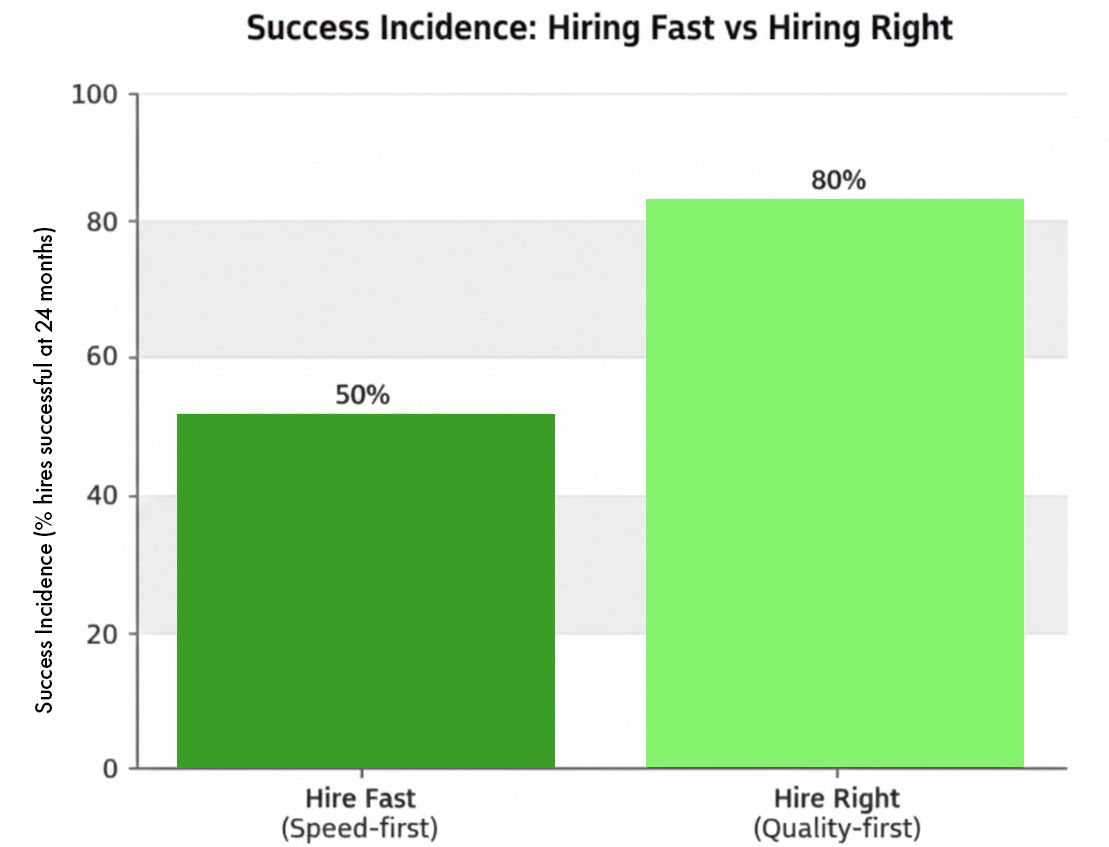
Although the process is slower, it usually leads to better performance and higher retention.
Fewer re-hires and less retraining reduce long-term costs and time spent on recruitment.

The Hidden Costs of Hiring Too Fast
Hiring in a rush may solve short-term staffing pressure, but well-established research shows it often leads to long-term financial and operational damage.
The costs usually appear later through turnover, lost productivity, lower morale, and wasted training.
High Turnover Rates and Time Lost Re-Hiring
Rushed hiring decisions are a major driver of preventable turnover.
According to Forbes, as much as 80 percent of employee turnover can be traced back to poor hiring decisions, not pay or benefits.
This means many exits could have been avoided with better evaluation upfront.
For senior and specialist roles, Forbes notes that a failed hire can cost several times the employee’s annual salary once recruitment, onboarding, lost productivity, and disruption are considered.
Each early exit forces companies to restart the hiring process, extending vacancy periods and slowing execution.
Misaligned Hires Can Hurt Culture and Morale
The effects of a misaligned hire often appear first in everyday team interactions.
When expectations, work style, or communication styles do not align, managers and coworkers must spend extra time resolving issues instead of focusing on their own responsibilities.
Research from Gallup shows that teams with low engagement, often driven by poor role fit and unclear expectations, experience weaker collaboration and lower morale.
Gallup emphasizes that engagement is heavily influenced by whether employees feel they belong and can perform well in their roles.
When misalignment persists, trust erodes and motivation declines, even if employees remain in position.
Training Investment Goes to Waste With Wrong Hires
Onboarding and training require real investment before a new hire becomes fully productive. However, when a hire is a poor fit, much of that investment is lost.
Research on employee engagement from Gallup reveals that the global cost of disengaged or poorly matched employees is enormous.
According to the State of the Global Workplace report, low engagement costs the world economy an estimated $8.8 trillion in lost productivity — roughly 9 percent of global GDP.
Poor engagement also contributed about $438 billion in lost productivity in 2024 alone due to lower employee involvement and effectiveness at work.
Because disengagement is closely linked to misalignment in role fit and poor performance, these figures offer a sense of scale for how much productivity and output companies risk losing when hires are not thoughtfully matched.
When training and onboarding are followed by early turnover or ongoing underperformance, organizations effectively write off that investment and then must invest again as they repeat hiring and training cycles.
Why Some Roles Can’t Afford a Slow Hire
Some roles simply cannot stay vacant for long without creating real risks.
In these situations, hiring speed protects revenue, customer trust, and operational stability.
The challenge is knowing when the urgency to fill a role is justified—and when it’s best to step back and take a more careful approach instead.
Client-Facing or Revenue-Critical Roles
Positions tied directly to customers or revenue are highly sensitive to delays.
When sales, account management, or customer support roles remain unfilled for too long, response times slow and client relationships weaken.
Prolonged vacancies can lead to missed deals, reduced satisfaction, and lost revenue.
In these cases, moving quickly helps maintain momentum, provided role expectations and required skills are clearly defined.
Filling Sudden Vacancies or Backlogs
Unexpected resignations, leave, or sudden increases in workload can overwhelm existing teams. As pressure builds, quality and morale often decline.
Hiring quickly helps stabilize operations and prevents temporary disruptions from becoming long-term performance issues.
Even under time pressure, basic screening and alignment are essential to avoid repeating the same hiring problem.
Seasonal Scaling (e.g., Holidays, Tax Season)
Some roles are time-bound by nature. Retail, accounting, and logistics teams often need to scale rapidly during peak periods.
Slow hiring in these situations usually results in missed deadlines or lost revenue rather than better hires.
Clear role scopes, defined timeframes, and focused onboarding allow companies to move fast while keeping performance on track.
How to Hire Fast and Right: Is It Possible?
Teams that hire well under pressure usually prepare ahead of time.
Instead of starting from zero, they build a talent pipeline or outsource parts of the hiring process to gain faster access to talent. This recruitment strategy allows companies to move quickly without lowering their standards.
Done right, this shifts hiring from a last-minute scramble into strategic hiring. Decisions are more consistent, timelines are shorter, and the quality of screening improves.
Pre-Define Role Expectations and Success Metrics
Fast hiring fails when roles are unclear. Without clear expectations, interviews become inconsistent and decisions are based on instinct instead of facts.
High-performing teams define key responsibilities and success metrics upfront.
This clarity makes it easier to assess fit, speeds up decisions, and helps new hires understand what’s expected from day one, leading to better onboarding and stronger retention.
Use Structured Interviews and Skill Assessments
Structure makes fast hiring work. Using consistent interviews, clear scoring, and role-specific skill checks helps teams make quicker and fairer decisions.
Instead of adding more interview rounds, effective recruitment focuses on the right questions and the skills that matter most.
This keeps the hiring process efficient while protecting culture fit and performance.
At scale, structure is not red tape. It helps organizations grow without increasing the cost of bad hires.
Hiring Models That Support Speed and Quality
Companies that hire well under pressure do not rely on last-minute decisions.
They use clear systems that allow them to move quickly without lowering standards.
In-House Recruitment Teams with Offshore Support
Many businesses use in-house recruiters but struggle when hiring needs increase.
Offshore support helps handle sourcing, screening, and coordination so internal teams can focus on final decisions.
This setup shortens the hiring timeline and improves efficiency, as long as roles and expectations are clearly defined.
Working with Pre-Vetted Talent Pools (Like Remote Staff)
Pre-vetted talent pools make fast hiring safer. Candidates are already screened for skills and communication, so companies can focus on fit and performance.
Instead of restarting the hiring process every time, businesses can hire from an existing pool.
This saves time, improves candidate quality, and supports better retention.
Use of Tech and Human Screening for Efficiency
Technology helps speed up hiring tasks like screening and scheduling. Human judgment is still needed to assess communication and culture fit.
The best results come from using both. Systems that combine technology and people allow companies to hire faster without repeating the same mistakes.

How Remote Staff Helps You Hire Fast—Without Compromising Fit
Hiring right vs hiring fast does not have to be a trade-off. Hiring quickly does not mean lowering standards when the right systems are in place.
Remote Staff is built to support speed while protecting fit, performance, and long-term retention through structured systems rather than ad hoc hiring.
Role-Based Matching with Cultural Alignment
Remote Staff matches candidates based on role requirements, skills, and working style.
Beyond technical ability, candidates are screened for communication, reliability, and alignment with client expectations.
This role-based approach helps improve candidate quality and culture fit, reducing the risk of early turnover caused by mismatched expectations.
Pre-Onboarding Support and Retention Monitoring
Hiring success does not stop at placement. Remote Staff supports pre-onboarding to ensure new hires are clear on responsibilities, tools, and performance expectations before Day One.
Ongoing retention monitoring helps identify issues early, supporting onboarding success and employee retention while reducing the cost of bad hires.
Offshore Hiring Done Right: Vetting, Trial, Feedback Loop
Remote Staff applies a structured offshore hiring model that includes vetting, trial periods, and continuous feedback.
Clients are involved early, with clear checkpoints to assess performance and fit.
This system allows businesses to move fast without committing blindly, improving hiring process efficiency while maintaining control and transparency.
FAQs – Hiring Right vs Fast in a Remote and Offshore World
Hiring decisions become more complex in a remote and offshore setup.
Speed, quality, and fit all matter, but the right balance is not always obvious. These common questions address how businesses can hire efficiently without increasing risk.
Is it better to hire quickly or wait for the perfect candidate?
Neither extreme works well. Hiring too quickly increases the risk of poor fit and early turnover, while waiting for a “perfect” candidate can leave teams understaffed and overworked for too long.
The better approach is to define what “good enough” looks like for the role and hire decisively once those criteria are met.
Clear role expectations and structured interviews make this balance easier to achieve.
How can we reduce time-to-hire without rushing?
Reducing time-to-hire is less about moving faster and more about removing friction.
Pre-defining role requirements, using structured interviews, and maintaining a talent pipeline all help shorten the hiring timeline without sacrificing candidate quality.
Systems-based recruitment strategies outperform ad hoc hiring when speed is required.
Can offshore teams be onboarded faster than local hires?
Yes, when the process is structured. Offshore hiring often moves faster because talent pools are broader and candidates are more accustomed to remote onboarding.
Clear documentation, defined success metrics, and pre-onboarding preparation allow offshore hires to become productive quickly, sometimes faster than local hires with longer notice periods.
Does Remote Staff offer trial periods or flexible staffing?
Yes. Remote Staff supports structured trial periods and flexible staffing arrangements so businesses can assess performance and fit before making long-term commitments.
This approach reduces risk, improves onboarding success, and helps teams hire fast without locking in the wrong hire.
Conclusion – Build a Hiring Process That Balances Both
Hiring right vs hiring fast are often treated as competing goals, but they do not have to be.
The real problem is not speed itself. It is relying on rushed, unstructured decisions instead of a repeatable hiring process.
As this guide shows, hiring too fast without clarity leads to higher turnover, wasted onboarding investment, and long-term productivity loss.
At the same time, moving too slowly creates operational gaps, burnout, and missed opportunities. The most successful teams avoid this false choice by building systems that support both urgency and quality.
With clear role definitions, structured interviews, talent pipelines, and the right hiring model, businesses can move quickly without compromising fit.
When these systems are supported by experienced partners, hiring becomes more predictable, scalable, and resilient.
If your team needs to hire fast while protecting performance and culture, the answer is not to choose one over the other. It is to design a hiring process that balances both from the start.

Leandro is a content creator and digital nomad who started his career as a remote working content writer. He is an advocate of location independent sources of income. And he believes that everyone has the ability to be one as well.