
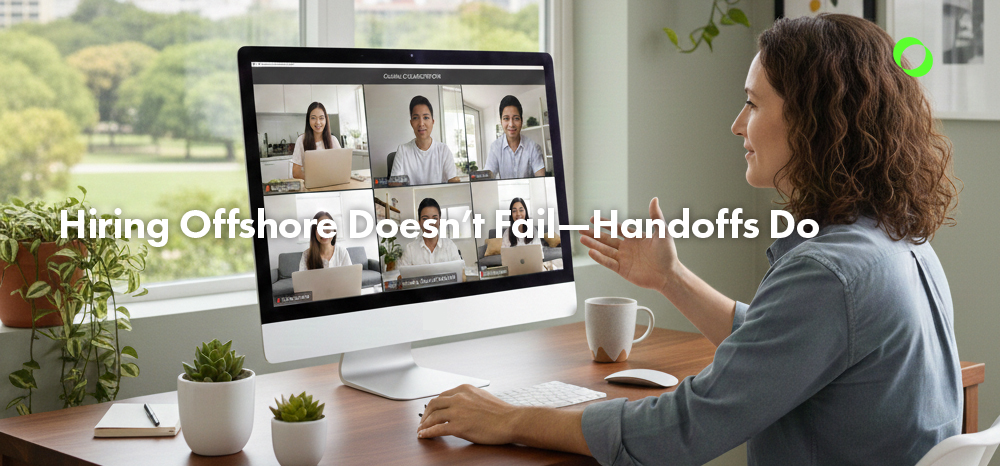
Remote work has existed for years, even before the pandemic. However, it became mainstream during mandatory lockdowns and later evolved into a preferred long-term setup for many beyond 2020.
Despite the clear benefits of remote work, many business owners still struggle to see the value of a distributed workforce. Concerns abound about productivity, particularly whether high-quality work can be delivered by someone thousands of miles away.
In reality, failed offshoring is rarely due to the remote hires themselves, but often, because of the hiring company or client.
Why does this happen, and what can be done about it?
IN THIS BLOG
- ➤
The Offshore Blame Game (And Why It’s Wrong) - ➤
“They Didn’t Get It” Isn’t the Whole Story - ➤
Output Gaps Often Reflect Input Gaps - ➤
What’s Often Missing in the Handoff - ➤
3 Offshore Handoff Personas That Sabotage Success - ➤
#1. The Micromanager Who Won’t Let Go - ➤
#2. The Abdicator Who Disappears After Assigning - ➤
#3. The Assumer Who Thinks “It’s Obvious” - ➤
What Great Handoffs Actually Look Like - ➤
Fixing the Handoff: A Quick Audit for Leaders - ➤
Does Someone Own the Onboarding Process? - ➤
Are Deliverables or Outcomes Being Delegated? - ➤
What Happens After the First 7 Days? - ➤
How Remote Staff Ensures Handoff Success - ➤
FAQs – Offshore Handoffs and Delegation Clarity - ➤
#1. Why Do Offshore Hires “Fail” Even When They Look Good on Paper? - ➤
#2. Who Should Own the Onboarding Process? - ➤
#3. How Much Documentation Is Too Much? - ➤
#4. Can Remote Staff Help with Handoff Planning? - ➤
#5. Should I Start with Simple Tasks or Go All-In? - ➤
Conclusion – It’s Not Hiring Offshore That Fails. It’s the Handoff.
The Offshore Blame Game (And Why It’s Wrong)
Remote workers are often blamed for poor performance, especially when they struggle to deliver in their first few weeks on the job.
However, this is not entirely their fault.
“They Didn’t Get It” Isn’t the Whole Story
Just because an offshore hire fails to deliver as expected does not mean their talent is lacking. Nor is it necessarily due to cultural differences in offshoring.
More often than not, the claim that “they just didn’t get it” points to a breakdown in clear, explicit communication issues in offshore teams. Unlike onsite teams, offshore workers rely heavily on precise instructions where nothing is left to assumption.
For example, when a manager assigns a task and says, “make it look professional,” the offshore hire may not realize this actually means, “use our 2024 brand guidelines.”

Output Gaps Often Reflect Input Gaps
There is an unspoken pressure on remote hires to prove that they are just as skilled, if not more so, than their onsite counterparts.
Yet companies often overlook a simple truth: the quality of output from a remote team is directly proportional to the quality of input they receive.
Hence, the first 90 days are critical. New hires need consistent guidance and feedback, ideally through a dedicated mentor who shows them how things work and closely supports them until they can operate independently.
What’s Often Missing in the Handoff
Delegation is one of the most crucial parts of a new employee’s first few days.
Unfortunately, some managers treat tasks as something to simply “toss over the wall,” leading to breakdowns in delegation:
- No Documented Expectations or SOPs – Standard operating procedures (SOPs) are the backbone of a remote team. Without them, offshore hires are forced into a guessing game. Without clear instructions and guidance on how tasks are done, remote workers, and even onsite employees, are left to improvise.
- No Real Owner of Handoff Success – Accountability drives success. Unfortunately, many organizations face an accountability gap: executives sign the contract, HR handles the paperwork, but no one is clearly responsible for ensuring a new hire’s success in the first 30 days. Moreover, without proper onboarding, onshore peers may view a remote worker as a burden rather than an asset. Meanwhile, offshore hires may hesitate to ask questions for fear of appearing incompetent.
- Feedback Comes Too Late or Not At All – Mistakes can go unnoticed for a long time, especially without regular feedback. Unlike frequent check-ins, delayed feedback can feel more like a performance review than a coaching opportunity. As a result, new hires may develop a fear of failure, becoming hesitant to take initiative, particularly when they are still unclear about expectations.
3 Offshore Handoff Personas That Sabotage Success
Now that we’ve established that a new hire isn’t always to blame for “failing,” who is responsible?
Here are some examples.
#1. The Micromanager Who Won’t Let Go
Some managers fear that an offshore hire will disrupt their well-established processes.
As a result, instead of delegating tasks fully, they hold tightly to control them, even while the remote worker is expected to handle the work.
Illustration:
Mark hires John, a senior developer. However, instead of letting John focus on his tasks, Mark insists on reviewing every line of code as it’s written and requires John to provide updates three times a day.
Unsurprisingly, this makes John feel trapped. Eventually, he stops taking initiative, or worse, begins looking for a new job. Meanwhile, Mark becomes burned out from doing more himself and ends up blaming John for underperformance.
Candidates:
Filter by Role:
*Booking interviews depend on candidates' availability and interest.
All-inclusive Rate: USD $8.54/hr
Mary
Candidate ID: 787869
ADVANCED
-
Scheduling, Calendar Management, Invoicing, Contract management...
INTERMEDIATE
-
Compliance, Ad Posting, Resume Screening...

Median Rate
$8.54
$9.29
if $1 = PHP52
$10.96
if $1 = PHP40
Currency Fluctuation Range

*includes service fee. Please note that hourly rates are linked to the exchange rate, and fluctuate slightly from month to month.
**Please note that hourly rates are linked to the exchange rate and fluctuate slightly from month to month.
Employment Preferences
(inclusive of service fee)
*Plus GST for Australian Businesses
Part Time: $USD 8.54 per hour or $USD 740.06 per month
Full Time: $USD 8.54 per hour or $USD 1480.13 per month
Remote Staff Recruiter Comments
Kath is an experienced Talent Acquisition and Recruitment Operations professional with 5 years of experience supporting APAC, EMEA, and US hiring teams. She has consistently demonstrated strong capabilities in end-to-end interview coordination, onboarding operations, and stakeholder management across high-volume corporate environments. Her background in supervising recruitment coordination teams and optimizing administrative workflows makes her a highly capable professional for complex talent acquisition and human resources operations.
Work Experience & Educational Background-
Mary Kathleen possesses 5 years of relevant work experience in recruitment operations, coordination, and administration.
-
She has developed her expertise by working within high-volume corporate environments across the enterprise recruitment outsourcing, workforce solutions, and healthcare support industries.
-
She holds a Bachelor of Science in Psychology from San Beda College Alabang, obtained in 2018.
-
Her previous responsibilities and areas of expertise include:
-
Coordinating interview scheduling and recruitment operations across multiple active, high-touch requisitions.
-
Managing onboarding documentation, due diligence processing, and pre-employment checks.
-
Generating offers and contracts for executive requisitions while ensuring compliance with local requirements.
-
Coordinating patient communication and administrative workflows in a fast-paced healthcare support setting.
-
-
She successfully supervised a team of 11 recruitment coordinators, resulting in improved workflow coordination, better SLA adherence, and increased onboarding consistency.
-
She improved coordination workflows and onboarding efficiency by organizing documentation tracking systems, which successfully reduced onboarding follow-up delays and processing backlogs.
-
She actively managed recruitment escalations and stakeholder concerns while maintaining smooth hiring operations across multiple enterprise accounts.
-
She trained new coordinators on recruitment processes, scheduling standards, Applicant Tracking System (ATS) usage, and operational workflows.
-
She supported process improvement initiatives that effectively increased operational efficiency, data accuracy, and the overall candidate experience.
-
She has advanced proficiency in utilizing industry-standard Applicant Tracking Systems (ATS) and HR platforms, specifically Workday, Taleo, iCIMS, and ServiceNow.
-
She is highly skilled in utilizing productivity and coordination tools, including Microsoft 365 (Outlook, Excel, Word, Teams), Google Workspace, Zoom, and Slack.
-
She efficiently manages workflow and coordination using GoodTime, shared calendars, and documentation management systems.
-
She actively leverages AI and productivity tools to enhance her administrative output, maintaining proficiency in ChatGPT, Gemini, Grammarly AI, and Microsoft Copilot.
-
Her core functional skills encompass executive calendar support, talent operations, compliance processing, team training, and reporting.
Employment History
Talent Acquisition Senior Coordinator
Industry:
Insurance
Employment Period:
May 2024 to July 2026 (26 Months)
Duties and Responsibilities:
- Coordinate interview scheduling (in-person and virtual format) across the region.
- Work with candidates at offer stage to collate, check and validate all personal details and documentation required for completion of due diligence, contract preparation and work pass application.
- Collaborate with HR and third-party partner to ensure hiring process is completed in an efficient and effective manner.
- Provide support in early careers screening and shortlisting activities.
- Maintain a positive and engaging candidate and hiring manager experience.
- Produce the regular internal careers newsletter and support with job posting administration.
- Provides support on reporting and performance metrics.
- Support processing of recruitment invoices including set-up of supplier Purchase Orders and processing placement fee invoices
- Make continuous improvement for recruiting administration/onboarding processes.
Onboarding Specialist
Industry:
Human Resources Management / Consulting
Employment Period:
September 2023 to December 2023 (3 Months)
Duties and Responsibilities:
- Coordinated pre-employment screenings, background checks, and documentation requirements to expedite hiring timelines and reduce potential delays in bringing talent onboard.
- Worked closely with new hire applicants, addressing questions and handling various concerns during onboarding processes.
- Compile employee files, and collecting required digital or physical information to meet requirements.
Lead Specialist - Recruitment Administration
Industry:
Human Resources Management / Consulting
Employment Period:
February 2022 to September 2023 (18 Months)
Duties and Responsibilities:
- Managed account specific administration activities for the following scope of services: CV capturing, requisition management, interview scheduling, helpdesk support, candidate checklist management, candidate care, onboarding, invoice admin, updating applicant tracking system, identity & address verification, and pre-employment screening.
- Managing various adhoc administration activities to support the effective running of the recruitment process e.g updating Operations Manual or other process documentation.
- Completing reports and trackers accurately up-to-date.
- Building and maintaining strong working relationships between all parties including recruiters, hiring managers, vendors and other account stakeholders.
- Ensuring stakeholders and colleagues are continually appraised and updated on the relevant processes, including changes providing first line support for managing and resolving escalations.
- Reviewing processes to identify areas of improvement.
- Overseeing work allocation and reviewing accuracy of output to other Senior Recruitment Coordinators.
Recruitment Coordinator
Industry:
Human Resources Management / Consulting
Employment Period:
March 2021 to February 2022 (10 Months)
Duties and Responsibilities:
- Managed interview scheduling for EMEA, US and APAC region through manual and automated platforms.
- Skilled in resolving helpdesk queries through call, chat and email.
- Experienced in job posting through internal and external job boards
- Trained junior colleagues and new hires with various processes when necessary.
- Assisted Lead Specialist with Compliance Audit for the team.
- Prepared minutes of the meeting report for the team.
- Managed ID-Verification for EMEA region.
Care Coordinator
Industry:
Call Center / IT-Enabled Services / BPO
Employment Period:
July 2019 to July 2020 (12 Months)
Duties and Responsibilities:
- Partner with the recruiting team by proactively sourcing and pre-qualifying candidates based on a specific client need.
- Generate candidate's interest through email blast, job posting, cold calling to ensure pipelines are actively supporting the client's needs and business growth.
- Coordinating with candidates to schedule their interviews.
- Pre-screening candidates for basic qualification
- Handling end-to-end recruitment process.
Education History
Field of Study:
Psychology
Major:
AB
Graduation Date:
December 17, 2017
Located In:
Philippines
License and Certification: :
N/A
Skills
ADVANCED ★★★
-
Scheduling, Calendar Management, Invoicing, Contract management, Email management, Administrative Support, Training,
INTERMEDIATE ★★
-
ComplianceAd PostingResume Screening
Work at Home Capabilities:
- Internet Bandwidth: Greater than 100mbps
- Working Environment: Private Room
- Speed Test Result: https://www.speedtest.net/
- Internet Type: Broadband
- Hardware Type: Laptop
- Brand Name: Huawei
- Processor: AMD Ryzen 5
- Operating System: Windows 11
All-inclusive Rate: USD $22.63/hr
Aries
Candidate ID: 784990
ADVANCED
-
Hubspot CRM, Gmail, DocuSign, CRM...
INTERMEDIATE
-
Google APIs, Basecamp...
Median Rate
$22.63
$25.60
if $1 = PHP52
$32.16
if $1 = PHP40
Currency Fluctuation Range
*includes service fee. Please note that hourly rates are linked to the exchange rate, and fluctuate slightly from month to month.
**Please note that hourly rates are linked to the exchange rate and fluctuate slightly from month to month.
Employment Preferences
(inclusive of service fee)
*Plus GST for Australian Businesses
Part Time: $USD 22.63 per hour or $USD 1961.60 per month
Full Time: $USD 22.63 per hour or $USD 3923.21 per month
Remote Staff Recruiter Comments
Aries is an experienced Sales and Marketing Automation Specialist and Virtual Assistant with over a decade of remote, freelance, and agency experience. After earning a professional title as a Registered Nurse, they transitioned back to their passion for marketing management, initiating a full-time freelancing career in 2016. Throughout their tenure, they have developed a strong expertise in managing customer relationship management (CRM) systems, complex workflows, cross-platform integrations, and digital marketing strategies. Their work history spans partnerships with digital marketing agencies, software-as-a-service (SaaS) companies, and specialized insurance marketing operations across the United States, Canada, Australia, and Asia.
They demonstrate significant competency in designing, building, and optimizing automated marketing campaigns, lead scoring models, sales pipelines, and automatic lead assignments. They possess extensive technical proficiency across a wide array of CRMs and database tools, specifically highlighting deep operational familiarity with platforms such as:
- Pipedrive
- GoHighLevel
- ActiveCampaign
- HubSpot
- Salesforce
Employment History
Virtual Assistant (Project Management)
Industry:
Others
Employment Period:
June 2016 to December 2016 (6 Months)
Duties and Responsibilities:
- Worked with my Australian client looking for an urgent work (big project).
- I have given the opportunity to recruit and lead a team of freelancers working towards a common goal.
- Trained, supervised and managed my team – give them first an instruction on how to get things done as well as providing concrete examples.
- We do mostly web research, collect data based on client’s criteria and input into spreadsheet.
- We communicated through Facebook group (we are all Filipino Freelancers) and sometimes through email.
- Closely monitoring and reporting of the project progress.
- Planning and Defining Scope of the project.
- Slack for communication - exchanging of files and discussion of project with the team.
Researcher / Social Media Moderation
Industry:
Others
Employment Period:
April 2017 to July 2018 (15 Months)
Duties and Responsibilities:
- Worked as a researcher of software time tracking company.
- Primary duties include research, updating lead's data in CRMs (Intercom and HubSpot) and sending over to sales representative for reach out.
- Daily Slack communication with sales team to make sure everything is updated and organized.
CRM Administrator / Lead Generator
Industry:
Non-Profit Organisation / Social Services / NGO
Employment Period:
January 2016 to June 2016 (5 Months)
Duties and Responsibilities:
- Managed their CRM (Nimble).
- Research of new prospects based on the client’s criteria and updating database.
- Worked closely with all departments to ensure the CRM works effectively for all aspects of the company.
- Monitored and maximized customer’s lifetime value strategies ensuring maximum profitability.
- Ensured that the database segmented effectively for targeted marketing activities.
Mechanical Turk Worker
Industry:
Others
Employment Period:
December 2016 to March 2017 (3 Months)
Duties and Responsibilities:
- Browse all micro jobs where I am qualified and earn credits through every task completed
- Did surveys, web research, email list building, transcriptions and generation of leads.
- We used Slack for communication and e-time proof (onlinejobs.ph) for tracking of hours.
- Used of google sheets for market research and data collection.
Virtual Assistant
Industry:
Advertising / Marketing / Promotion / PR
Employment Period:
April 2021 to May 2026 (61 Months)
Duties and Responsibilities:
- Social media management (Social media post, sending replays to clients, commenting, etc.)
- Uploading training to Kajabi and Google drive.
- CRM management (Pipedrive, GoHighLevel, ActiveCampaign, Airtable)
- Creating automation between CRMs, calendars (Acuity & GHL), google sheet, zoom, signing software, notifications through Slack, Stripe and Airtable.
- LinkedIn prospecting, opportunity links from Facebook post, assisting the whole team.
- Other general admin tasks.
Virtual Assistant
Industry:
Advertising / Marketing / Promotion / PR
Employment Period:
July 2018 to January 2021 (30 Months)
Duties and Responsibilities:
- Working as a lead generation specialist, administrative support and some in marketing stuff.
- Working with social media channels like Facebook, Instagram and LinkedIn (prospecting, posting, commenting and management).
- Daily Skype/Slack communication with the team to make sure everything is updated and organized.
- Other administrative tasks such as document creation, uploading, editing, templates, etc.
- Creation of email templates at ActiveCampaign/Autopilot, testing A/B, scheduling, workflows, triggers, tags, list and automations.
- Tasks depends on our clients since we’re a digital marketing agency.
Education History
Field of Study:
Nursing
Major:
Graduation Date:
March 31, 2015
Located In:
Philippines
License and Certification: :
N/A
Skills
ADVANCED ★★★
-
Hubspot CRM, Gmail, DocuSign, CRM, Google Drive, Calendly, API Integration, System integration, MailChimp, Gravity forms, Marketing automation,
INTERMEDIATE ★★
-
Google APIsBasecamp
Work at Home Capabilities:
- Internet Bandwidth: Greater than 100mbps
- Working Environment: Private Room
- Speed Test Result: https://www.speedtest.net/result/19237364426
- Internet Type: Fiber
- Hardware Type: Desktop
- Brand Name: N/A
- Processor: Intel Core i3
- Operating System: Windows 10
All-inclusive Rate: USD $9.02/hr
Terrence
Candidate ID: 780479
ADVANCED
-
Google Sketchup Pro, AutoCAD, 3D Rendering, Layout Design...
INTERMEDIATE
-
V-Ray, Adobe Photoshop, Microsoft Office...
Median Rate
$9.02
$9.85
if $1 = PHP52
$11.68
if $1 = PHP40
Currency Fluctuation Range
*includes service fee. Please note that hourly rates are linked to the exchange rate, and fluctuate slightly from month to month.
**Please note that hourly rates are linked to the exchange rate and fluctuate slightly from month to month.
Employment Preferences
(inclusive of service fee)
*Plus GST for Australian Businesses
Part Time: $USD 9.02 per hour or $USD 781.61 per month
Full Time: $USD 9.02 per hour or $USD 1563.23 per month
Remote Staff Recruiter Comments
Terrence has more than seven years of experience in the interior design and modular cabinetry industry, specializing in residential projects with additional exposure to commercial spaces such as hotels and offices. His background includes design conceptualization, client coordination, project supervision, fabrication monitoring, and installation management within furniture and cabinetry manufacturing companies.
He demonstrates proficiency in industry-standard design and rendering software including SketchUp, SketchUp Layout, AutoCAD, Enscape, V-Ray, Photoshop, and CNC-related tools. His experience involves creating design proposals, drafting layouts, rendering 3D perspectives, and coordinating workflow execution from site visit through project completion.
Employment History
Interior Designer
Industry:
Manufacturing / Production
Employment Period:
May 2025 to August 2025 (3 Months)
Duties and Responsibilities:
AutoCAD Operator
Industry:
Manufacturing / Production
Employment Period:
January 2025 to May 2025 (4 Months)
Duties and Responsibilities:
Senior Interior Designer
Industry:
Manufacturing / Production
Employment Period:
March 2019 to July 2024 (64 Months)
Duties and Responsibilities:
Technical Designer
Industry:
Manufacturing / Production
Employment Period:
December 2017 to January 2019 (13 Months)
Duties and Responsibilities:
Sales Interior Decorator
Industry:
Retail / Merchandise
Employment Period:
October 2017 to December 2017 (2 Months)
Duties and Responsibilities:
Education History
Field of Study:
Architecture
Major:
Interior Design
Graduation Date:
July 6, 2017
Located In:
Philippines
License and Certification: :
N/A
Skills
ADVANCED ★★★
-
Google Sketchup Pro, AutoCAD, 3D Rendering, Layout Design, Technical drawing,
INTERMEDIATE ★★
-
V-RayAdobe PhotoshopMicrosoft Office
Work at Home Capabilities:
- Internet Bandwidth: Between 5mbps to 100mbps
- Working Environment: Private Room
- Speed Test Result: https://www.speedtest.net/result/19161125087
- Internet Type: Fiber
- Hardware Type: Laptop
- Brand Name: Lenovo
- Processor: i5 13th gen
- Operating System: Windows 11
All-inclusive Rate: USD $12.37/hr
Lovely
Candidate ID: 778468
ADVANCED
-
Facebook Marketing, Marketing automation, Landing Page Design, Digital Marketing...
INTERMEDIATE
-
Google Analytics, WordPress, Canva...
Median Rate
$12.37
$13.73
if $1 = PHP52
$16.73
if $1 = PHP40
Currency Fluctuation Range
*includes service fee. Please note that hourly rates are linked to the exchange rate, and fluctuate slightly from month to month.
**Please note that hourly rates are linked to the exchange rate and fluctuate slightly from month to month.
Employment Preferences
(inclusive of service fee)
*Plus GST for Australian Businesses
Part Time: $USD 12.37 per hour or $USD 1072.46 per month
Full Time: $USD 12.37 per hour or $USD 2144.91 per month
Remote Staff Recruiter Comments
Love is a conversion-focused Digital Marketing Strategist with solid experience in funnel building, social media marketing, lead generation systems, and marketing automation across multiple industries including ecommerce, real estate, wellness, coaching, healthcare, and service-based businesses. Her background includes creating structured marketing systems that improve lead nurturing, streamline customer journeys, and support scalable growth.
She has a strong understanding of end-to-end marketing automation processes, particularly in building customer acquisition and lead qualification systems using chat automation, email workflows, funnel pages, and CRM integrations. She has hands-on experience in creating automated lead nurturing flows for a real estate business, where she implemented qualification stages, virtual property viewing sequences, and booking workflows to help reduce unqualified inquiries and improve operational efficiency. She also automated campaigns for a healthcare and wellness-related business, where she segmented leads based on behavioral triggers and customer intent to improve conversion outcomes.
Love showed familiarity with multiple marketing and automation platforms including:
- GoHighLevel
- ClickFunnels
- Shopify
- WordPress
- ActiveCampaign
- Mailchimp
- ManyChat
- HubSpot integrations
- Meta Ads Manager
Overall, Love is a capable and versatile digital marketing professional with strong practical experience in marketing automation, funnel systems, paid advertising support, and lead nurturing workflows.
Employment History
Funnel Builder Strategist and Social Media Manager
Industry:
Advertising / Marketing / Promotion / PR
Employment Period:
January 2022 to May 2026 (52 Months)
Duties and Responsibilities:
- Worked with multiple clients across e-commerce, real estate, wellness, coaching, and service-based businesses.
- Built and optimized conversion-focused funnels and websites to support lead generation
- Developed marketing strategies aligned with customer journey and business goals
- Managed Meta Ads campaigns and improved performance through testing creatives and messaging
- Created email and chat automation flows to improve lead nurturing and conversion
- Executed social media strategies that support both engagement and sales
- Improved overall marketing flow by structuring systems from traffic → lead → conversion
Social Media Manager & Shopify Builder and Manager
Industry:
Advertising / Marketing / Promotion / PR
Employment Period:
January 2020 to December 2021 (23 Months)
Duties and Responsibilities:
- Managed social media calendars and content for agency clients
- Led community engagement and audience interaction
- Built and optimized Shopify websites and product listings
- Supported internal brand marketing and content execution
Education History
Field of Study:
Nursing
Major:
Graduation Date:
January 1, 2020
Located In:
Philippines
License and Certification: :
N/A
Skills
ADVANCED ★★★
-
Facebook Marketing, Marketing automation, Landing Page Design, Digital Marketing, Social Media Marketing, Social Media Management, Copywriting, Shopify,
INTERMEDIATE ★★
-
Google AnalyticsWordPressCanva
Work at Home Capabilities:
- Internet Bandwidth: Greater than 100mbps
- Working Environment: Private Room
- Speed Test Result: https://www.speedtest.net/result/19156153150
- Internet Type: DSL
- Hardware Type: Laptop
- Brand Name: Acer
- Processor: 13th Gen Intel Core i5
- Operating System: Windows 11
All-inclusive Rate: USD $15.73/hr
Johanna
Candidate ID: 778174
ADVANCED
-
Salesforce CRM, Dashboard Data Visualization, Marketing automation, Data integration...
INTERMEDIATE
-
HTML, CSS, Adobe Photoshop, Figma...
Median Rate
$15.73
$17.61
if $1 = PHP52
$21.77
if $1 = PHP40
Currency Fluctuation Range
*includes service fee. Please note that hourly rates are linked to the exchange rate, and fluctuate slightly from month to month.
**Please note that hourly rates are linked to the exchange rate and fluctuate slightly from month to month.
Employment Preferences
(inclusive of service fee)
*Plus GST for Australian Businesses
Part Time: $USD 19.09 per hour or $USD 1654.14 per month
Full Time: $USD 15.73 per hour or $USD 2726.60 per month
Remote Staff Recruiter Comments
Johanna is a seasoned Salesforce CRM and Marketing Automation Specialist with more than 8 years of experience supporting global marketing and sales operations across the events management, SaaS, media, and government sectors. She has extensive hands-on expertise in Salesforce, Pardot, Marketo, Salesforce Marketing Cloud, Zapier, SOQL, reporting/dashboard creation, and marketing automation workflows. Her background demonstrates strong exposure to end-to-end campaign execution, CRM administration, data governance, and automation support.
She has a solid understanding of full-funnel marketing operations, from lead generation and segmentation through lead nurturing, reporting, and sales handoff. She managed complex global nurture campaigns involving multiple regions including APAC, EMEA, and the Americas. She is familiar with engagement journeys, lead scoring, workflow automation, HTML/CSS email customization, integration troubleshooting, and data synchronization between Salesforce and marketing automation platforms. She also has experience supporting campaign analytics, KPI tracking, MQL/SQL reporting, and dashboard development for marketing teams.
Johanna’s strengths include Salesforce administration, marketing automation setup, campaign segmentation, data quality management, integration troubleshooting, and reporting/analytics. She also has prior experience as a Marketo trainer, which reflects her ability to communicate technical processes and support user enablement.
Overall, Johanna is a technically capable and experienced Marketing Automation Specialist with strong Salesforce and CRM operations expertise. She would be well-suited for roles involving Salesforce administration, Pardot/Marketo campaign execution, marketing operations support, CRM data management, and reporting/analytics functions within remote international teams.
Employment History
Salesforce Admin and Marketing Automation Specialist
Industry:
Advertising / Marketing / Promotion / PR
Employment Period:
March 2022 to May 2026 (50 Months)
Duties and Responsibilities:
- Platform Administration: Acted as a global Pardot/SFMC Admin, managing user access, system configuration, and ad-hoc support across US/CAN, APAC, EMEA, and LATAM regions.
- Lead Management: Configured Lead Scoring and Grading models and developed Engagement Programs for automated lead nurturing.
- Asset Development: Designed and tested high-converting landing pages and email templates using HTML/CSS within Pardot and Salesforce Marketing Cloud.
- Conversion Optimization: Created and managed form handlers for lead generation and established engagement journeys specifically for event-based campaigns.
- Database Management: Conducted database maintenance and data quality analysis using SOQL queries to optimize inbound data sources.
- Cross-System Integration: Served as the primary liaison between internal database systems to ensure seamless communication and data flow.
- Tracking & Attribution: Administered website/email tracking, including UTM parameters and engagement history, to monitor the lead’s journey through the sales funnel.
- Special Projects: Supported Salesforce implementation projects focusing on Channel Transformation, including Deal Registration and Content Management audits.
- Global Reporting: Took full ownership of global marketing reports and dashboards to track performance across multiple territories.
- Performance Analytics: Analyzed campaign ROI and lead conversion rates, providing actionable insights to executive sales and marketing teams.
- Workflow Automation: Assisted in setting up workflow automations and email triggers to reduce manual effort and optimize team efficiency.
- Process Optimization: Managed Salesforce enhancement requests from stakeholders to refine system functionality and process flow.
- Advanced Segmentation: Developed dynamic and static contact lists based on multi-field filters (e.g., job title, location, and producer criteria).
- Strategic Collaboration: Partnered with technical, system operations, and sales teams to design and execute targeted production campaigns.
- Data Governance: Managed field mapping, data cleansing, and list-building protocols to ensure high data integrity for all outbound activities.
Marketo Trainer
Industry:
Government / Defence
Employment Period:
April 2022 to July 2022 (3 Months)
Duties and Responsibilities:
- Technical trainer for Salesforce and Marketo
- Develop customize training materials for Marketo including key concepts, hands-on activities and training delivery
Salesforce Administrator
Industry:
Advertising / Marketing / Promotion / PR
Employment Period:
February 2017 to March 2022 (61 Months)
Duties and Responsibilities:
- Create and maintain fields, views, reports, dashboards, campaigns, and other salesforce.com objects and functions
- Map salesforce.com hierarchy and territories in response to personnel changes.
- Reassign Accounts, Contacts, and Opportunities in response to personnel changes.
- Grant/remove and maintain user licenses
- Design, create and maintain user roles, profiles, and hierarchies
- Monitor application storage usage and archive data as needed
- Performs ad-hoc system testing with automation tool and integration for seamless data workflow
- Assist Salesforce Manager in Project Request Implementation i.e data building, field mapping testing, Salesforce Release system update testing, and other ad-hoc system testing
- Assist with migration from older systems/processes into Salesforce.com
- Monitor neglected Leads, Opportunities, Accounts, and Contacts as appropriate
- Import data as appropriate using dataloader.io
- Monitor and manage exception logs for back-end system integration with SFDC
- Manage duplicate records
- Monitor and improve data quality.
- Ensure data integrity by merging duplicate Leads, Contacts, and Accounts: performing mass uploads and updates of data as required: Removing unnecessary fields and data: ensuring screens, fields, and workflow have accurate names and reflect current workflow.
- Manage and ensure smooth synchronization of Salesforce and Pardot, previously with Salesforce and Marketo
- List building, list segmentation, and campaign creation in Marketo based on target criteria or data brief provided by Sales Team
- Data building and mining for new leads based on target criteria provided by Sales Team
- Serves as the point-of-contact for webinar automation and integration using Zapier, Pardot Marketing / Marketo
Marketo Specialist
Industry:
Advertising / Marketing / Promotion / PR
Employment Period:
August 2021 to November 2021 (3 Months)
Duties and Responsibilities:
- Support efforts to enable Marketo's Full suite of capabilities
- Support essential marketing operations initiatives in Marketo and Salesforce such as managing lead lifecycle, lead scoring, lead nurturing, segmentation, and data cleansing
- Setup and launch webinars following our multi-step model from invite to follow-upAid in landing page and form development and implementation
- Setup and launch email nurture campaigns using Marketo with multiple streams and triggers using automation methodology and best practices
- Optimize materials for campaign tracking and attribution (UTM, Bizible, GTM)
- Support efforts in building best practices to drive lead generation efforts
- Aid in building automated reports and dashboards for internal use
- Support data management standards and compliance efforts
- Perform adhoc system audits between Marketo, Calendly, Zoom, Zapier and Salesforce, making sure that fields are mapped correctly, data are captured correctly from forms, landing pages, and other gated sources.
Education History
Field of Study:
Engineering (Computer/Telecommunication)
Major:
Computer Engineering
Graduation Date:
January 1, 2007
Located In:
Philippines
License and Certification: :
N/A
Skills
ADVANCED ★★★
-
Salesforce CRM, Dashboard Data Visualization, Marketing automation, Data integration, Data Management, Reporting Analysis,
INTERMEDIATE ★★
-
HTML, CSS, Adobe Photoshop, FigmaCanvaProject ManagementSocial Media ManagementMicrosoft Office
Work at Home Capabilities:
- Internet Bandwidth: Greater than 100mbps
- Working Environment: Private Room
- Speed Test Result: N/A
- Internet Type: Fiber
- Hardware Type: Laptop
- Brand Name: N/A
- Processor: i5
- Operating System: Windows 11
All-inclusive Rate: USD $7.58/hr
Chandarella
Candidate ID: 777342
ADVANCED
-
Landing Page Design, CRM, Website Builder, Responsive Website...
INTERMEDIATE
-
Microsoft Office, Canva, Graphic Design, Virtual Assistant Skills...
Median Rate
$7.58
$8.18
if $1 = PHP52
$9.51
if $1 = PHP40
Currency Fluctuation Range
*includes service fee. Please note that hourly rates are linked to the exchange rate, and fluctuate slightly from month to month.
**Please note that hourly rates are linked to the exchange rate and fluctuate slightly from month to month.
Employment Preferences
(inclusive of service fee)
*Plus GST for Australian Businesses
Part Time: $USD 7.58 per hour or $USD 656.97 per month
Full Time: $USD 7.58 per hour or $USD 1313.93 per month
Remote Staff Recruiter Comments
Chandarella has relevant hands-on experience in marketing automation, CRM workflow setup, funnel building, and lead nurturing, primarily supporting businesses within the home services industry. She has over two years of practical experience using Go High Level (GHL) for automation and customer acquisition workflows. Her core responsibilities included creating high-converting landing pages, sales funnels, automated SMS/email sequences, CRM pipeline management, lead routing systems, and customer follow-up workflows.
A notable strength of hers is her continuous upskilling through certifications directly related to marketing automation and CRM systems. She completed certifications in Go High Level Mastery, GHL Automation Mastery, and Funnel Mastery, all of which are highly relevant to marketing automation, workflow building, and funnel optimization. These certifications reinforce her practical experience with automation systems, lead nurturing, and conversion-focused funnel strategy. Additionally, her Canva certification supports her ability to create marketing assets and landing page visuals independently.
Her previous experience also includes lead generation and virtual assistant work for businesses in industries such as roofing, windows, landscaping, remodeling, pest control, and related service sectors. In these roles, she handled inbound/outbound communication, CRM updates, pipeline tracking, and reporting functions, contributing to her understanding of sales processes and customer engagement workflows.
Overall, Chandarella is a suitable candidate for junior to mid-level marketing automation, CRM support, funnel building, and Go High Level specialist roles, particularly for small to medium-sized businesses in service-based industries.
Employment History
Funnel Builder, Web Designer, and GHL Specialist
Industry:
Repair and Maintenance Services
Employment Period:
January 2024 to May 2026 (28 Months)
Duties and Responsibilities:
- Built high-converting landing pages and sales funnels for roofing and window companies, applying full funnel strategy from customer journey mapping to conversion design.
- Set up Go High Level pipelines, configured automation workflows, and managed SMS/email trigger sequences for lead follow-up and nurturing.
- Designed and deployed lead capture workflows with automated routing -- turning cold clicks into booked appointments.
- Managed SEO web design projects and handled client communications across multiple concurrent US accounts.
- Integrated social media touchpoints into funnel campaigns to keep leads connected and campaigns performing across channels.
Graphic Designer and Admin Assistant
Industry:
Non-Profit Organisation / Social Services / NGO
Employment Period:
January 2023 to December 2024 (23 Months)
Duties and Responsibilities:
- Produced all organizational graphic materials, documents, and financial reports using Excel, Word, and Canva.
- Maintained data accuracy across financial records and internal documentation -- strong attention to detail under real operational pressure.
- Managed scheduling, admin workflows, and digital communications for the organization.
Virtual Assistant
Industry:
Call Center / IT-Enabled Services / BPO
Employment Period:
January 2019 to December 2023 (59 Months)
Duties and Responsibilities:
- Generated and qualified leads for US home service companies — windows, roofing, gutters, landscaping, pest control, and remodeling.
- Managed inbound and outbound sales calls across B2B and B2C campaigns, consistently meeting lead targets.
- Operated CRM and dialer tools to track pipeline stages, manage follow-up tasks, and maintain data accuracy.
- Coordinated with US-based clients remotely via Google Workspace and Excel for reporting and workflow management.
Education History
Field of Study:
Education/Teaching/Training
Major:
English
Graduation Date:
June 22, 2018
Located In:
Philippines
License and Certification: :
Licensed Professional Teacher Passer
Skills
ADVANCED ★★★
-
Landing Page Design, CRM, Website Builder, Responsive Website, Marketing automation, Lead management, Email Marketing, Lead Generation,
INTERMEDIATE ★★
-
Microsoft Office, CanvaGraphic DesignVirtual Assistant SkillsSchedulingRecord Management
Work at Home Capabilities:
- Internet Bandwidth: Between 5mbps to 100mbps
- Working Environment: Private Room
- Speed Test Result: N/A
- Internet Type: DSL
- Hardware Type: Desktop
- Brand Name: Acer
- Processor: Intel Core i5
- Operating System: Windows 11
All-inclusive Rate: USD $11.90/hr
Frances
Candidate ID: 774756
ADVANCED
-
Marketing automation, Salesforce CRM, Zoho CRM, Hubspot CRM...
INTERMEDIATE
-
WordPress, HTML, Canva, Adobe Photoshop...
Median Rate
$11.90
$13.18
if $1 = PHP52
$16.00
if $1 = PHP40
Currency Fluctuation Range
*includes service fee. Please note that hourly rates are linked to the exchange rate, and fluctuate slightly from month to month.
**Please note that hourly rates are linked to the exchange rate and fluctuate slightly from month to month.
Employment Preferences
(inclusive of service fee)
*Plus GST for Australian Businesses
Part Time: $USD 12.37 per hour or $USD 1072.46 per month
Full Time: $USD 11.90 per hour or $USD 2061.81 per month
Remote Staff Recruiter Comments
Tracy is a full-stack marketer with 9+ years of experience across B2B and B2C environments, with strong exposure to marketing automation, CRM systems, and campaign strategy. Her background spans industries such as industrial solutions, outsourcing services, real estate investment, and event marketing services. She demonstrates end-to-end ownership of campaigns—from strategy and content creation to execution, automation, QA, and performance analysis.
She has strong CRM experience (Salesforce, HubSpot, Zoho) and integration tools like Zapier. She also has hands-on experience with multiple marketing automation platforms including:- Salesforce Account Engagement (Pardot)
- Eloqua
- ActiveCampaign
- HubSpot
- Zoho
Tracy is knowledgable in building marketing automation workflows, particularly focused on lead nurturing and sales follow-up sequences triggered by CRM events. She demonstrated a solid understanding of the full lead lifecycle, from initial lead capture through nurturing and eventual MQL tagging, as well as the use of behavioral triggers such as click-based segmentation to drive automation decisions. She also showed familiarity with workflow branching, automation logic, and the integration between CRM systems and marketing platforms, while tracking performance through key metrics like open rates, click-through rates, and MQL generation.
Employment History
Demand Generation Specialist
Industry:
Call Center / IT-Enabled Services / BPO
Employment Period:
July 2025 to Present
Duties and Responsibilities:
- Strategize, write and build marketing automation campaigns across industry communities in AU and SG and lead nurture flows using Salesforce Marketing Cloud Account Engagement (Pardot).
- Work with data team to monitor and maintain lead quality and data integrity in Salesforce.
- Audit previous SPEX campaign performance and
- Set up reports and analyse campaign performance (MQL’s) in Salesforce and optimise open rates, CTR, conversion to meetings, and conversion to SQLs.
- Support with re-engagement strategies for cold or aged leads.
- Create SOPs for Sponsorship (SPEX) marketing automation campaigns.
Senior Digital Marketing Inbound Specialist
Industry:
Call Center / IT-Enabled Services / BPO
Employment Period:
January 2023 to July 2025 (30 Months)
Duties and Responsibilities:
- Spearheaded a website contact form revamp project to enhance lead data collection and management through standardized fields.
- Established a lead scoring system in Zoho CRM to categorize leads as cold, warm, or hot.
- Implemented an automated workflow for MQL tagging and a corresponding sales cadence within Zoho CRM.
- Reviewed and provided strategic recommendations to optimize SEM architecture and expand keywords for the digital agency vendor.
- Developed, set up, and launched targeted email campaigns for welcome, promotional, and inbound lead nurturing via Zoho Campaigns and Zoho CRM.
- Developed, set up, and launched targeted cold outreach email campaign and LinkedIn message using Skylead and Apollo database
- Built and tested lead generation landing pages using Instapages, ensuring successful integration with Zoho CRM.
- Optimized webpage and landing page performance by analyzing user behavior with GA4, Hotjar, and Microsoft Clarity.
- Strategized, executed, and tracked paid media campaigns on Meta, Google, and LinkedIn to generate leads and increase brand awareness for B2B and B2C services.
- Collaborated with account managers and clients to develop content and storyboards for case studies in various formats.
- Created and presented monthly reports for stakeholders by analyzing data from Zoho CRM, Google Analytics, Ahrefs, Zoho Social, and Google Ads.
- Handled PR/Media coordination
Digital Marketing Specialist
Industry:
Call Center / IT-Enabled Services / BPO
Employment Period:
June 2022 to January 2023 (6 Months)
Duties and Responsibilities:
- Created and updated lead-gen landing pages using drag-and-drop content blocks on Instapages and integrated with third-party apps like ActiveCampaign, Google Ads, Facebook Ads, and Google Analytics.
- Designed graphics for social media posts, branded presentations, and reports using Canva and Adobe Photoshop
- Tracked and updated dashboard and reports with weekly LP Views, Lead and Booked Appointments, Ad Spend & CPA, and created data visualization dashboards in Databox
- Created emails and automation (for webinar/nurture campaigns) using ActiveCampaign
- Conducted a social media audit on Dashdot's social media accounts
Social Media Senior Analyst
Industry:
Electrical & Electronics
Employment Period:
April 2019 to June 2022 (38 Months)
Duties and Responsibilities:
- Handled the export of raw data and created customized reports for organic social media campaigns.
- Managed the content scheduling for organic social media posts across multiple brand accounts using Hootsuite.
- Published blog posts to the company's expert blog site using WordPress.
- Served as a YouTube administrator, handling video modifications such as updating descriptions and adding end screen elements.
Associate Digital Ad Trafficker
Industry:
Advertising / Marketing / Promotion / PR
Employment Period:
February 2019 to March 2019 (1 Months)
Duties and Responsibilities:
- Set up digital campaigns, specializing in static and rich-media banner ads for small and medium-sized businesses.
- Ensured high-quality output by performing quality assessments on each digital campaign before launch.
- Utilized programmatic platforms such as Simpli.fi and Tapclicks for setting up, activating, and mapping campaigns.
Brand Marketing Specialist
Industry:
Banking / Financial Services
Employment Period:
April 2017 to December 2018 (20 Months)
Duties and Responsibilities:
- Developed and executed integrated marketing campaigns, including merchandising and activations, to increase product awareness and acquire new clients.
- Conducted competitor and market research and analysis to develop effective marketing strategies.
- Conceptualized and developed creative designs and copy for social media content and branch merchandising materials.
Freelance Digital Marketing Specialist
Industry:
Advertising / Marketing / Promotion / PR
Employment Period:
June 2022 to December 2024 (30 Months)
Duties and Responsibilities:
- Designed and developed websites for clients using Duda drag-and-drop and responsive website builder, and set-up GA4 accounts
- Revamped client websites and executed on-page/off-page SEO audit and updates
- Update e-commerce store category and product pages
- Set up and launched a Meta ad campaign to drive appointments
Education History
Field of Study:
Business Studies/Administration/Management
Major:
Management
Graduation Date:
June 28, 2016
Located In:
Philippines
License and Certification: :
N/A
Skills
ADVANCED ★★★
-
Marketing automation, Salesforce CRM, Zoho CRM, Hubspot CRM, Eloqua, Lead Generation, Campaign Management, Google Analytics, SEO,
INTERMEDIATE ★★
-
WordPressHTMLCanvaAdobe Photoshop
Work at Home Capabilities:
- Internet Bandwidth: Greater than 100mbps
- Working Environment: N/A
- Speed Test Result: N/A
- Internet Type:
- Hardware Type: Laptop
- Brand Name: N/A
- Processor: 11th Gen i7
- Operating System: Windows 11
All-inclusive Rate: USD $19.09/hr
James
Candidate ID: 770967
ADVANCED
-
API, HTML, Marketing automation, JavaScript...
INTERMEDIATE
-
jQuery, CSS, JavaScript...
Median Rate
$19.09
$21.50
if $1 = PHP52
$26.82
if $1 = PHP40
Currency Fluctuation Range
*includes service fee. Please note that hourly rates are linked to the exchange rate, and fluctuate slightly from month to month.
**Please note that hourly rates are linked to the exchange rate and fluctuate slightly from month to month.
Employment Preferences
(inclusive of service fee)
*Plus GST for Australian Businesses
Part Time: $USD 19.09 per hour or $USD 1654.14 per month
Full Time: $USD 19.09 per hour or $USD 3308.28 per month
Remote Staff Recruiter Comments
James is a seasoned no-code developer specializing in Bubble.io, with over five years of experience delivering scalable, high-performance web applications across diverse industries. His career reflects a strong blend of technical depth and practical execution, having built and maintained production systems used by over 140,000 users. He demonstrates a consistent ability to translate complex business requirements into efficient workflows, robust database architectures, and reliable integrations. His hybrid capability—extending no-code platforms with backend technologies like Node.js—positions him as a highly adaptable and solutions-driven developer.
Work Experience / Educational Background
The candidate has 5+ years of relevant experience in no-code and low-code development, primarily using Bubble.io, with additional backend exposure.
- Developed scalable web applications for clients across consulting, technology, and digital platform industries
- Built and maintained a high-traffic lottery-based platform serving 140K+ users, ensuring performance and stability
- Designed complex workflows, database structures, and admin dashboards for business operations
- Delivered MVPs, SaaS tools, and internal systems for global clients as a freelance developer
- Contributed to a social content platform focused on user interaction and media sharing
- Extended no-code solutions with Node.js and EJS for advanced backend functionality
- Experience working with international stakeholders and cross-functional teams
Education:
- Bachelor of Science in Industrial Engineering
Career Highlights / Relevant Projects
- Played a key role in developing a lottery-style web platform that scaled to over 140,000 users, implementing complex draw logic and concurrent user handling, resulting in a stable and high-performing production system
- Successfully optimized application workflows and database structures across multiple projects, significantly improving system responsiveness and reducing workload usage
- Delivered end-to-end solutions (from concept to deployment) for global clients, showcasing ownership and accountability in project execution
- Built hybrid applications combining no-code and custom backend services, enabling more advanced use cases beyond typical platform limitations
- Developed social and content-sharing platforms with interactive features, demonstrating versatility across different product types
These accomplishments highlight his ability to meet non-negotiable requirements such as scalability, performance optimization, and complex system design.
Skill Proficiency / Tech Stack
- Bubble.io (5+ years): Advanced in workflow creation, database design, and performance optimization; consistently used in building scalable production applications
- Node.js / EJS (3+ years estimated): կիրառ for extending backend capabilities and handling complex logic beyond no-code limitations
- API Integrations (5+ years): Extensive experience with REST APIs, webhooks, and third-party service integrations
- Automation Tools: Make (Integromat), n8n for process automation
- Frontend: HTML, CSS, JavaScript for UI customization
- Payments Integration: Stripe, Apple Pay, Google Pay, and other global payment systems
He demonstrates strong proficiency through hands-on delivery of production-grade systems, particularly in high-load environments and complex business logic implementation. His top strengths—Bubble.io development, system architecture, and API integration—are highly aligned with roles requiring scalable no-code solutions.
Work Availability / Schedule
- Can potentially start within a short notice period, subject to alignment with ongoing engagements
Employment History
Bubble.io Developer
Industry:
Call Center / IT-Enabled Services / BPO
Employment Period:
February 2021 to December 2022 (22 Months)
Duties and Responsibilities:
- Built and maintained internal Bubble.io systems
- Handled data modeling, privacy rules, and performance tuning
- Worked closely with QA and operations teams
Bubble.io Developer
Industry:
Computer / Information Technology (Software)
Employment Period:
January 2024 to January 2026 (24 Months)
Duties and Responsibilities:
- Develop and maintain production Bubble.io applications
- Implement user workflows, admin tools, and system enhancements
- Assist with performance improvements and feature rollouts
Bubble.io Developer
Industry:
Consulting (Business & Management)
Employment Period:
September 2023 to March 2026 (30 Months)
Duties and Responsibilities:
- Develop and maintain Bubble.io applications for international clients across multiple industries •
- Design scalable database architectures and implement complex business workflows
- Integrate third-party APIs and automate business processes
- Extend platform capabilities using Node.js-based backend services when needed
- Optimize application performance, reducing workload usage and improving responsiveness
- Deliver end-to-end solutions from concept to deployment
Upwork Clients
Industry:
Computer / Information Technology (Software)
Employment Period:
January 2021 to March 2026 (62 Months)
Duties and Responsibilities:
- Delivered end-to-end Bubble.io and hybrid (no-code + Node.js) solutions for global clients
- Built MVPs, SaaS platforms, dashboards, and internal tools
- Integrated APIs, payment gateways, and third-party services
- Developed custom backend logic using Node.js and EJS for advanced use cases
- Managed multiple client projects, ensuring timely delivery and high-quality output
- Maintained long-term client relationships through consistent performance
Bubble.io Developer
Industry:
Advertising / Marketing / Promotion / PR
Employment Period:
October 2025 to Present
Duties and Responsibilities:
- Contribute to the development of a social content platform (sparkable.cc) that enables users to share content, express ideas, and connect through posts, media, and interactive features
- Improve workflow efficiency and database structure to enhance system performance
- Support feature development, debugging, and continuous platform improvements
- Collaborate with cross-functional teams to deliver scalable and user-focused solutions
Education History
Field of Study:
Engineering (Industrial)
Major:
Industrial Engineering
Graduation Date:
December 31, 2020
Located In:
Philippines
License and Certification: :
N/A
Skills
ADVANCED ★★★
-
API, HTML, Marketing automation, JavaScript, Web Development,
INTERMEDIATE ★★
-
jQueryCSSJavaScript
Work at Home Capabilities:
- Internet Bandwidth: Greater than 100mbps
- Working Environment: Private Room
- Speed Test Result: https://www.speedtest.net/result/19100329210
- Internet Type: Fiber
- Hardware Type: Laptop
- Brand Name: Huawei MateBook D16
- Processor: 12th Gen Intel(R) Core(TM) i5-12450H (2.00GHz)
- Operating System: Windows 11
All-inclusive Rate: USD $15.25/hr
Franceska
Candidate ID: 770663
ADVANCED
-
Hubspot CRM, Graphic Design, Email Marketing, SEO Writing...
INTERMEDIATE
-
UI Design, UX Design, Canva, Google Analytics...
Median Rate
$15.25
$17.06
if $1 = PHP52
$21.05
if $1 = PHP40
Currency Fluctuation Range
*includes service fee. Please note that hourly rates are linked to the exchange rate, and fluctuate slightly from month to month.
**Please note that hourly rates are linked to the exchange rate and fluctuate slightly from month to month.
Employment Preferences
(inclusive of service fee)
*Plus GST for Australian Businesses
Part Time: $USD 15.25 per hour or $USD 1321.75 per month
Full Time: $USD 15.25 per hour or $USD 2643.50 per month
Remote Staff Recruiter Comments
Franceska is a Digital Marketing Specialist with experience supporting startups and B2B organizations across industries such as SaaS, cybersecurity, healthcare, and technology. She brings a strong background in marketing automation, CRM lifecycle management, and multi-channel campaign execution, complemented by an analytical foundation from her chemical engineering background.
She has demonstrated hands-on expertise in building and optimizing lifecycle email automation systems using platforms such as:
- HubSpot
- Salesforce Marketing Cloud
- Mailchimp
- Brevo
In her previous work, she developed structured onboarding and lead nurturing systems with multiple entry points and behavior-based triggers, helping address inconsistent follow-ups and lead drop-offs. She tracks performance using both engagement metrics (open rates, CTRs) and conversion-focused indicators (lead progression and activation), showing a strong data-driven and iterative approach. She also applies A/B testing effectively, with one example demonstrating that value-driven messaging significantly outperformed product-focused emails, leading to improved engagement and subsequent optimization of campaign strategies.
Overall, Franceska is a well-rounded marketing automation professional with solid technical skills, practical experience across multiple industries, and a strong analytical approach
Employment History
Admin Assistant
Industry:
Banking / Financial Services
Employment Period:
January 2022 to June 2022 (5 Months)
Duties and Responsibilities:
- Provided administrative coordination including scheduling meetings, preparing reports, and managing documentation systems.
- Assisted in internal reporting and organizational record management supporting operational efficiency.
Content Creator and Workflow Coordinator
Industry:
Advertising / Marketing / Promotion / PR
Employment Period:
October 2022 to February 2023 (4 Months)
Duties and Responsibilities:
- Produced marketing copy for social media campaigns, websites, and promotional materials supporting brand messaging and digital marketing initiatives.
- Applied SEO optimization techniques improving website visibility and search traffic potential.
- Coordinated internal marketing workflows and project communication using Trello and collaborative tools.
SEO Intern
Industry:
Advertising / Marketing / Promotion / PR
Employment Period:
December 2022 to February 2023 (2 Months)
Duties and Responsibilities:
- Conducted keyword research and SEO optimization for blog content and landing pages improving search ranking performance for targeted keywords.
- Assisted with website analytics monitoring using Google Analytics and SEO tools including Ahrefs.
- Implemented internal linking strategies and SEO best practices improving content discoverability and search indexing.
Digital Marketing Consultant
Industry:
Advertising / Marketing / Promotion / PR
Employment Period:
January 2025 to March 2026 (14 Months)
Duties and Responsibilities:
- Provide digital marketing strategy and campaign execution support to startups and B2B companies in SaaS, cybersecurity, healthcare, and marketing technology sectors.
- Developed multi-channel marketing strategies across email marketing, SEO content, and social media resulting in approximately 20% growth in audience engagement across client platforms.
- Built lifecycle email marketing automation systems using HubSpot, Brevo, and Mailchimp supporting lead nurturing and improving open rates and click through engagement.
- Designed marketing landing pages and UI components using Figma and Framer improving conversion flow and reducing bounce rates on client landing pages.
- Produced SEO optimized blog articles and thought leadership content supporting organic traffic growth and brand authority in technology and healthcare sectors.
- Managed CRM segmentation and outreach workflows enabling targeted campaigns and improving lead qualification processes.
Digital Marketing Specialist
Industry:
Security / Law Enforcement
Employment Period:
July 2023 to February 2025 (19 Months)
Duties and Responsibilities:
- Managed multi-channel marketing campaigns across social media, paid advertising, and CRM platforms supporting brand awareness and lead generation initiatives.
- Executed targeted email marketing campaigns using Salesforce Marketing Cloud including audience segmentation and lifecycle messaging improving campaign engagement rates.
- Managed social media strategy including content creation, scheduling, and engagement monitoring contributing to increased audience reach and platform engagement.
- Collaborated with financial analysts and marketing teams to produce compliant blog content, market commentary, and educational articles for digital publication.
- Monitored marketing campaign performance and prepared analytics reports to support campaign optimization and marketing strategy decisions.
- Coordinated CRM audience segmentation and messaging workflows to improve targeted outreach and campaign personalization.
Education History
Field of Study:
Engineering (Chemical)
Major:
Graduation Date:
December 31, 2021
Located In:
Philippines
License and Certification: :
Licensed Chemical Engineer
Skills
ADVANCED ★★★
-
Hubspot CRM, Graphic Design, Email Marketing, SEO Writing, Salesforce Marketing Cloud, MailChimp, SEMrush,
INTERMEDIATE ★★
-
UI DesignUX DesignCanvaGoogle AnalyticsMicrosoft Excel
Work at Home Capabilities:
- Internet Bandwidth: Greater than 100mbps
- Working Environment: N/A
- Speed Test Result: N/A
- Internet Type:
- Hardware Type: Desktop
- Brand Name: N/A
- Processor: AMD Ryzen 5
- Operating System: Windows 11
All-inclusive Rate: USD $8.54/hr
Ely
Candidate ID: 768534
ADVANCED
-
Customer Service, Customer Handling, Customer Retention, Customer Relations...
INTERMEDIATE
-
Administrative Skills, Administrative Support...
Median Rate
$8.54
$9.29
if $1 = PHP52
$10.96
if $1 = PHP40
Currency Fluctuation Range
*includes service fee. Please note that hourly rates are linked to the exchange rate, and fluctuate slightly from month to month.
**Please note that hourly rates are linked to the exchange rate and fluctuate slightly from month to month.
Employment Preferences
(inclusive of service fee)
*Plus GST for Australian Businesses
Full Time: $USD 8.54 per hour or $USD 1480.13 per month
Remote Staff Recruiter Comments
Ely has over 4 years of experience in customer service, sales, and virtual assistance, with strong exposure to cold calling, appointment setting, lead generation, and outbound sales campaigns. They have supported clients across the real estate, healthcare, fitness, and entertainment industries, demonstrating strong communication skills and adaptability in remote work environments.
Their background includes working as a Real Estate Virtual Assistant for a US-based client, conducting cold calls to potential property sellers and qualifying leads for negotiations. Ely also worked for Topdoc as a Sales Telemarketer for two years, handling over 150 outbound calls daily to doctors across the United States to promote premium online profiles and recognition plaques. Additionally, they gained experience as an Appointment Setter for Barbizon and handled administrative and customer service tasks for Premier Fitness.
Ely demonstrates experience working in high-volume sales environments and shared a structured approach to handling objections, maintaining credibility during calls, and improving communication strategies through client interactions.
Tools and software proficiency include:
• Salesforce
• HubSpot
• RingCentral
• Mojo
They are fully equipped with a primary laptop and backup desktop setup, with contingency plans for internet and power interruptions. Ely is available to start immediately and is open to full-time opportunities.
Employment History
Customer Service AND Administrative Support
Industry:
Employment Period:
November 2024 to May 2025 (6 Months)
Duties and Responsibilities:
Modeling AND Acting
Industry:
Employment Period:
February 2024 to August 2024 (6 Months)
Duties and Responsibilities:
Telemarketing Sales Representative
Industry:
Employment Period:
October 2021 to November 2023 (25 Months)
Duties and Responsibilities:
Industry:
Employment Period:
April 2020 to May 2021 (13 Months)
Duties and Responsibilities:
Customer Service Representative
Industry:
Employment Period:
January 2009 to October 2013 (57 Months)
Duties and Responsibilities:
Education History
Field of Study:
Major:
Secondary
Graduation Date:
January 1, 1970
Located In:
Philippines
License and Certification: :
N/A
Field of Study:
Major:
Graduation Date:
January 1, 1970
Located In:
Philippines
License and Certification: :
N/A
Skills
ADVANCED ★★★
-
Customer Service, Customer Handling, Customer Retention, Customer Relations, Outbound Sales,
INTERMEDIATE ★★
-
Administrative SkillsAdministrative Support
Work at Home Capabilities:
- Internet Bandwidth: Greater than 100mbps
- Working Environment: Private Room
- Speed Test Result: N/A
- Internet Type: DSL
- Hardware Type: Laptop
- Brand Name: N/A
- Processor: N/A
- Operating System: Windows 10
All-inclusive Rate: USD $9.02/hr
Allan
Candidate ID: 765954
ADVANCED
-
Account Management, Order Management, Client Support, Purchasing Management...
INTERMEDIATE
-
Microsoft Excel, Oracle CRM On Demand, Salesforce.com...
Median Rate
$9.02
$9.85
if $1 = PHP52
$11.68
if $1 = PHP40
Currency Fluctuation Range
*includes service fee. Please note that hourly rates are linked to the exchange rate, and fluctuate slightly from month to month.
**Please note that hourly rates are linked to the exchange rate and fluctuate slightly from month to month.
Employment Preferences
(inclusive of service fee)
*Plus GST for Australian Businesses
Part Time: $USD 9.02 per hour or $USD 781.61 per month
Full Time: $USD 9.02 per hour or $USD 1563.23 per month
Remote Staff Recruiter Comments
Allan is an experienced professional with a comprehensive background in customer experience, order fulfillment, and compliance within the outsourcing, renewable energy, and telemarketing sectors. Leveraging his educational foundation in finance and management accounting , he applies a highly analytical approach to resolving fulfillment issues, ensuring invoice compliance, and managing end-to-end client relations. His proven ability to balance independent problem-solving with collaborative stakeholder management makes him an excellent fit for roles requiring meticulous order tracking and high-level partner support.
Work Experience & Educational Background-
The candidate holds a Bachelor of Science in Commerce with a major in Finance and Management Accounting, obtained in 2007.
-
He possesses over a decade of relevant work experience spanning the IT-enabled services, renewable energy, and education sectors.
-
Managed inside sales, vendor fulfillment, and customer experience within the outsourcing industry, tracking purchase orders through all stages until full invoicing.
-
Handled dealer support, sales order booking, and invoice compliance as an analyst and support representative for a prominent renewable energy company.
-
Served as a Team Leader and Quality Assurance Specialist in a sales and telemarketing environment.
-
Acted as a Communications Coach, tailoring lesson plans to accommodate varying learning styles to properly prepare students for careers in the call center industry.
-
Successfully managed the end-to-end fulfillment process, actively problem-solving vendor issues to ensure customer expectations were consistently met through original or substitute vendors.
-
Owned the on-time delivery of partner orders by region, holding personal accountability for regional customer satisfaction while providing direct support to Regional and Area Sales Managers.
-
Validated the accuracy of complex invoice packages and successfully managed the end-to-end process for handling exceptions according to strictly approved policies.
-
Performed extensive quantitative data analysis, extracting critical reports used by stakeholders and partners in key business presentations.
-
Order Fulfillment & Partner Support: Highly proficient in tracking orders, resolving fulfillment discrepancies, and maintaining strong client relations for both cash and lease orders.
-
Invoice Compliance & Data Analysis: Skilled in strict document validation, policy enforcement, and quantitative reporting.
-
Coaching & Leadership: Experienced in evaluating student progress, preparing tailored lesson plans, and previously leading a student assistant team.
-
CRM & Inventory Systems: Experienced in utilizing software applications including HubSpot, Salesforce, and SOS Inventory for order updates.
-
ERP & Reporting Tools: Proficient in maintaining existing sales orders via Oracle ERP and utilizing Oracle Discoverer for data extraction.
-
He can start immediately and is open to both full-time and part-time
Employment History
Inside Sales / Vendor Fulfillment
Industry:
Call Center / IT-Enabled Services / BPO
Employment Period:
September 2022 to May 2025 (32 Months)
Duties and Responsibilities:
- Process each purchase order and track it through various stages until the order has shipped and been invoice in full
- Stay in regular communications with vendors making sure that there are no issues that arise in the fulfillment process and if there are, problem solve to ensure that we can meet our customers' expectations, whether it is through that specific original vendor or another vendor that we can substitute our order to.
- Advise Sales Team and Management with any issues that arise in the order fulfillment process.
- Successfully enter and keep on track of each order.
- Answer in-bound calls from clients and manufacturers.
- Make updates in HubSpot, Salesforce and SOS Inventory as Needed
Partner Support Representative
Industry:
Computer / Information Technology (Hardware)
Employment Period:
May 2016 to May 2021 (60 Months)
Duties and Responsibilities:
- Dealer/Client Support and Order Management
- Responsible for the end to end Partner support and client relations, working with Partner executives to meet all business needs both cash and lease orders
- Own the on-time delivery of Partners orders and requirements by region, being personally accountable for customer satisfaction
- Direct support for Regional Sales Manager and Area Sales Manager
- Sales order booking
- Receives and qualify customer POs (through online or mailbox)
- Sends sales order confirmation to the customers within specified SLAs
- Updates and maintains existing sales orders as required through Oracle ERP, Salesforce
- Extract reports from Oracle Discoverer and use this in their presentations/meetings with stakeholders and Partners
Invoice Compliance Analyst (Project-based)
Industry:
Computer / Information Technology (Hardware)
Employment Period:
January 2015 to January 2016 (12 Months)
Duties and Responsibilities:
- Responsible for document validation and submission to ensure compliance and invoice processing.
- Works closely with Partner Compliance in enforcing policies and guidelines pertaining to dealer requirements.
- Provides accurate solutions to all customer's needs (internal customers -- Partners, lPs) that is within the pre-defined policies and scope as required for Lease, Cash.
- Works closely and in cooperation with various groups within the GBFS Organization (e.g. AP, PSR, AR and Finance).
- Able to perform extensive data and quantitative analysis consistently.
- In depth understanding o1 applicable policies on Invoice Validation for Lease and Cash.
- Validates accuracy of invoice packages and coordinates with internal customers to resolve any discrepancies.
- Responsible for end-to-end process of managing exceptions as per approved policy.
- Creates, executes, and updates reports, as needed, and serves as point person/go-to person for issues or in any area or project he is responsible for within the Invoice Compliance scope.
- Performs other duties as assigned.
Education History
Field of Study:
Finance/Accountancy/Banking
Major:
Commerce: Finance and Management Accounting
Graduation Date:
January 1, 2007
Located In:
Philippines
License and Certification: :
N/A
Skills
ADVANCED ★★★
-
Account Management, Order Management, Client Support, Purchasing Management, Logistics,
INTERMEDIATE ★★
-
Microsoft ExcelOracle CRM On DemandSalesforce.com
Work at Home Capabilities:
- Internet Bandwidth: Greater than 100mbps
- Working Environment: Private Room
- Speed Test Result: https://www.speedtest.net/result/19301032536
- Internet Type: Fiber
- Hardware Type: Desktop
- Brand Name: H610MHP 2.0
- Processor: 12th Gen Intel(R) Core(TM) i5-12400 (2.50 GHz)
- Operating System: Windows 11
All-inclusive Rate: USD $11.42/hr
Diana
Candidate ID: 763049
ADVANCED
-
Project Management, Material Cost Estimation, Project Planning, Project Documentation...
INTERMEDIATE
-
Material Cost Estimation, Quantity Surveying, Architectural Design...
Median Rate
$11.42
$12.62
if $1 = PHP52
$15.28
if $1 = PHP40
Currency Fluctuation Range
*includes service fee. Please note that hourly rates are linked to the exchange rate, and fluctuate slightly from month to month.
**Please note that hourly rates are linked to the exchange rate and fluctuate slightly from month to month.
Employment Preferences
(inclusive of service fee)
*Plus GST for Australian Businesses
Part Time: $USD 11.42 per hour or $USD 989.36 per month
Full Time: $USD 11.42 per hour or $USD 1978.72 per month
Remote Staff Recruiter Comments
Diana is a licensed Architect with approximately seven years of professional experience in architecture, interior design, and construction project management. She completed her Bachelor of Science in Architecture from a university in Northern Luzon in 2019 and obtained her architecture license in 2021. Her career includes both on-site construction management and remote architectural drafting and design work for international clients.
Professionally, Diana has worked in the construction and architectural design industry where she gained hands-on experience in residential, commercial, and fit-out projects. Her early career involved working as an Architectural Interior Designer for a local architectural firm where she prepared architectural drawings, interior design concepts, shop drawings, and renderings, while also participating in client presentations and site inspections. She later transitioned to site-based roles in the construction industry, serving as a Site Manager and later Assistant Project Manager, where she handled construction supervision, quality control, subcontractor coordination, permit applications, and project scheduling. In one notable project, she managed a government office renovation covering approximately 2,100 square meters and supervised more than 30 workers on site.
In addition to her local industry experience, Diana has worked with international clients in remote or freelance setups. She has supported design teams in the United States and Australia as an Architectural Draftsman, producing 2D drawings, 3D models, and detailed joinery and cabinetry drawings. Her responsibilities included preparing kitchen layouts, drafting decking designs, and creating architectural details for residential projects. She also collaborated with design teams using international standards and client requirements, demonstrating familiarity with remote coordination and offshore work environments.
Technically, Diana is proficient in several architectural design and visualization tools including:
- AutoCAD
- Revit
- ArchiCAD
- SketchUp
- V-Ray
- Enscape
Overall, Diana presents herself as a technically capable architect with a balanced background in design, drafting, and on-site project management. Her exposure to international clients, combined with her proficiency in BIM and rendering tools, makes her a suitable candidate for roles related to architectural drafting, interior design support, or remote architectural production work.
Employment History
Interior Sales Design Specialist
Industry:
Architectural Services / Interior Designing
Employment Period:
July 2024 to September 2025 (14 Months)
Duties and Responsibilities:
- Led design and renovation of commercial spaces, focusing on store layouts and visual merchandising to enhance customer experience and drive sales
- Conducted site supervision, ensuring quality control, timeline adherence, and budget management
- Analyzed market trends and foot traffic to optimize store layouts and customer flow
- Collaborated with marketing to align design ideas with strategies, improving store aesthetics and engagement
- Managed visual merchandising displays, keeping up with trends and seasonal campaigns
- Worked with cross-functional teams to improve store operations and customer satisfaction
Architectural Draftsman
Industry:
Architectural Services / Interior Designing
Employment Period:
February 2023 to January 2025 (23 Months)
Duties and Responsibilities:
- Drafted kitchen designs using the English metric system, ensuring accurate layouts and client specifications.
- Created detailed joinery and cabinetry drawings, providing carpentry instructions for precise installation.
- Developed decking design drafts, incorporating client feedback for final approval.
- Coordinated with clients to gather requirements and ensure their needs were met throughout the design process.
- Collaborated with a US-based design team, delivering tailored solutions while adhering to local and international standards.
Site Manager/Assistant Project Manager
Industry:
Architectural Services / Interior Designing
Employment Period:
November 2021 to May 2023 (18 Months)
Duties and Responsibilities:
- Observe construction projects at construction sites
- Respond to contractor questions
- Overseeing 30+ laborers and ensuring proper safety management
- Making sure that all the construction drawings are properly executed on site
- Handles different subcon from electrical, plumbing, ceiling and painting
- Develop and prepare reports and records relating to particular assignments or projects.
- Handles subcontractor proposals and negotiations in accordance with the project's budget
- Do estimates for bidding
- Assists the senior project manager handle all of the projects and do quality control
- In charge of submitting RFIs and RFAs to the designer
- Managed various Fit-out projects in mall and condominiums
- Keep the Site Manager updated regularly on progress
- Notify and schedule vendor representatives and equipment/system specialists
- Organize and coordinate the contractors intervention on site
- Organize and lead weekly review meeting with the contractors
- Participate to weekly review meeting with the client
- Follow-up the progress of the work done by site managers
- Ensure that the construction schedule is followed and put in place corrective actions with the contractors in case of delay
Architectural Draftsman
Industry:
Architectural Services / Interior Designing
Employment Period:
July 2024 to March 2026 (20 Months)
Duties and Responsibilities:
- Interior Space Design: Collaborated with clients to design and customize interior spaces according to their preferences and functional requirements.
- Joinery and Cabinetry Detailing: Produced detailed designs and technical drawings for customized joinery and cabinetry, ensuring a seamless fit within interior layouts.
- ArchiCAD Expertise: Utilized ArchiCAD as the primary tool for creating, modifying, and presenting design drawings, ensuring accuracy and high-quality deliverables.
- Lift Design Collaboration: Worked closely with a team to design, detail, and specify the location of lifts for Australian clients, meeting both aesthetic and functional requirements.
- Drawing and Detailing: Drafted comprehensive detailed sections, elevations, and material specifications for lift designs, ensuring compliance with Australian building standards and codes.
- Material Specification: Assisted in selecting and specifying materials required for the lift design, ensuring durability and compliance with Australian standards.
Architectural Interior Designer
Industry:
Architectural Services / Interior Designing
Employment Period:
June 2019 to June 2021 (24 Months)
Duties and Responsibilities:
- Conducted site visits and inspections to ensure compliance with architectural plans and project timelines
- Created detailed architectural drawings for residential and commercial projects, meeting client and regulatory requirements
- Developed shop drawings, interior designs, and renderings to support design approvals and client presentations
- Actively joined client meetings and presentations, addressing feedback and ensuring alignment with design goals
- Sourced quality materials, ensuring cost-effective options aligned with client needs
- Produced as-built plans to document changes and complete project handovers.
Project Manager
Industry:
Architectural Services / Interior Designing
Employment Period:
June 2023 to July 2024 (13 Months)
Duties and Responsibilities:
- Conducting site inspections and quality control
- Overseeing day to day project accomplishments
- Application of permits
- Project Management and decisions
- Sourcing suppliers and evaluating each vendor for the client's best interest
- Planning the project’s schedule
- Managed teams and subcontractors
- Managed a 2,100 sq. m government office renovation.
- Analyzed project proposals and blueprints, hiring subcontractors as needed to meet the client's budget and deadline requirements
Architectural Draftsman
Industry:
Architectural Services / Interior Designing
Employment Period:
April 2021 to January 2024 (33 Months)
Duties and Responsibilities:
- Assisted in drafting 3D models for clients’ homes, translating design concepts into visual representations.
- Designed kitchen layouts, ensuring functionality and aesthetic appeal based on client preferences.
- Created studio designs, aligning with both client requirements and space constraints.
- Contributed to the creation of architectural details by refining 3D models provided by other team members.
- Drafted interior spaces and rendered 3D models to showcase design solutions and aid in client presentations.
Education History
Field of Study:
Architecture
Major:
Architecture
Graduation Date:
May 30, 2019
Located In:
Philippines
License and Certification: :
Registered and Licensed Architect
Skills
ADVANCED ★★★
-
Project Management, Material Cost Estimation, Project Planning, Project Documentation, Project Support, Project Coordination,
INTERMEDIATE ★★
-
Material Cost EstimationQuantity SurveyingArchitectural Design
Work at Home Capabilities:
- Internet Bandwidth: Greater than 100mbps
- Working Environment: Private Room
- Speed Test Result: N/A
- Internet Type: Fiber
- Hardware Type: Laptop
- Brand Name: Acer
- Processor: 13th Gen Intel(R) Core(TM) i5-13500HX (20 CPUs), ~2.5GHz
- Operating System: Windows 11
*includes service fee. Please note that hourly rates are linked to the exchange rate, and fluctuate slightly from month to month.
**Please note that hourly rates are linked to the exchange rate and fluctuate slightly from month to month.

#2. The Abdicator Who Disappears After Assigning
Meanwhile, there’s another type of manager who is the opposite of the micromanager.
While the micromanager constantly hovers over new hires, an abdicator disappears completely after delegating a task.
Illustration:
Gail is assigned to supervise Anna, a new offshore hire. To get her started, Gail sends an email on Friday at 5 PM with the instructions: “Here is the client data. Please build a 20-slide deck by Monday. You’re the expert, so I’ll leave the creatives to you.”
Anna accepts the task willingly, but she has many questions about the client profile, as she was not given sufficient information. She tries to reach out to Gail, but receives no response over the weekend.
On Monday, Anna is unable to complete the task, leaving Gail frustrated and blaming Anna.
#3. The Assumer Who Thinks “It’s Obvious”
Finally, there’s the assumer, a manager who expects everyone, including new hires, to “just get it” instantly.
This type of manager often has a lot of experience and expertise – but unfairly expects the same level of understanding from everyone else.
Illustration:
Owen has been with the company for a decade and is assigned to monitor Alex, the new offshore hire. On the first day, Owen tells Alex to run the weekly report. While this instruction seems obvious to Owen, it actually involves:
- Pulling data from three different sources;
- Cross-referencing them in an Excel spreadsheet; and
- Sending a PDF copy immediately afterward.
Without this specific knowledge, Alex complied with the instructions as best as he could. He did a standard report and handed it over to Owen who was baffled at the results and ends up berating Alex for not exercising his best judgment – when the latter wasn’t given enough context and background information to begin with.
What Great Handoffs Actually Look Like
The above examples show how easily managers can undermine new offshore hires, often without even realizing it.
Now that we know what not to do, let’s take a look at what effective handoffs look like.
- Shared Understanding, Not Just Assigned Tasks – Assigning tasks is not enough. It’s equally important to explain why a task is being assigned. When a new hire understands the overall business objective, they can make informed decisions and smart pivots when facing roadblocks, rather than waiting for instructions.
- Clear, Documented Expectations and Samples – Create a checklist outlining what a completed task should look like, and include tangible benchmarks. For example, provide examples of finished tasks so the offshore hire can see exactly what “success” looks like and replicate it effectively.
- First 30 Days of Feedback Built-In – A great handoff begins as early as the first week. Spend at least 10 minutes providing feedback to the offshore hire, helping them build confidence in their work. Be clear and encouraging, letting them know that questions are expected and they should never hesitate to ask. This proactive approach helps prevent small misunderstandings, especially in a remote setting.
Fixing the Handoff: A Quick Audit for Leaders
Since we’ve covered what goes wrong in a handoff and who’s responsible, let’s now focus on how to fix it by asking the right questions.
Does Someone Own the Onboarding Process?
If everyone is responsible for the new hire, no one truly is.
Accountability cannot be shared across an entire department. The offshore hire should clearly know who to approach when an immediate issue arises.
Are Deliverables or Outcomes Being Delegated?
Delegation is at the heart of every successful project. When done right, it ensures accountability and helps maintain a high quality of work.
More importantly, proper delegation ensures team members are not left hanging. When they finish tasks early, they know what to do next without having to ask.
What Happens After the First 7 Days?
Onboarding is a marathon. It doesn’t end after you hand over login details.
After the first week, they should be in learning mode with the guidance of their immediate supervisor or mentor. They can observe how their managers work, while managers review their output without micromanaging.
By Day 7, the hire should clearly know what they are expected to master by Day 30.
How Remote Staff Ensures Handoff Success
Handoff and onboarding may seem straightforward; however, they come with nuances that can be tedious and time-consuming.
As a result, many business owners delegate these tasks to outsource providers and Employers of Record like Remote Staff.
For 18 years and counting, Remote Staff has helped Western businesses with administrative support, including onboarding. When it comes to outsourcing, Remote Staff uses a pre-vetting process to ensure candidates are already skilled and experienced in their field.
More importantly, they assign a dedicated account manager to ensure remote workers are properly trained and onboarded, both during the first 7 days and beyond the first 30 days.
FAQs – Offshore Handoffs and Delegation Clarity
Here are some frequently asked questions about failed offshore handoffs and effective delegation for offshore hires.
#1. Why Do Offshore Hires “Fail” Even When They Look Good on Paper?
Skilled offshore workers often don’t fail due to a lack of talent but because they lack context.
When leaders assign tasks without proper SOPs or instructions, the hire is left to guess. And these guesses are often mistaken for poor performance rather than gaps in guidance.
#2. Who Should Own the Onboarding Process?
Onboarding is a shared responsibility, but it should primarily fall on the manager or direct supervisor. Define what success looks like, provide clear examples, and set 30-60-90 day milestones.
If you lack the time or expertise to onboard effectively, you can rely on third parties like Remote Staff, who specialize in offshore onboarding and administration.
#3. How Much Documentation Is Too Much?
The right documentation focuses on speed, not quantity. It becomes counterproductive when reviewing SOPs slows a new hire instead of helping them work faster.
In other words, if your hire spends their first week just reading manuals instead of doing tasks, you’ve fallen into the trap of documentation paralysis.
#4. Can Remote Staff Help with Handoff Planning?
Yes! Remote Staff handles the onboarding process and supports business owners with administrative tasks like payroll, time tracking, and employee assistance.
With these time-consuming duties taken off your plate, you can focus on giving clear instructions for the tasks where you need help the most.
#5. Should I Start with Simple Tasks or Go All-In?
It’s tempting to go all-in, but it’s more effective to follow a crawl, walk, and run approach.
Start with high-frequency, low-risk tasks like checking emails, data entry, filing documents, and backing up data.
If you dump a complex, high-stakes project on a new hire in Week 1, you’re testing their guesswork, not their ability.
Conclusion – It’s Not Hiring Offshore That Fails. It’s the Handoff.
The offshore blame game cannot be won without clearly identifying the ones responsible for a new hire’s success.
No matter how skilled a remote professional is, they are likely to fail in an environment that relies on luck instead of systems. Your input drives the output, your documentation limits guesswork, and your ownership ensures accountability.
In other words, if you provide the right map, the right talent will always find the destination. Without it, even the most skilled offshore hire will get lost.
Need assistance with onboarding?

Syrine studies law while working as a content writer. Outside of writing and studying, she tutors, plans events, and browses social media. In 2021, she published Stellar Thoughts.