

Offshore hiring has grown in popularity in recent years—and for good reason.
For employers, it reduces overhead costs such as rent, equipment, electricity, and other expenses associated with in-house operations. For employees, it is a preferred setup due to the flexibility it offers.
However, not all businesses can or should offshore.
Companies that require physical labor in a single location, such as those in manufacturing or production, still need onsite staff. For many others, however, such as finance, marketing, information technology, human resources, and administrative functions, most tasks can be outsourced.
The only question is: how?
In this article, we will examine the key factors that determine whether you’re ready to hire offshore – complete with a checklist to guide you through the steps.
What Offshore Readiness Really Means

If your only goal for hiring offshore is to secure the lowest possible hourly rate, you are likely setting yourself up for high turnover and subpar results.
The problem is that many business owners view offshoring as a quick way to slash payroll costs. While this may be true to some extent, the real advantage lies in reinvesting those savings into higher-quality talent and better tools
Moreover, business offshoring readiness and long-term success must be built as internal capabilities. You cannot successfully offshore if your existing processes are disorganized. In such cases, even the most talented offshore staff member will struggle to deliver results.
Why Most Companies Fail at Offshore Hiring
Not every company that outsources talent succeeds. In fact, many fail – but why?
They Hire Before They Are Ready
The most common mistake is jumping into the global talent pool in an attempt to fix internal chaos. However, if your local operations are disorganized, offshoring will not solve the problem. It will only amplify it.
- No Standard Operating Procedures (SOP) – Many business owners hire because they are “too busy.” Unfortunately, they often fail to document how the work is actually done. Without written SOPs, an offshore staff member tasked with handling the remaining work is forced to guess their way through tasks. This often leads to errors, wasted hours, and a significant drop in output quality.
- No Onboarding – Success begins in the first 90 days. Most failing companies, however, treat Day 1 as “here is your login, good luck.” Proper offshore team onboarding requires a structured introduction to the company culture. Without this, the hire never truly feels like part of the team.
They Expect Offshore Teams to “Figure It Out”
An offshore talent should not be expected to know everything, despite having relevant experience working with different cultures or foreign companies.
This hands-off approach is just a recipe for disaster.
When a remote worker isn’t given clear instructions or context, they often feel paralyzed on how to proceed.
Thus, they may spend hours working on a task only to find they’ve done it incorrectly. This creates a high-stress environment especially for someone who genuinely wants to perform well.
The Offshore Readiness Checklist
There’s no one-size-fits-all approach to achieving 100% successful hiring.
However, there are proven methods to assess whether your organization is truly prepared to integrate offshore talent effectively.
Let’s take a look.
#1. Leadership Readiness
Success starts at the top. If leadership is not fully committed, then the initiative will likely stall at the first sign of friction.
This raises an important question then: Are you hiring to scale, to free up local staff for high-value tasks, or simply to cut costs?
Having a clear purpose ensures that the hire is integrated into the right part of the business.
It’s also important to confirm that all stakeholders are aligned on what the offshore team can and cannot do. Without this alignment, misaligned expectations around speed, quality, or autonomy can quickly derail a project.
#2. Process Readiness

Your processes must be transferable before you can assign or outsource them to another.
For example, recurring tasks should have a clear, step-by-step guide. A documented SOP ensures that your outsourced hire can produce the same output consistently. Without it, outsourcing becomes a waste of time and resources.
In addition, your workflows must be standardized. When a project follows a set path – from initial request, through quality assurance, to final approval – everyone knows exactly where a task stands at any given time.
Without this structure, offshore staff often experience decision fatigue, unsure of who to hand tasks off to or when a task is truly complete.
#3. Role Clarity
It’s not enough to say you need “general assistance.” When roles lack boundaries, remote staff often struggle to prioritize, leading to burnout or inactivity.
Focus on the output.
For example, specifying “five blog posts per week” is clearer than simply saying they must produce quality articles weekly. This shifts the emphasis from hours worked to measurable value and accountability.
#4. Management Readiness
Remote teams require active, intentional leadership. They do not self-organize or function effectively without a clear management structure.
Every offshore hire needs a single, clearly defined direct report.
They cannot be expected to answer to multiple people on the team. Therefore, it is critical that they have an anchor – a manager who not only has the capacity to oversee their tasks but also the willingness to mentor someone working in a different time zone.
#5. Technology Readiness
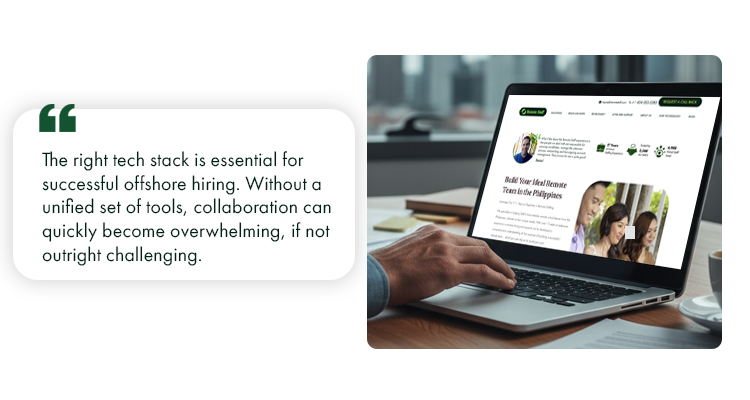
The right tech stack is essential for successful offshore hiring. Without a unified set of tools, collaboration can quickly become overwhelming, if not outright challenging.
Here are some offshoring technology requirements:
- Communication and Project Tools
-
- Synchronous
-
-
- Slack
- Microsoft Teams
- Zoom
- Google Meet
- Asynchronous
- Jira
- Asana
- Trello
- Notion
-
- File Access
-
- Cloud Storage
-
-
-
- Google Drive
- Dropbox
- Sharepoint
-
-
-
- Brand Assets
-
-
- Canva
- Adobe Creative Cloud
-
-
- Security
-
-
- Password Manager
-
-
-
-
- LastPass
- 1Password (Shared Folders)
-
-
-
-
- 2FA Setup
-
-
-
-
- Authy
- Google Authenticator
-
-
- Role-Specific
-
- CRM Access
-
-
-
- HubSpot
- Salesforce
-
-
-
- Social Media
-
-
- Meta Business Suite
- Hootsuite
-
#5. Cultural Readiness
Bridging the gap between the typically “flat” management style in the West and the more indirect communication styles found in other regions requires deliberate effort.
For example, in many Asian cultures – where many offshore staff are based – there is an invisible hierarchy in place. This means employees may hesitate to point out a manager’s mistake or deliver bad news out of fear of retaliation or punishment.
Moreover, U.S. employers are often known for being straightforward; however, this directness can be perceived as harsh or aggressive in other cultures. Conversely, a remote worker’s indirect feedback may be misinterpreted as vagueness or incompetence.
How To Score Your Offshore Readiness
Based on the above, here’s an offshore operations checklist:
- Do you have a specific, documented reason for hiring rather than just “needing help”?
- Have you written down at least three KPIs for offshore teams?
- Is the leadership team aligned on the budget and the long-term goal of this hire?
- Are the tasks this person will perform documented in a step-by-step SOP (video or text)?
- Have you designated a specific manager who has at least 3–5 hours a week to dedicate to this person?
- Do you have a “Daily Huddle” or “Weekly 1-on-1” schedule already blocked out in your calendar?
- Do you use a Project Management tool to assign and track tasks?
- Do you use a Password Manager to share credentials securely?
- Does your team use a centralized chat tool rather than relying solely on email?
- Have you defined your “Communication Style” (e.g., how you prefer to give and receive feedback)?
0-3: Not Ready (The Danger Zone)
If you score 0-3 out of 10, hiring now would be a mistake.
At this stage, you will spend more time answering basic questions than the offshore staff spends working.
Thus, focus first on documenting your top three most repetitive tasks into simple SOPs and then choose a project management tool to standardize your processes.
4-6: High Risk (The “Fix-As-You-Go” Zone)
This range means you have the basic intent and few tools in place but your structure is still fairly disorganized.
If you hire a remote worker under these conditions, they may perform well on some days and poorly on others because expectations are not standardized. In other words, inconsistency is inevitable since no one has documented the actual rules of the game.
Therefore, it’s best to identify a designated manager immediately. Ensure they have at least five hours per week dedicated specifically to mentoring and oversight before the new hire starts.
7-10: Ready to Scale (The Green Zone)
At this point, you already know:
- Why you’re hiring;
- What your outsourced staff will do;
- How you’ll measure their output; and
- Which buttons they need to click.
You won’t have to worry about onboarding since the “how-to” is already documented. As a result, your new hire can become productive within days rather than months.
This allows you to focus on finding the best talent, rather than worrying about whether they will “figure it out” themselves.
What Happens When You Hire Offshore Too Early
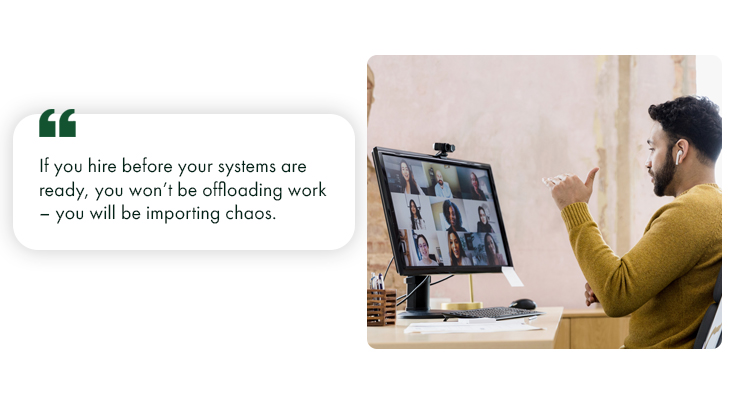
If you hire before your systems are ready, you won’t be offloading work – you will be importing chaos.
High-quality offshore professionals want to succeed and are eager to dive into work from day one. However, if they’re dropped into a vacuum without clear instructions, SOPs, or feedback, they won’t hesitate to leave.
This often leads to a cycle of hiring that never gains momentum or achieves retention.
As a business owner, time is your most valuable asset.
A failed offshore attempt can consume three to six months, representing wasted time. Instead of scaling, you’ll be stuck troubleshooting basic tasks. Simply put, without proper systems in place, offshoring becomes a burden rather than a benefit.
How High-Performing Offshore Teams Are Built
Successful companies don’t just hire people.
Like other great organizations, they first ensure that their systems and processes are designed to support skilled professionals.
In other words, their high-performing teams succeed because a strong operational system is already in place.
Systems First, Hiring Second
If you can’t explain a task to a local employee in five minutes, don’t expect a remote worker in a different time zone to master it via email.
This is where written SOPs for offshore roles become essential.
Before posting a job ad, ensure that the workflow you’re hiring for is thoroughly documented, covering the what, how, and where (including which tools to use).
Ownership Beyond Day One
High-performing teams have clear lines of ownership. They typically have a dedicated manager responsible for the new hire’s integration.
The goal is to ensure that the new hire understands the company culture, the tech stack, and the specific nuances of their tasks.
FAQs – Offshore Readiness
Here are some frequently asked questions about offshore hiring and the right time to do it.
#1. How Many Employees Should We Have Before Hiring Offshore?
There’s no magic number of employees required before offshoring. What matters most is your managerial capacity.
You’re ready when you have at least one person – whether the founder or a dedicated manager – who has both the ability and willingness to document processes and lead a remote team.
#2. Do We Need SOPs Before Hiring?
Absolutely! Offshore hiring without standard operating procedures is the single most costly mistake you can make when offshoring.
Without a documented process, your remote worker will be forced to second-guess your preferences, quality standards, and workflows. This inevitably leads to frustration for both parties.
#3. Can Startups Hire Offshore?
Yes. For a startup, offshoring isn’t just about saving money—it’s also about accessing a broader talent pool beyond your local area.
However, the “startup trap” is real.
Startups often move quickly and pivot frequently, which means they may lack the documentation an offshore hire needs to succeed. That’s why it’s important to look for “builders” or experienced offshore professionals who can help create SOPs while they work.
Final Thoughts – Offshore Hiring Is a System, Not a Shortcut

More often than not, offshoring is sold as a magic pill for business growth. The reality, however, is far more pragmatic.
Finding a rockstar offshore talent is directly tied to the systems you build before even conducting the first interviews.
While documentation and system-building may feel like they slow you down, don’t stop. This preparation can make or break your offshoring efforts.
By treating this stage as an investment, you can maximize the performance of your offshore teams. More importantly, it improves your chances of winning the talent war in an increasingly competitive hiring market.
For more information on how to offshore skilled talents effectively and efficiently, request a call back now.

Syrine studies law while working as a content writer. Outside of writing and studying, she tutors, plans events, and browses social media. In 2021, she published Stellar Thoughts.