

Relying on distributed teams has become an integral part of many business strategies. For many companies, this shift has improved operational systems while growing their bottom line
However, offshoring is not as easy or straightforward as it may seem.
While there are thousands of remote workers willing and able to work, identifying and selecting the right candidates can be challenging. Even after finding and hiring suitable talent, there is no guarantee they will stay with your company.
So, how do you move forward?
The Reality of Offshore Hiring: High Turnover in the First 3 Months
According to data, between 30% and 60% of offshore hires fail to last beyond their initial probation period. But this is often not due to a lack of technical ability.
Rather, the early turnover is mostly caused by:
- Misalignment;
- Onboarding gaps; and
- Lack of structure.
In other words, offshore talent requires clear processes. Otherwise, you will be spending weeks interviewing and months paying agency fees for sourcing that offers zero ROI.

Reasons Offshore Hires Don’t Make It Past 90 Days
The first 90 days are a trial by fire.
This is when a new employee learns the company culture, figures out their responsibilities, and determines whether the company aligns with their professional goals.
Many don’t last past this period due to the following reasons.
#1. Vague Job Descriptions and Role Expectations
Problems arise when organizations simply copy and paste job descriptions originally designed for local, onshore teams, assuming they will be sufficient for offshore roles.
This highlights the need for a different set of key performance indicators tailored specifically for offshore hires. This allows them to demonstrate their value while ensuring they receive the same opportunities as their office-based counterparts.
Otherwise, they eventually stop playing – because they don’t know what winning looks like.
#2. No Structured Onboarding Plan
The quickest way to alienate a new hire is to make them feel like an outsider rather than a teammate. Far too often, offshore talent is “onboarded” by simply being given login credentials.
A structured onboarding experience, for example, invests in:
- Welcome kits;
- Granular training checklists; and
- Phased milestones.
#3. Lack of Cultural Sensitivity and Fit
While technical skills – such as coding, digital marketing, programming, and the like – are learned and largely universal, communication is deeply cultural.
For instance, offshore workers may hesitate to “speak up” or challenge a manager’s mistake because doing so may be culturally perceived as disrespectful.
Hence, it is important to hire offshore workers who are familiar with cultural differences – or, even better, have prior experience working with diverse cultural teams.
#4. Poor Manager Engagement
Managerial ghosting is another major culprit.
Without active and consistent engagement, offshore talents often feel invisible. This sense of isolation can lead to early churn, especially when their work goes unnoticed or unappreciated.
#5. Inconsistent Communication Tools and Schedules
Without clear rules on which platforms to use for specific tasks, information can easily become fragmented.
For example, an offshore hire in a different time zone may miss a critical update buried in a long Slack thread while they were sleeping.
Eventually, when an offshore employee feels they are constantly “chasing” the onshore team’s schedule, they may begin to feel like a second-class citizen. This highlights the importance of standardizing tools and schedules, regardless of employee location.
#6. Tech and Infrastructure Issues
Leaving hardware and connectivity entirely up to the hire is usually a losing gamble.
Even the most skilled engineer will struggle if they are working on a five-year-old laptop or dealing with unstable home internet.
#7. No Community or Belonging
Offshore workers, especially new hires, often operate in a vacuum, missing out on the informal “watercooler” moments that build connection.
Without a sense of belonging, they are far more likely to leave for a marginal pay increase elsewhere, as their relationship with the company is reduced to a purely transactional paycheck.
What To Do Before Hiring Offshore To Set Them Up For Success
Here’s a pre-hiring checklist for reference:
- Write Location-Specific Job Descriptions
- Define the time zone;
- “Must be available from 9 AM to 1 PM Eastern Standard Time for syncs.”
- Be clear about the specific tasks required and contextualize them;
- “Coordinate with the NY-based creative team to execute weekly LinkedIn strategies.”
- Define the time zone;
- Prepare Onboarding Playbooks
- Ensure you have a centralized knowledge base using tools like Notion, Guru, or Trainual;
- Include a “How We Work” Guide, including Slack etiquette, naming conventions for files, and how to request time off.
- Record Loom videos of common tasks so the hire can learn asynchronously without waiting for a meeting.
- Assign Onboarding Buddies or Mentors
- Assign a “buddy” for cultural or social questions.
- Partner the new hire with a senior lead, especially for technical guidance.
- Ensure the new hire has a safe space to ask questions.
- Establish Cultural Training for Both Sides
- Educate your onshore staff about the new hire’s background and communication style.
- Conversely, provide new hires with a brief “business culture” guide to help them better understand your work culture.
- Pre-Check Internet Speed and Tool Access
- Require candidates to send a screenshot of a speed test and a photo of their backup power/internet solution during the final interview stage.
- Create a “Day 1 Access Checklist” that includes essentials such as VPN, Slack, and email access. This allows new hires to stay productive while waiting for other IT approvals.
Your First 90-Day Success Plan for Offshore Staff
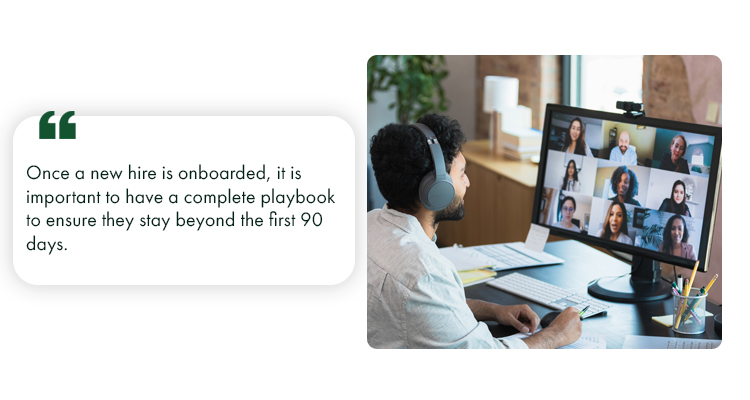
Once a new hire is onboarded, it is important to have a complete playbook to ensure they stay beyond the first 90 days.
Here’s a quick guide to help you:
Phase 1: Welcome & Setup (Day 1-30)
The first month focuses on integration.
At this stage, the goal is to help the new hire feel like a genuine team member, working alongside their onshore counterparts.
- Week 1-2: Introduction and Integration
-
- Hosting a formal team introduction via Zoom or Google Meet.
- Ensure all logins are active within the first four hours.
- Ask the hire to review the library of Standard Operating Procedures (SOPs).
- Week 3-4: Assigning Tasks and Celebrating Achievements
-
- Assign a low-stakes task that can be completed within the first week.
- Celebrate small wins with timely feedback and appreciation.
The goal during the first 30 days is to establish connections and to ease them into the workflow.
Phase 2: Alignment and Collaboration (Day 31-60)
The second month marks the transition from learning to doing.
At this stage, the goal is to help the hire integrate fully into the team’s daily rhythm.
- Week 1-2: Mentorship
-
- Rather than simply assigning tasks, pair the hire with a senior team member on a complex project.
- Encourage other peers, especially experienced offshore hires, to share tips on workflow efficiency and the team’s “unwritten” rules.
- Week 3-4: Ownership
-
- Give the hire a chance to own a mini project.
- Assign a new task that allows them to take responsibility for a specific outcome, fostering a sense of ownership and accountability.
Phase 3: Review and Retention (Day 61-90)
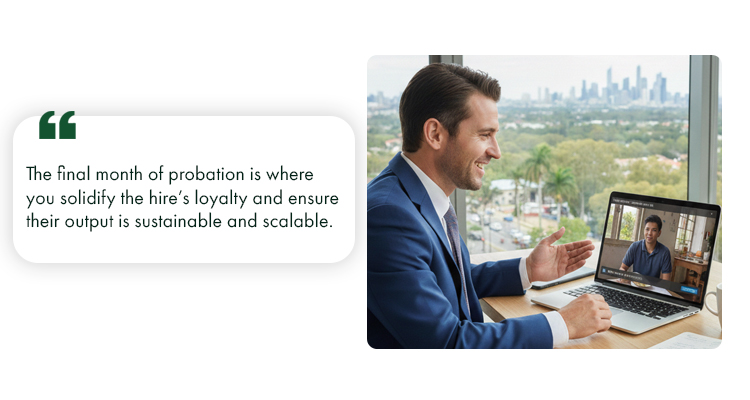
The final month of probation is where you solidify the hire’s loyalty and ensure their output is sustainable and scalable.
Here’s how.
- Week 1: Comprehensive 90-Day Review
-
- Conduct a formal performance evaluation.
- Focus on both technical and cultural integration.
- Ask the hire to self-evaluate their progress first.
- Week 2-3: Confirmation of Cultural Alignment
-
- Check if their communication style fits the team.
- Review if they are comfortable with the tech and tools.
- Ask if there are cultural friction points, like hesitation to speak up in meetings.
- Week 4: Plan Long-Term Growth
-
- Discuss a 6-month or 1-year roadmap.
- Show the offshore hire that there’s a path for promotion or specialized training.
By Day 90, the new hire should no longer feel like just an offshore employee but as a full-fledged team member, making meaningful contributions to the company’s overall success.
Offshore Retention Tips
Thanks to remote work and the internet, it’s now common for multinational companies to have distributed teams – and they are able to make them work effectively.
Here are some tips.
- Onboarding Buddy System – Many businesses and multinational organizations assign a buddy for every new offshore hire. This buddy is often a peer who helps the new hire navigate the unwritten rules of the company.
For example, Google calls new employees “Nooglers,” a term combining “new” and “Google.” Beyond a welcome kit, orientation, and a quirky propeller beanie, Nooglers are paired with an onboarding buddy to help them learn the culture and build connections. - Open “Ask-Me-Anything” Sessions with Execs – On the other hand, multinational tech companies like Microsoft hold regular AMA (Ask Me Anything) sessions with senior leaders.
These sessions allow employees to ask top officials questions directly, reflecting the company’s belief that leadership visibility is a powerful retention tool. This transparency also helps remote hires feel like valued insiders with insight into the company’s vision and long-term strategy.
FAQs – Offshore Hiring and Retention
Here are some of the frequently asked questions about hiring and retaining offshore employees beyond 90 days.

#1. What’s a Good 90-Day Retention Benchmark for Offshore Hires?
A healthy 90-day retention benchmark is 85% or higher, yet the industry average typically falls between 30% and 60%.
If turnover exceeds 20% within the first three months, it often indicates a systematic issue with your selection process or onboarding structure.
#2. How Can I Build Loyalty With Remote Hires?
Show them a future.
Loyalty isn’t earned with a paycheck alone. Rather, it’s built through integration and support.
Invest in their growth by offering career development opportunities, such as certifications or promotions. This demonstrates that you value them as people, not just for their output.
#3. Should Offshore Staff Follow US Time Zones?
It depends on the role. Many offshore hires, Filipinos, for example, are willing to work night shifts to align with their US employers’ time zone.
For high-collaboration roles, such as project managers and designers, a 4-hour overlap is ideal. For execution-heavy roles like developers, a 2-hour overlap is sufficient for daily stand-ups and addressing blockers.
#4. How Do I Know If Someone’s Struggling in Their Role?
Early signs of struggling offshore hires are often quiet rather than obvious.
For example, a previously responsible hire who starts giving one-word answers, delays responses on Slack, or goes “dark” during their shift may be feeling overwhelmed or disengaged.
In some cases, a hire who stops asking clarifying questions and says “yes” to every deadline, even while missing them, may be struggling with the tasks but afraid to admit it.
#5. Can I Turn Early Failures Into Learning Systems?
Absolutely! A failed 90-day hire doesn’t necessarily reflect a poor candidate. Rather, it often serves as a stress test that reveals weaknesses in the company’s internal systems.
You can turn this into a learning system by conducting a recruitment post-mortem:
- Audit the job description;
- Analyze the friction point; and
- Update the onboarding playbook.
By documenting and analyzing why a hire didn’t work out, you can prevent making the same $$$ mistake twice.

Final Thoughts – Offshore Hiring Success Starts Before Day One
There’s no one-size-fits-all approach to hiring, and even the best processes can result in a bad hire. That’s why, when you find a candidate who perfectly fits your company’s needs, it’s crucial to hold on to them.
Make them feel like a true team member. Allow them to contribute, take ownership of their work, and see a future for growth within your organization.
In other words, give them the right tools, boost their trust and morale, and provide a clear career path. This way, they feel like stakeholders, not just contractors.
After all, when you invest in your people – regardless of their time zone or location – they invest in you in return.
Ready to build your offshore team? Call us today or request a call back now.

Syrine studies law while working as a content writer. Outside of writing and studying, she tutors, plans events, and browses social media. In 2021, she published Stellar Thoughts.